Demand elasticity and revenue decisions
Introduzido| English | Significado |
|---|---|
| price elasticity of demand/praɪs ɪlæˈstɪsɪti ɒv dɪˈmænd/ | elasticidade-preço da demanda |
| total revenue/ˈtəʊtl ˈrevənjuː/ | receita total |
Free museums, 2001
- In December 2001 Britain's national museums, such as the Science Museum and the Natural History Museum, stopped charging for entry. In the first year, visits to the museums that had charged rose by about 70%. Many visitors had been sensitive to the price.
- Price elasticity of demand tells a seller what a price change will do to revenue.
PED again
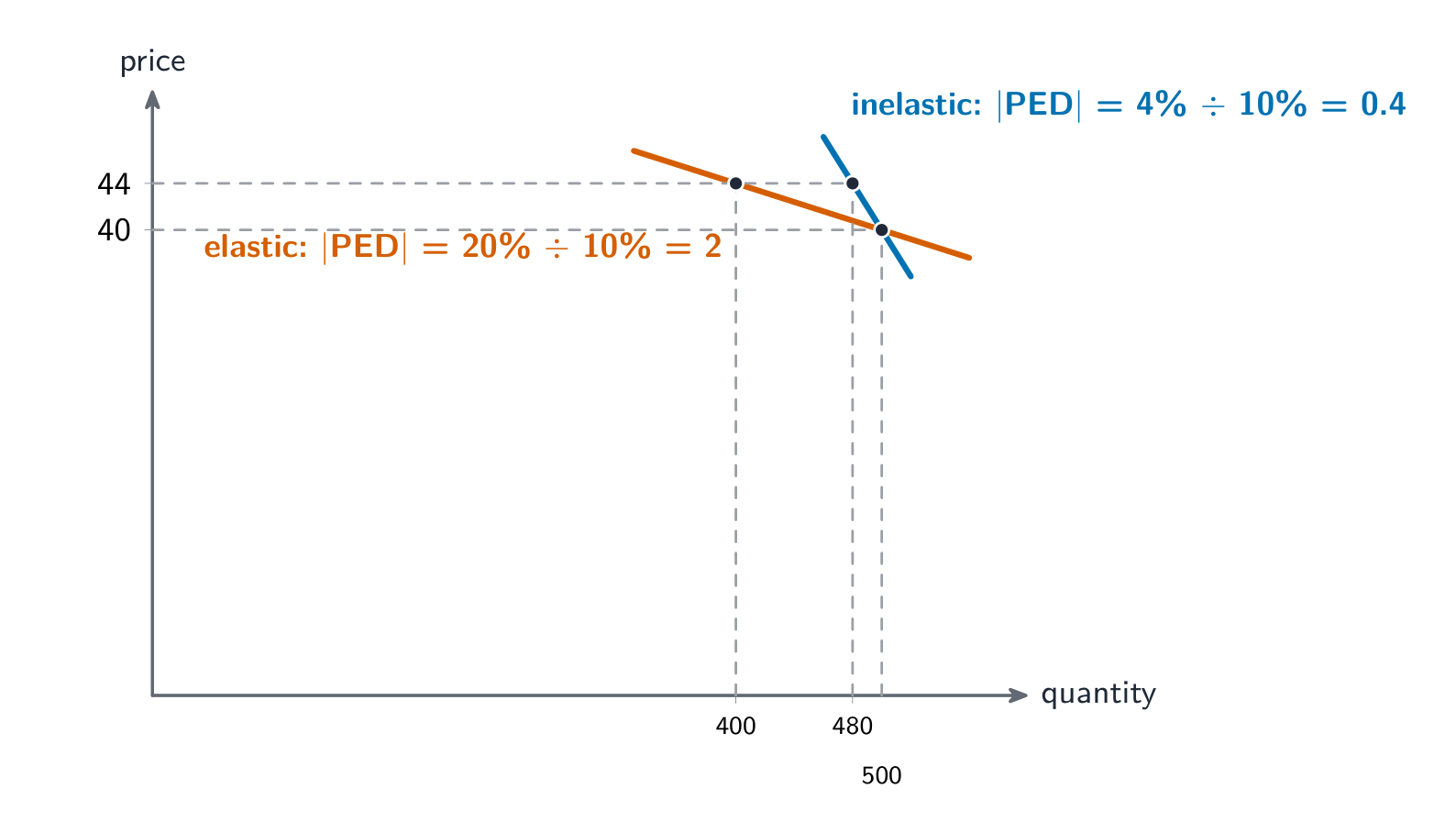
- Price elasticity of demand 需求价格弹性 $= \dfrac{\% \text{ change in quantity demanded}}{\% \text{ change in price}}$.
- Elastic (above 1): buyers react strongly. Inelastic (below 1): buyers react weakly.
Total revenue
- Total revenue 总收入 $=$ price $\times$ quantity sold.
- A price rise gives more per sale but usually fewer sales. Which effect is bigger depends on PED.
A cinema sells 300 tickets at 40 yuan. What is its total revenue?
Dificuldade 2/5 · Moedas 140 + pequeno bônus na primeira conclusão hoje
300 × 40.
Worked example: a museum ticket
A museum charges 10 yuan and has 100 visitors an hour. At 11 yuan it would have 80.
- PED: $\dfrac{-20\%}{+10\%} = -2$, elastic.
- Revenue: $10 \times 100 = 1000$ now; $11 \times 80 = 880$ after.
- Decision: raising the price would lose 120 yuan an hour. To raise revenue, the museum should not raise this price.
Price changes and revenue rectangles
Compare price times quantity before and after a change. State the percentage base when calculating finite-change PED.
The inelastic case
- If 10 → 11 yuan cut visitors only from 100 to 95 (PED $-0.5$), revenue would rise to $11 \times 95 = 1045$.
- Inelastic demand: raise the price to raise revenue.
The cinema raises its price to 50 yuan and sells 270 tickets. What is the new total revenue?
Dificuldade 2/5 · Moedas 140 + pequeno bônus na primeira conclusão hoje
50 × 270.
Find the PED for that change (40 → 50 yuan, 300 → 270 tickets).
Dificuldade 2/5 · Moedas 140 + pequeno bônus na primeira conclusão hoje
−10% ÷ +25%.
Using PED in decisions
- Firms raise prices on inelastic goods and cut them on elastic goods to increase revenue.
- Governments tax goods with inelastic demand (petrol, tobacco) because sales fall little, so tax revenue is reliable.
Demand for a train route has PED −1.8. To raise revenue, the operator should
Dificuldade 1/5 · Moedas 100 + pequeno bônus na primeira conclusão hoje
Elastic demand.
Why do governments often tax petrol?
Dificuldade 1/5 · Moedas 100 + pequeno bônus na primeira conclusão hoje
Inelastic demand.
A price rise does not always increase revenue. With elastic demand, the lost sales outweigh the higher price: 1000 falls to 880 yuan. Check PED before deciding.
Raising price always raises total revenue.
Dificuldade 1/5 · Moedas 100 + pequeno bônus na primeira conclusão hoje
Not when demand is elastic.
Total revenue = price × quantity. Elastic demand: price and revenue move in opposite directions. Inelastic demand: they move together. Firms and governments use PED to set prices and choose taxes.
When UK national museums became free in 2001, visits rose about 70%. What does this suggest about PED for museum visits, and why might the government accept losing ticket revenue?
PED and policy.