When economic agents choose other aims
Introduzido| English | Significado |
|---|---|
| profit maximization/ˈprɒfɪt ˌmæksɪmaɪˈzeɪʃn/ | maximização do lucro |
| revenue maximization/ˈrevənjuː ˌmæksɪmaɪˈzeɪʃn/ | maximização da receita |
Nine years without a profit
- Amazon was founded in 1994 but did not make a yearly profit until 2003. Its owners chose to grow sales and market share first, even at a loss. Not every firm tries to make the most profit right now.
- Different economic agents — consumers, firms, workers and governments — have different aims.
The usual aims
- Consumers aim to get the most satisfaction from their income. Workers aim for good pay and conditions.
- Firms are usually assumed to aim for profit maximization 利润最大化: the largest gap between revenue and cost.
Match each agent to its usual aim.
Dificuldade 2/5 · Moedas 140 + pequeno bônus na primeira conclusão hoje
Typical assumptions.
Other aims for firms
- Revenue maximization 收入最大化: the largest sales income, perhaps to win market share.
- Growth, survival, or social and environmental goals. In 2022 the founder of the clothing firm Patagonia gave the company to a trust so that its profits fund climate work.
Which are possible aims of a firm other than maximum profit?
Dificuldade 2/5 · Moedas 140 + pequeno bônus na primeira conclusão hoje
Higher costs are not an aim.
Worked example: two prices, two aims
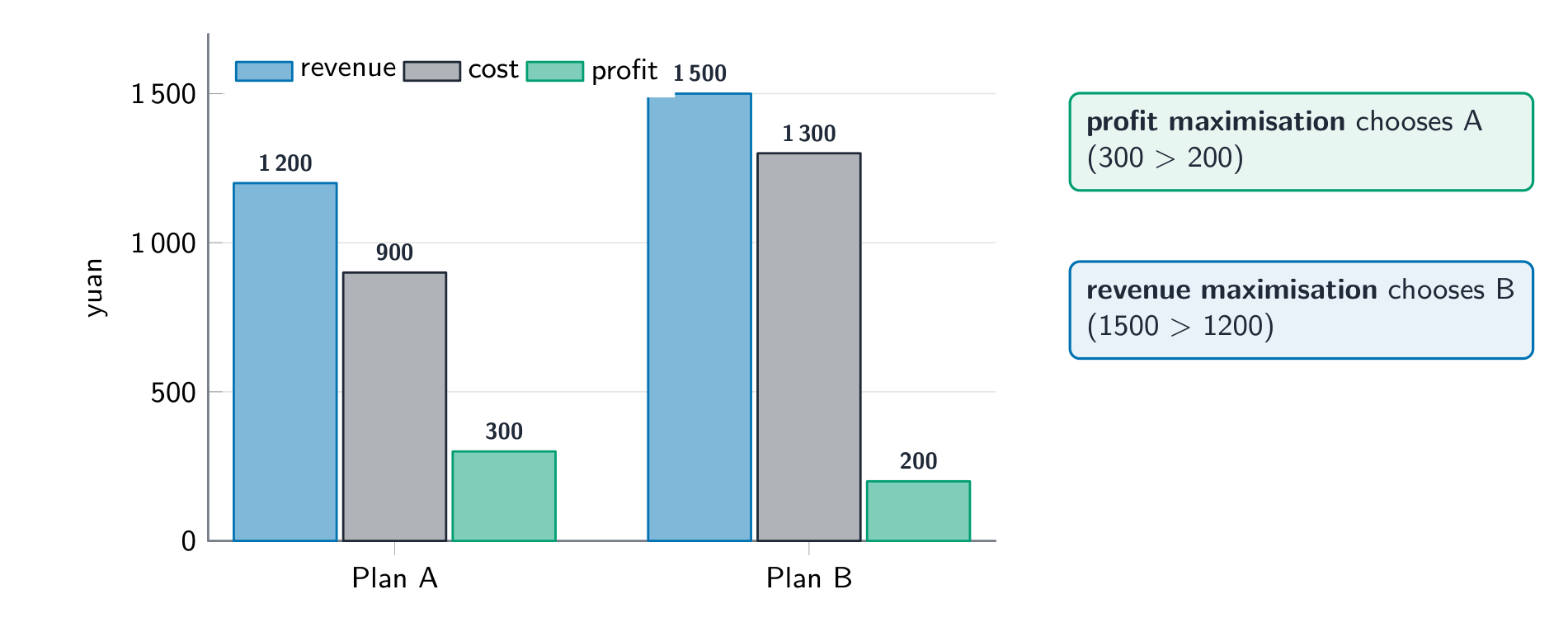
A firm can charge 10 yuan and sell 100 units (cost 700 yuan), or 8 yuan and sell 150 units (cost 1000 yuan).
- At 10 yuan: revenue $10 \times 100 = 1000$, profit $1000 - 700 = 300$.
- At 8 yuan: revenue $8 \times 150 = 1200$, profit $1200 - 1000 = 200$.
- Choice: a profit maximizer picks 10 yuan; a revenue maximizer picks 8 yuan. Same firm, different aim, different price.
A firm sells 200 units at 6 yuan with costs of 900 yuan. What is its profit in yuan?
Dificuldade 2/5 · Moedas 140 + pequeno bônus na primeira conclusão hoje
1200 − 900.
Option A: revenue 2000, cost 1500. Option B: revenue 2400, cost 2100. Which does a profit maximizer choose?
Dificuldade 1/5 · Moedas 100 + pequeno bônus na primeira conclusão hoje
Compare profits.
Government aims
- Governments aim for the welfare of the whole population: jobs, stable prices, growth and fairness.
- A state-owned railway may keep an unprofitable rural line open because people need it.
A state-owned railway may keep an unprofitable line open because of its aims.
Dificuldade 1/5 · Moedas 100 + pequeno bônus na primeira conclusão hoje
Welfare, not profit.
Consumers are not always "rational"
- People may buy a familiar brand even when a cheaper one tastes the same, or give money to charity.
- Habit, information and values affect choices as well as price.
More revenue does not mean more profit. At 8 yuan the firm takes 1200 yuan instead of 1000, but its profit falls from 300 to 200 because costs rise faster. Always subtract costs.
A firm that raises its revenue always raises its profit.
Dificuldade 1/5 · Moedas 100 + pequeno bônus na primeira conclusão hoje
Costs may rise more.
Economic agents have different aims. Firms often seek maximum profit but may choose revenue, growth, survival or social goals. The aim decides the price and output a firm chooses.
Why might a new online firm choose low prices and losses for several years? Use one example.
Firm objectives.