Markets and elasticity
Introduzido| English | Significado |
|---|---|
| elasticity/ɪlæˈstɪsɪti/ | elasticidade |
| equilibrium/ˌiːkwɪˈlɪbrɪəm/ | equilíbrio |
| price elasticity of demand/praɪs ɪlæˈstɪsɪti ɒv dɪˈmænd/ | The percentage change in quantity demanded divided by the percentage change in price. |
Netflix's 2011 price rise
- In July 2011 Netflix raised the price of its DVD-plus-streaming plan by about 60%. Over the next three months it lost around 800 000 subscribers in the US. Customers were more sensitive to price than the firm expected.
- Price elasticity measures how strongly buyers react to a price change.
Equilibrium first
- In a market, the price settles where the quantity demanded equals the quantity supplied: the equilibrium 均衡.
- A price change by a seller moves buyers along the demand curve.
At equilibrium, quantity demanded equals quantity supplied.
Dificuldade 1/5 · Moedas 100 + pequeno bônus na primeira conclusão hoje
The market clears.
Price elasticity of demand
- Elasticity 弹性 compares percentage changes: PED $= \dfrac{\% \text{ change in quantity demanded}}{\% \text{ change in price}}$.
- Above 1 (ignoring the minus sign) is elastic; below 1 is inelastic.
A good has PED of −0.3. What kind of demand is this?
Dificuldade 1/5 · Moedas 100 + pequeno bônus na primeira conclusão hoje
Less than 1, ignoring the sign.
Worked example: the café
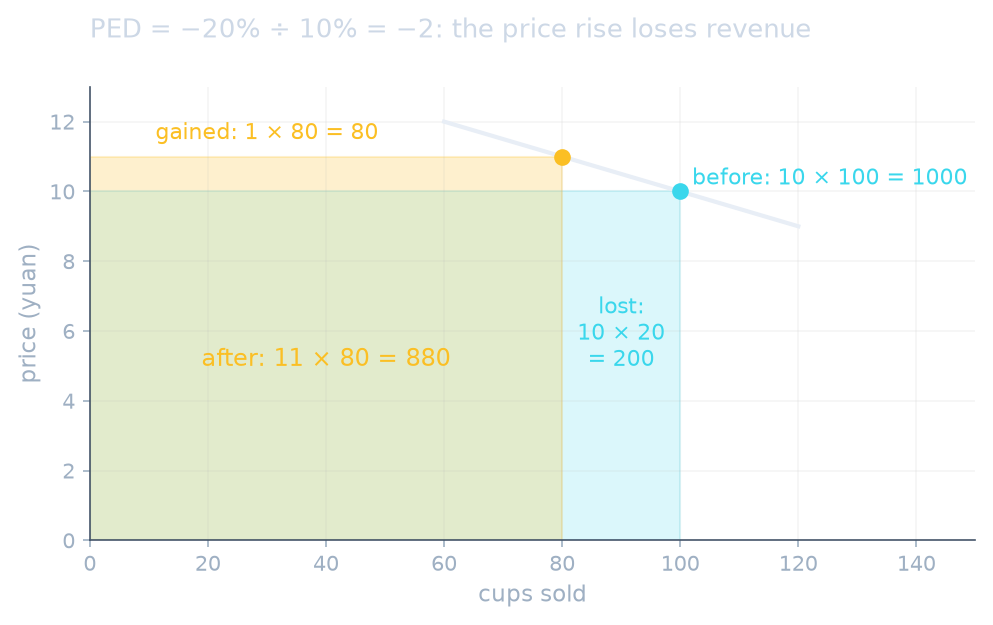
A café raises a drink's price from 10 to 11 yuan, and daily sales fall from 100 to 80 cups.
- % change in price: $\dfrac{1}{10} \times 100 = +10\%$. % change in quantity: $\dfrac{-20}{100} \times 100 = -20\%$.
- PED: $\dfrac{-20}{10} = -2$, elastic.
- Revenue: $10 \times 100 = 1000$ before, $11 \times 80 = 880$ after. The price rise lost the café 120 yuan a day.
Price changes and revenue rectangles
Compare price times quantity before and after a change. State the percentage base when calculating finite-change PED.
The price of a bus ticket rises from 2 to 2.20 yuan and journeys fall from 1000 to 950. Find the PED.
Dificuldade 2/5 · Moedas 140 + pequeno bônus na primeira conclusão hoje
−5% ÷ +10%.
What makes demand elastic?
- Many close substitutes (other cafés), a large share of income, and a long time to adjust.
- Necessities and habits — salt, petrol, cigarettes — have inelastic demand.
Which goods are likely to have inelastic demand?
Dificuldade 2/5 · Moedas 140 + pequeno bônus na primeira conclusão hoje
One brand of water has many substitutes.
Elasticity and revenue
- Elastic demand: a price rise lowers revenue; a price cut raises it.
- Inelastic demand: a price rise raises revenue. That is why governments tax petrol and tobacco.
Demand for a good is elastic. The firm cuts the price. What happens to total revenue?
Dificuldade 1/5 · Moedas 100 + pequeno bônus na primeira conclusão hoje
Quantity rises by a larger percentage.
Use percentages, not the raw changes. A 1-yuan rise and a 20-cup fall do not give PED 20. Divide by the starting values first: $-20\%$ over $+10\%$ gives $-2$.
A price rise of 1 yuan and a quantity fall of 20 units give a PED of −20.
Dificuldade 1/5 · Moedas 100 + pequeno bônus na primeira conclusão hoje
Use percentage changes.
PED = % change in quantity demanded ÷ % change in price. Elastic demand (above 1) means revenue moves the opposite way to price; inelastic demand (below 1) means it moves the same way. Substitutes, income share and time decide elasticity.
Use the idea of price elasticity to explain why Netflix lost subscribers after its 2011 price rise, and what happened to its revenue from those customers.
PED in context.