Combined isometries and invariants · Higher
Introduzido| English | Significado |
|---|---|
| invariant/ɪnˈveərɪənt/ | invariant: invariante |
Seventeen wallpaper patterns
- In 1891 the Russian crystallographer Evgraf Fedorov proved that every repeating wallpaper pattern uses one of just 17 combinations of reflections, rotations, translations and glide reflections. Craftsmen at the Alhambra in Spain had found many of them centuries earlier.
- Higher questions combine two transformations and look for what stays the same.
Doing one after another
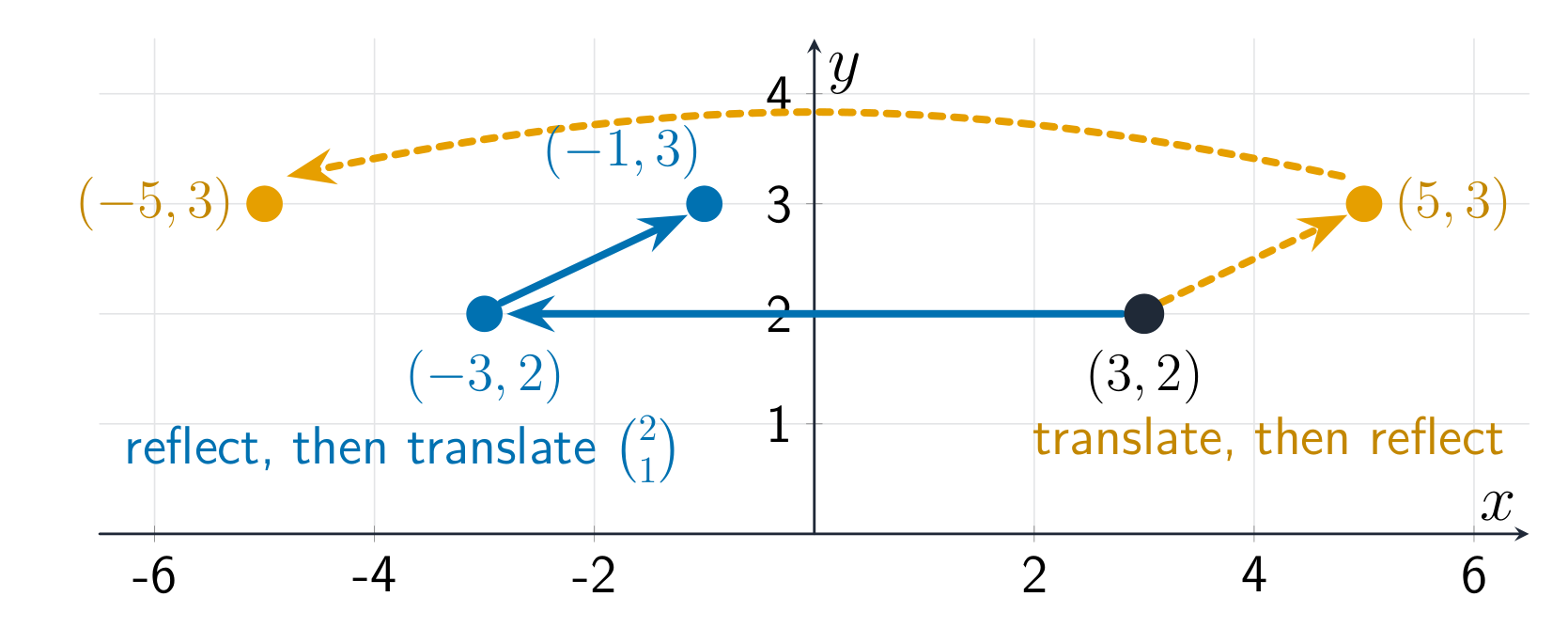
- Reflect $P(3, 2)$ in the $y$-axis: $(-3, 2)$. Then translate by $\begin{pmatrix} 2 \\ 1 \end{pmatrix}$: $(-1, 3)$.
- The second transformation acts on the image of the first.
Rotate $(4, 1)$ 90° anticlockwise about the origin, then translate by $\begin{pmatrix} 3 \\ 0 \end{pmatrix}$. Where does it end?
Dificuldade 1/5 · Moedas 100 + pequeno bônus na primeira conclusão hoje
$(4, 1) \to (-1, 4) \to (2, 4)$.
Order matters
- Translate first: $(3, 2) \to (5, 3)$; then reflect: $(-5, 3)$.
- $(-1, 3) \ne (-5, 3)$: changing the order changes the result.
Worked example: two reflections
Reflect $(3, 2)$ in $x = 0$, then in $x = 2$. What single transformation is this?
- First: $(3, 2) \to (-3, 2)$.
- Second: $-3$ is 5 left of $x = 2$, so it goes 5 right: $(7, 2)$.
- Single: a translation by $\begin{pmatrix} 4 \\ 0 \end{pmatrix}$ — twice the gap between the parallel mirror lines. Check $(0, 0) \to (0, 0) \to (4, 0)$ ✓.
Combined isometries and invariants
Apply each transformation to the current image in the stated order
Classify the worked-case statements, then explain the units or invariant that justifies each decision.
Reflect in $x = 1$, then in $x = 4$. What single transformation is this?
Dificuldade 1/5 · Moedas 100 + pequeno bônus na primeira conclusão hoje
Twice the 3-unit gap.
Crossing mirrors
- Reflect in the $x$-axis then the $y$-axis: $(3, 2) \to (3, -2) \to (-3, -2)$.
- That is a rotation of 180° about the origin. Two reflections in lines crossing at angle $\alpha$ give a rotation of $2\alpha$.
Reflect in the line $y = x$, then in the $y$-axis. The lines cross at 45°. What is the single transformation?
Dificuldade 1/5 · Moedas 100 + pequeno bônus na primeira conclusão hoje
Twice 45°.
Invariants
- An invariant 不变量 is something a transformation does not change. Isometries keep lengths and angles.
- A reflection reverses orientation (clockwise labels become anticlockwise); two reflections restore it.
Which are invariant under a rotation?
Dificuldade 2/5 · Moedas 140 + pequeno bônus na primeira conclusão hoje
Rotations are isometries; only the centre stays put.
Two reflections in a row keep the orientation of a shape.
Dificuldade 1/5 · Moedas 100 + pequeno bônus na primeira conclusão hoje
Reversed twice.
Do not assume the order can be swapped. Reflect-then-translate gave $(-1, 3)$ and translate-then-reflect gave $(-5, 3)$. Apply the transformations in the order given.
Reflect-then-translate always gives the same result as translate-then-reflect.
Dificuldade 1/5 · Moedas 100 + pequeno bônus na primeira conclusão hoje
(−1, 3) versus (−5, 3).
Apply combined transformations in order, each to the latest image. Test with two or three points to name one equivalent transformation. Two reflections give a translation (parallel mirrors) or a rotation (crossing mirrors); isometries keep lengths and angles invariant.
Triangle T has a corner at $(2, 1)$. T is reflected in the $x$-axis and then rotated 90° clockwise about the origin. Find the image of $(2, 1)$ and describe the single equivalent transformation.
Combined transformations.