Iterative processes with repeated deposits · Higher
Introduzido| English | Significado |
|---|---|
| recurrence relation/rɪˈkʌrəns rɪˈleɪʃn/ | relação de recorrência |
| fixed point/fɪkst pɔɪnt/ | A value that a repeated rule leaves unchanged, so the sequence settles there. |
Benjamin Franklin's 200-year gift
- When Benjamin Franklin died in 1790, he left 1000 pounds each to Boston and Philadelphia, to be lent out at interest for 200 years. Each year the fund grew and money was paid in and out. Boston's share was worth about 5 million dollars by 1990.
- When a balance gets interest and a fixed deposit each period, we use a recurrence relation 递推关系.
The rule
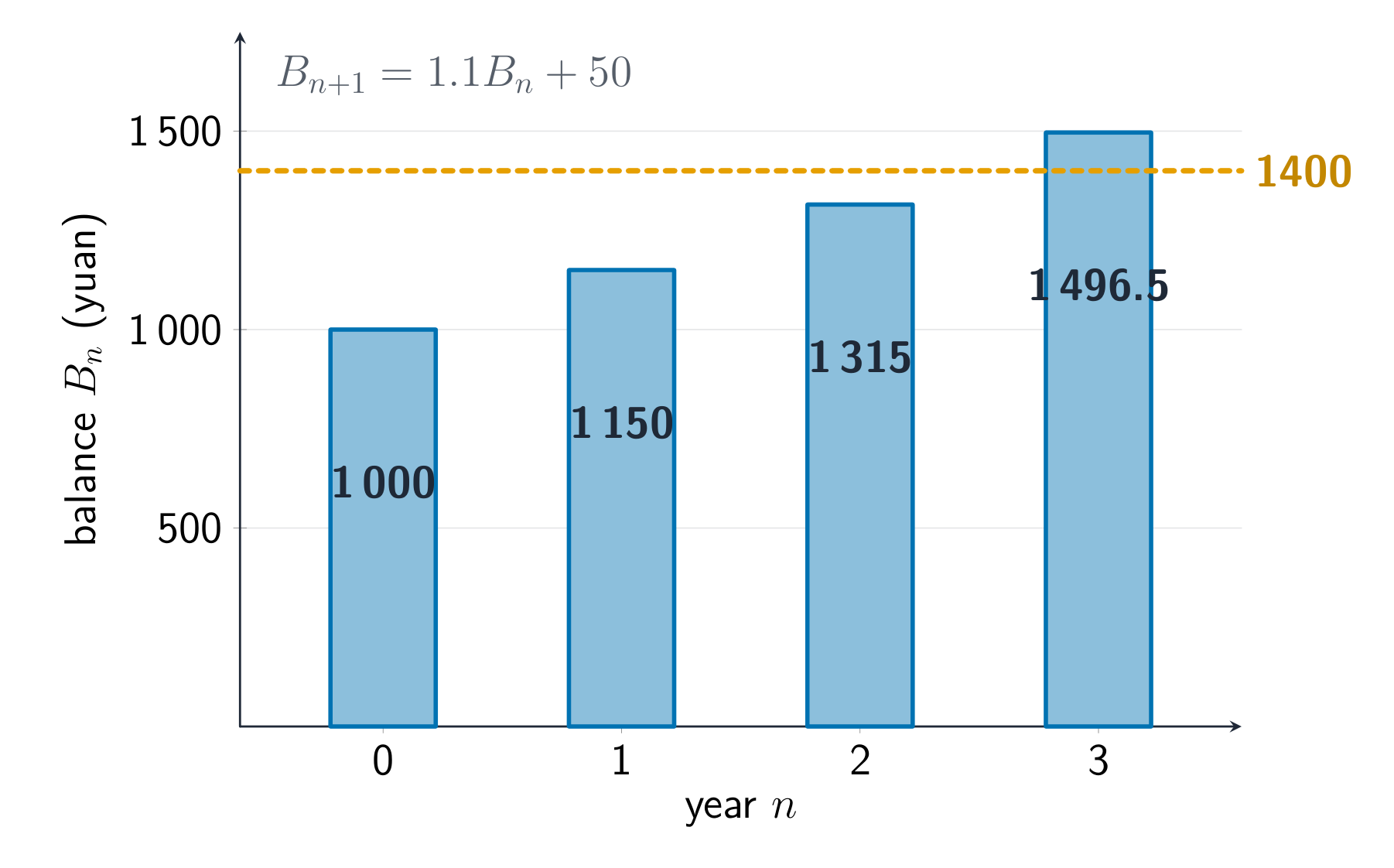
- $B_{n+1} = 1.1B_n + 50$: add 10% interest, then deposit 50 yuan.
- Start $B_0 = 1000$ and apply the rule again and again.
A savings account adds 3% interest each year, then the owner withdraws 200 yuan. Which rule fits?
Dificuldade 1/5 · Moedas 100 + pequeno bônus na primeira conclusão hoje
Interest first, then withdrawal.
The first steps
- $B_1 = 1.1 \times 1000 + 50 = 1150$.
- $B_2 = 1.1 \times 1150 + 50 = 1315$; $B_3 = 1.1 \times 1315 + 50 = 1496.5$.
$B_{n+1} = 1.05B_n + 100$ e $B_0 = 2000$. Find $B_2$.
Dificuldade 2/5 · Moedas 140 + pequeno bônus na primeira conclusão hoje
$B_1 = 2200$, $B_2 = 2310 + 100$.
Worked example: passing a target
Using $B_{n+1} = 1.1B_n + 50$ with $B_0 = 1000$, after how many years does the balance first exceed 1400 yuan?
- Values: $B_1 = 1150$, $B_2 = 1315$, $B_3 = 1496.5$.
- Decide: $1315 \le 1400 < 1496.5$.
- Answer: after 3 years.
Iterative processes with repeated deposits
Write an update rule and an initial value
Classify the worked-case statements, then explain the units or invariant that justifies each decision.
$B_{n+1} = 1.2B_n - 100$ e $B_0 = 1000$. After how many steps does $B$ first exceed 1500?
Dificuldade 2/5 · Moedas 140 + pequeno bônus na primeira conclusão hoje
1100, 1220, 1364, 1536.8.
Order matters
- Deposit first, then interest: $B_1 = 1.1 \times (1000 + 50) = 1155$, 5 yuan more.
- Read the question to see which happens first.
1000 yuan, deposit 50 yuan first, then add 10% interest. What is the balance after one year?
Dificuldade 2/5 · Moedas 140 + pequeno bônus na primeira conclusão hoje
$1.1 \times 1050$.
Decay with a top-up
- $V_{n+1} = 0.8V_n + 20$ from 200: $V_1 = 180$, $V_2 = 164$.
- A fixed point satisfies $V = 0.8V + 20$, so $0.2V = 20$ and $V = 100$. Values above 100 fall towards it.
Find the fixed point of $V_{n+1} = 0.6V_n + 30$.
Dificuldade 2/5 · Moedas 140 + pequeno bônus na primeira conclusão hoje
$0.4V = 30$.
Do not use $1000 \times 1.1^3$ when there are deposits. That ignores the 50 yuan added each year and gives 1331, not 1496.5. Apply the rule one step at a time.
With deposits, the balance after 3 years is $1000 \times 1.1^3$.
Dificuldade 1/5 · Moedas 100 + pequeno bônus na primeira conclusão hoje
The deposits add extra each year.
A recurrence relation gives the next value from the current one. Apply it step by step, keeping full values, and note whether interest or deposit comes first. A fixed point solves $x =$ rule$(x)$ and shows where values settle.
A pond has 500 fish. Each year 20% die and 60 new fish are added. Write a recurrence relation, find the numbers after 1 and 2 years, and find the long-term number.
Decay with a top-up.