Chemical purity: use melting and boiling evidence
Introduzido| English | Significado |
|---|---|
| chemical purity/ˈkemɪkl ˈpjʊərɪti/ | pureza química |
| melting point/ˈmeltɪŋ pɔɪnt/ | The temperature at which a solid and its liquid phase can coexist in equilibrium at a specified pressure. |
"Pure" orange juice?
- A carton of "pure orange juice" contains water, sugars, acids and vitamins. It is pure in the everyday sense: nothing added.
- In chemistry, chemical purity 化学纯度 means something stricter: a single element or compound, with nothing else mixed in.
A pure substance
- A pure substance contains only one element or one compound.
- Distilled water is pure; tap water and sea water are mixtures.
Which are pure substances in chemistry?
Dificuldade 2/5 · Moedas 140 + pequeno bônus na primeira conclusão hoje
Juice and sea water are mixtures.
Melting and boiling points
- A pure substance melts and boils at a fixed, sharp temperature. Pure water boils at 100 °C at normal pressure.
- An impure substance has a lower melting point 熔点 and melts over a range of temperatures.
How does an impurity affect the melting point?
Dificuldade 1/5 · Moedas 100 + pequeno bônus na primeira conclusão hoje
Impure solids melt lower, over a range.
Worked example: two samples of X
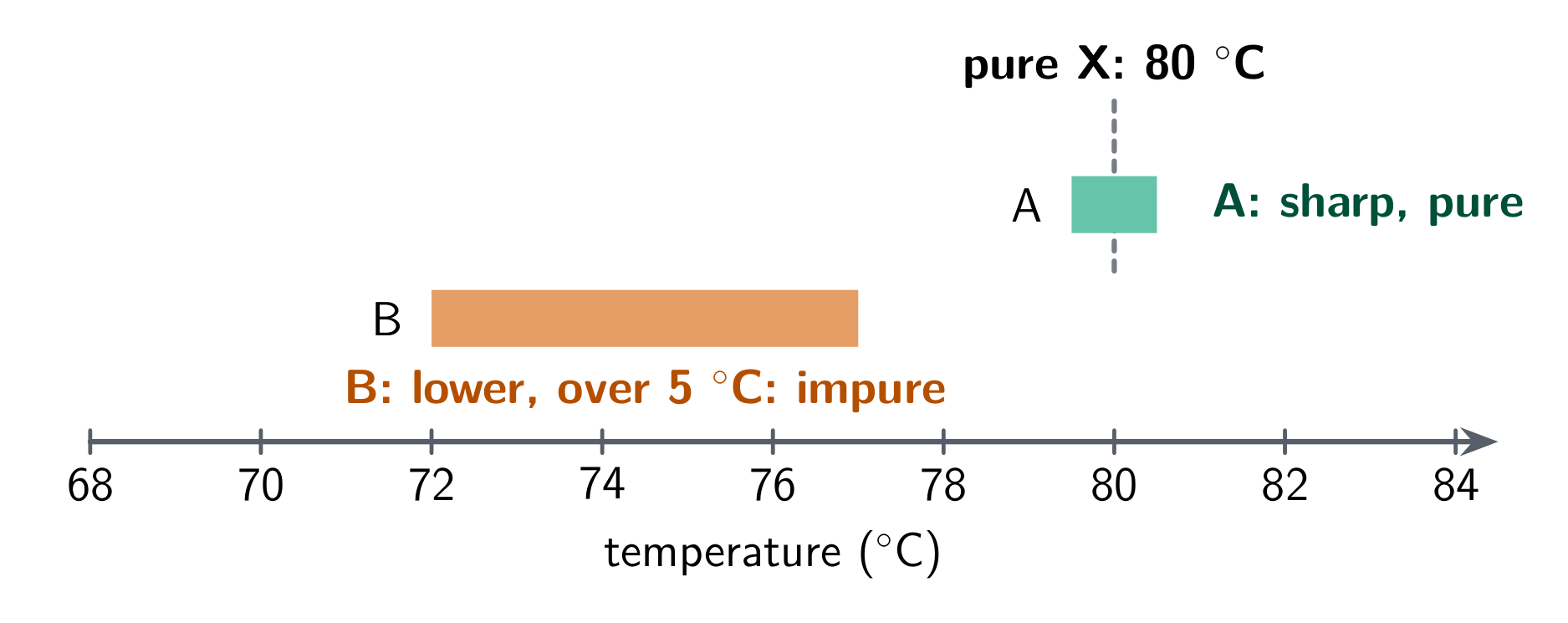
Pure X melts at 80 °C. Sample A melts from 79.5 to 80.5 °C. Sample B melts from 72 to 77 °C.
- Sample A: range $80.5 - 79.5 = 1.0$ °C, centred on 80 °C. Matches pure X.
- Sample B: range $77 - 72 = 5$ °C, and below 80 °C.
- Conclusion: B contains an impurity.
A pure substance melts sharply
Pure X melts at 80 °C. Sample A melts over 79.5–80.5 °C (1.0 °C wide) and matches; sample B melts over 72–77 °C, lower and 5 °C wide, which points to an impurity.
A sample melts from 118 °C to 121 °C. How wide is its melting range?
Dificuldade 2/5 · Moedas 140 + pequeno bônus na primeira conclusão hoje
$121 - 118 = 3$.
Pure aspirin melts at 136 °C. Which sample is purest?
Dificuldade 1/5 · Moedas 100 + pequeno bônus na primeira conclusão hoje
Sharp and at the right temperature.
Impurities in daily life
- Salt is spread on icy roads because salty water freezes below 0 °C.
- Salty water boils above 100 °C.
Why is salt spread on icy roads?
Dificuldade 1/5 · Moedas 100 + pequeno bônus na primeira conclusão hoje
Impurities lower the freezing point.
A mixture cannot be "pure" in chemistry, however natural it is. Natural honey, spring water and organic milk are all mixtures. Chemical purity is about one substance, not about being free of additives.
Spring water is chemically pure because nothing has been added.
Dificuldade 1/5 · Moedas 100 + pequeno bônus na primeira conclusão hoje
It contains dissolved minerals.
A chemically pure substance is a single element or compound. It melts and boils at sharp, fixed temperatures. Impurities lower the melting point, raise the boiling point and make melting happen over a range.
Explain how melting-point data can show whether a solid is pure.
Use the data.