Temperature and solid size: explain two different rate effects
Introduzido| English | Significado |
|---|---|
| successful collisions | Collisions with enough energy to make particles react. |
| surface-area-to-volume ratio/ˈsɜːfɪs ˈeərɪə tə ˈvɒljuːm ˈreɪʃɪəʊ/ | razão superfície-volume |
Why the fridge keeps milk fresh
- Milk goes sour in a day on a hot kitchen counter but lasts a week in the fridge. The souring reactions are slower when cold.
- Chopped potatoes cook faster than whole ones. Smaller pieces react faster.
- Temperature and surface area both speed reactions — but in different ways.
Why does milk stay fresh longer in a fridge?
Dificuldade 1/5 · Moedas 100 + pequeno bônus na primeira conclusão hoje
Lower temperature, fewer successful collisions.
Temperature: faster and harder
- Hotter particles move faster, so they collide more often.
- More important: a bigger fraction of collisions now have at least the activation energy. These are successful collisions 有效碰撞.
- A 10 °C rise often roughly doubles the rate.
Why does raising the temperature increase the rate?
Dificuldade 2/5 · Moedas 140 + pequeno bônus na primeira conclusão hoje
Heat changes speed and energy, not the barrier.
Surface area: more contact
- Only particles on the surface of a solid can collide with the solution or gas.
- Cutting a solid into smaller pieces increases its surface-area-to-volume ratio 表面积体积比, so more particles are exposed.
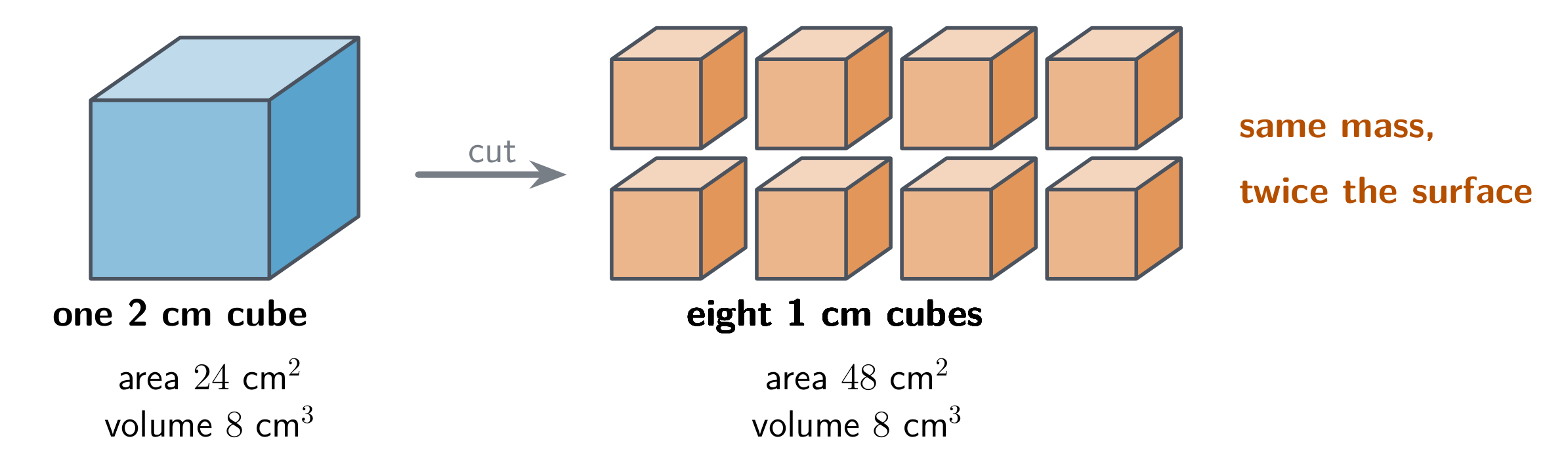
Worked example: cutting a cube
A 2 cm cube is cut into eight 1 cm cubes.
- One 2 cm cube: area $= 6 \times 2^2 = 24$ cm²; volume $= 8$ cm³.
- Eight 1 cm cubes: area $= 8 \times 6 \times 1^2 = 48$ cm²; same 8 cm³.
- Twice the surface with the same volume, so more collisions per second.
Cut the solid into smaller pieces
A 2 cm cube has 24 cm² of surface; cut into eight 1 cm cubes the same 8 cm³ exposes 48 cm². More exposed surface means more collisions per second.
A 3 cm cube is cut into 27 cubes of 1 cm. What is the total surface area of the small cubes?
Dificuldade 2/5 · Moedas 140 + pequeno bônus na primeira conclusão hoje
$27 \times 6 = 162$ cm² (vs 54 cm² for the big cube).
What is the surface area of the single 3 cm cube?
Dificuldade 2/5 · Moedas 140 + pequeno bônus na primeira conclusão hoje
$6 \times 3^2 = 54$.
Two different effects
- Surface area changes only how often particles collide.
- Temperature changes how often and how energetic the collisions are — which is why it has a bigger effect.
Which effect does each change have?
Dificuldade 2/5 · Moedas 140 + pequeno bônus na primeira conclusão hoje
Two different mechanisms.
Heating does not lower the activation energy. The barrier stays the same height. Heating gives more particles enough energy to get over it. Only a catalyst lowers the barrier.
Heating a reaction lowers its activation energy.
Dificuldade 1/5 · Moedas 100 + pequeno bônus na primeira conclusão hoje
Only a catalyst does that.
Higher temperature makes particles move faster, giving more frequent collisions and a much bigger fraction with at least the activation energy. Smaller pieces of solid have a larger surface area, so more particles can collide each second.
Compare how increasing the temperature and using powder instead of lumps increase the rate of reaction of calcium carbonate with acid.
Two mechanisms.