Fossils, preservation and an incomplete record
Introduzido| English | Significado |
|---|---|
| Fossils/ˈfɒslz/ | The remains of organisms from millions of years ago, found in rocks. |
| mineral replacement/ˈmɪnərəl rɪˈpleɪsmənt/ | substituição mineral |
| trace fossil/treɪs ˈfɒsl/ | fóssil rastro |
Footprints 3.7 million years old
- In 1978 Mary Leakey's team found footprints in volcanic ash at Laetoli, Tanzania. Made about 3.7 million years ago, they show early human relatives walked upright.
- Fossils 化石 are the remains of organisms from millions of years ago, found in rocks. They are our direct evidence of life in the past.
Three ways fossils form
| How it forms | What happens | Example |
|---|---|---|
| decay does not happen | one or more conditions for decay (oxygen, warmth, moisture) are missing, so the body is kept | insects in amber, mammoths in ice, bodies in peat bogs |
| mineral replacement 矿物替代 | as parts of the organism slowly decay, minerals replace them and form a stone copy | most dinosaur bones and shells |
| traces | the activity of the organism is preserved, not its body | footprints, burrows, rootlet traces |
Match each fossil to how it formed.
Dificuldade 2/5 · Moedas 140 + pequeno bônus na primeira conclusão hoje
Three ways to form a fossil.
Why do organisms in ice or peat bogs not decay?
Dificuldade 1/5 · Moedas 100 + pequeno bônus na primeira conclusão hoje
Decomposers cannot work without these conditions.
Mineral replacement, step by step
- The organism dies and is quickly buried by sediment (sand or mud). The soft parts decay; hard parts such as bones, teeth and shells decay much more slowly.
- Water carrying dissolved minerals seeps in. Over millions of years the minerals replace the hard parts, and the layers of sediment become rock. Later, rock movement and erosion may bring the fossil to the surface.
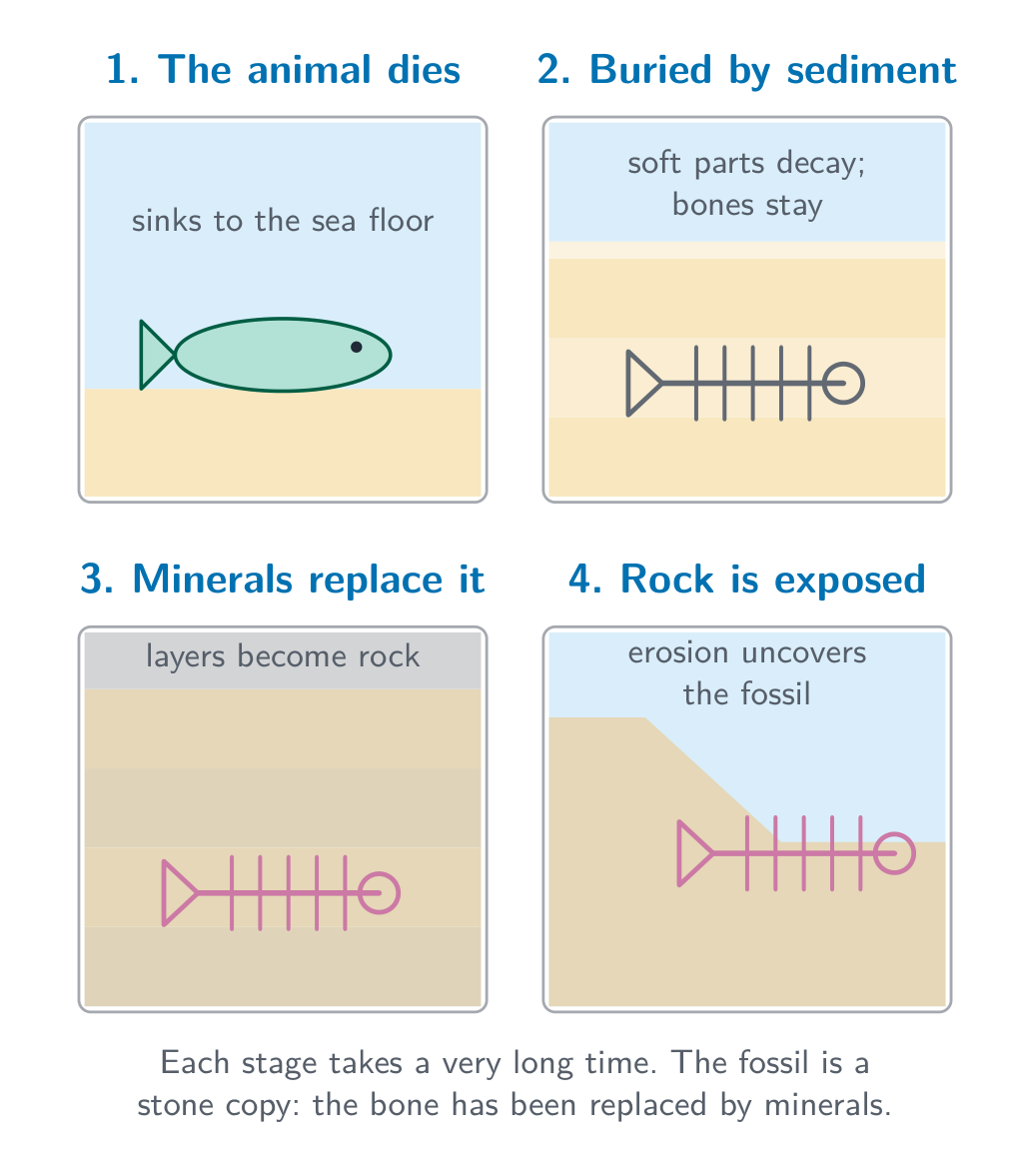
Put the stages of mineral replacement in order.
Dificuldade 3/5 · Moedas 200 + pequeno bônus na primeira conclusão hoje
Burial comes first; without it the whole body would decay or be eaten.
Why are fossils of jellyfish much rarer than fossils of shellfish?
Dificuldade 1/5 · Moedas 100 + pequeno bônus na primeira conclusão hoje
Soft parts decay quickly; mineral replacement needs parts that last a long time.
Trace fossils
- A trace fossil 遗迹化石 preserves activity rather than the body: footprints, burrows and rootlet traces.
- Traces tell us how an organism lived. The Laetoli footprints show walking on two legs, which bones alone could not prove so clearly.
Which of these are trace fossils?
Dificuldade 2/5 · Moedas 140 + pequeno bônus na primeira conclusão hoje
Traces record activity; the shell and the mammoth are the body itself.
Worked example: deeper layers are older
Sediment settles in layers, so lower layers formed first. In a cliff, rock builds up at about 1 cm per 1000 years. A fossil lies 50 m below a layer known to be 10 000 years old.
- Change units: 50 m $= 5000$ cm.
- Extra time: $5000 \times 1000 = 5\,000\,000$ years.
- Estimated age: $10\,000 + 5\,000\,000 \approx 5$ million years.
- Limit: this assumes the rate stayed the same, which is rarely true, so it is only an estimate.
Layers build up at 1 cm per 1000 years. How many years does 20 cm of rock represent?
Dificuldade 2/5 · Moedas 140 + pequeno bônus na primeira conclusão hoje
20 × 1000 = 20 000.
What fossils tell us
- Fossils of the same group in rocks of different ages show how much organisms have changed. The earliest horse ancestors, about 55 million years ago, were the size of a fox with several toes; modern horses are much larger and stand on one toe (the hoof).
- Fossils can also show how little some organisms have changed. Horseshoe crab fossils over 400 million years old look very like living horseshoe crabs.
Horse fossils from rocks of different ages show the animals becoming larger, with fewer toes. What does this show?
Dificuldade 1/5 · Moedas 100 + pequeno bônus na primeira conclusão hoje
Older rocks hold the earlier forms, so the series shows change over time.
Why the record is incomplete
- Many early forms of life were soft-bodied, so they left few traces. The traces that did form have mostly been destroyed by geological activity, such as rock movement and erosion.
- Most organisms never fossilised at all, because the conditions are rare. This is why scientists cannot be certain how life began on Earth.
Why is the fossil record incomplete?
Dificuldade 2/5 · Moedas 140 + pequeno bônus na primeira conclusão hoje
Most organisms never fossilise, and many fossils were destroyed.
Exam-style questions
Q1 (3 marks): Describe how a fossil of a bone forms by mineral replacement.
- The animal is buried quickly in sediment. ✓
- The bone decays slowly and is replaced by minerals. ✓
- The sediment turns into rock around it, over a very long time. ✓
Q2 (2 marks): Suggest why scientists cannot be certain how life began on Earth.
- Early life forms were soft-bodied, so they left few fossils. ✓
- Most fossils that formed were destroyed by geological activity. ✓
Where marks are lost: "the bone turns into stone" with no mention of minerals replacing it; or "there were no fossils then" instead of saying why few formed or survived.
Most organisms never become fossils. Fossils form only in rare conditions. So the absence of a fossil does not mean the organism never existed.
If no fossil of an organism is found, it never existed.
Dificuldade 1/5 · Moedas 100 + pequeno bônus na primeira conclusão hoje
Most organisms never fossilise.
Fossils form where decay does not happen, by mineral replacement, or as traces such as footprints. Deeper rock layers are usually older. Fossils show how much or how little organisms have changed. The record is incomplete because soft-bodied organisms rarely fossilise and geology destroyed many fossils, so we cannot be certain how life began.
A student says, "Fossils give us a complete history of life on Earth." Explain how fossils support the idea that organisms change over time, and why the student's statement is wrong. (4 marks)
Two marks for the evidence and two for the gaps.