Extinction: no surviving individuals
Introduzido| English | Significado |
|---|---|
| Extinction/ekˈstɪŋkʃn/ | The loss of every individual of a species. |
| competitors/kəmˈpetɪtəz/ | Organisms that need the same resource, such as food, light or space. |
The last passenger pigeon
- In the 1800s, passenger pigeons in North America numbered in the billions. Hunting and forest loss wiped them out. The last one, Martha, died in Cincinnati Zoo in 1914.
- Extinction 灭绝 means there are no remaining individuals of a species still alive. Once it happens, it cannot be undone.
What does extinction mean?
Dificuldade 1/5 · Moedas 100 + pequeno bônus na primeira conclusão hoje
Zero individuals.
Why some species cannot keep up
- Species change by natural selection: individuals with useful variations survive and breed. This needs variation in the population and many generations of time.
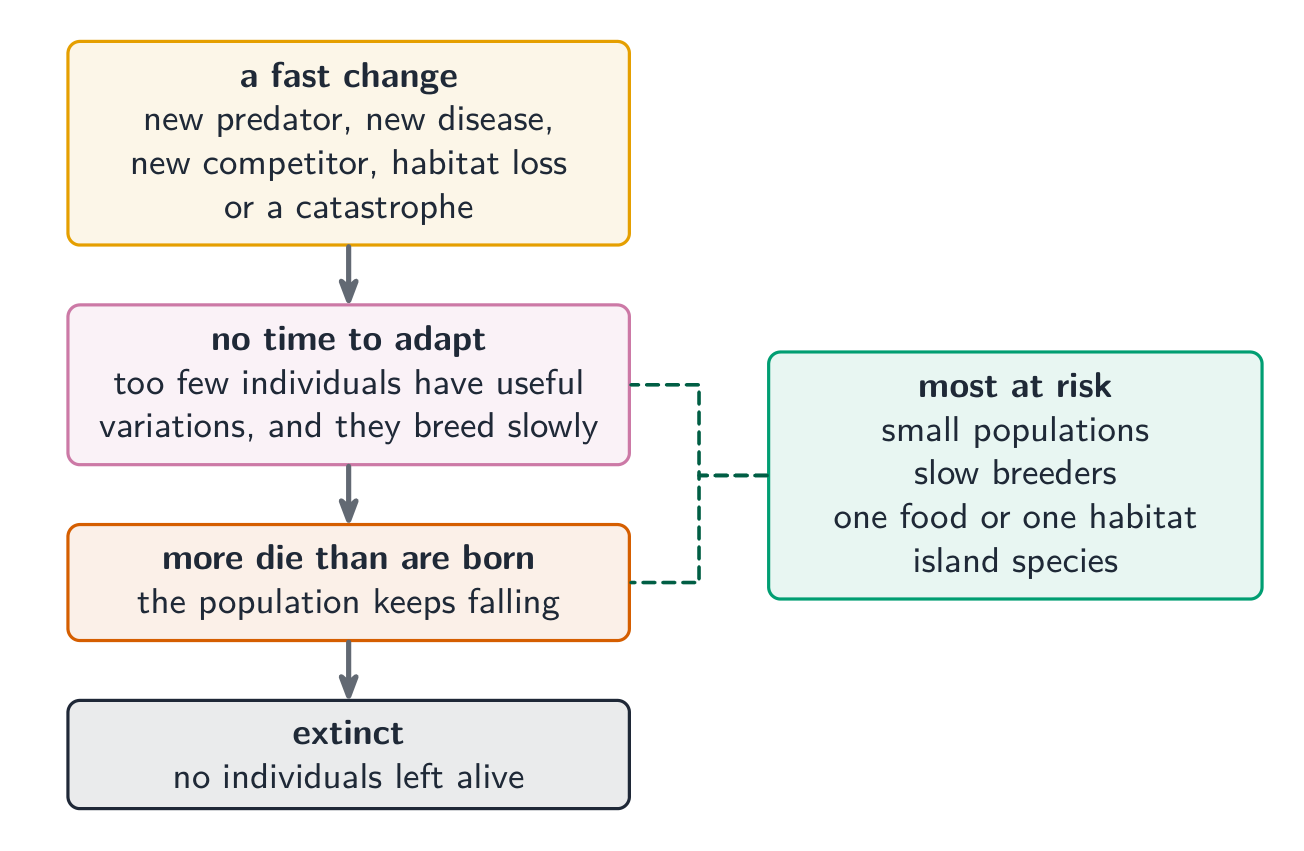
- If the environment changes faster than the species can adapt, more individuals die than are born, and the population falls until none are left.
Which species is most at risk of extinction if a new disease arrives?
Dificuldade 1/5 · Moedas 100 + pequeno bônus na primeira conclusão hoje
Few individuals means little variation, and slow breeding gives natural selection little time.
Causes of extinction
| Cause | How it works | Example |
|---|---|---|
| new predators | the prey has no defences against them | rats and pigs brought to Mauritius ate dodo eggs |
| new diseases | no individuals are resistant | a fungus (chytrid) has wiped out many frog species |
| new, more successful competitors 竞争者 | they take the food or space | grey squirrels have replaced red squirrels in most of Britain |
| environmental change | the habitat or climate changes too fast | forest clearing removed the passenger pigeon's food and nest sites |
| a catastrophic event | a sudden disaster kills most individuals | an asteroid 66 million years ago ended the non-bird dinosaurs |
Which can cause extinction?
Dificuldade 2/5 · Moedas 140 + pequeno bônus na primeira conclusão hoje
All four are factors in the specification.
Match each example to its cause.
Dificuldade 2/5 · Moedas 140 + pequeno bônus na primeira conclusão hoje
Ask what the change does to deaths or births.
Catastrophic events
- A single disaster, such as a huge volcanic eruption or an asteroid strike, can change the whole planet quickly.
- About 66 million years ago an asteroid hit near Mexico. Dust blocked sunlight, plants died, and food chains collapsed: about 75% of species, including the non-bird dinosaurs, died out.
Births in, deaths out
A closed population of 30 with 8 surviving births and 14 deaths ends at 30 + 8 − 14 = 24: a fall of 6, which is 20% of the start. A decline is not yet extinction.
Worked example: a shrinking population
A closed population of 30 animals has 8 surviving births and 14 deaths in a year.
- End of year $= 30 + 8 - 14 = 24$.
- Fall $= 6$, which is $\dfrac{6}{30} \times 100 = 20\%$.
- Not yet extinct: but if this continued, the population would soon be too small to find mates and breed successfully.
A population of 50 has 10 births and 25 deaths. What is its new size?
Dificuldade 2/5 · Moedas 140 + pequeno bônus na primeira conclusão hoje
50 + 10 − 25 = 35.
What is the percentage fall from 50 to 35?
Dificuldade 2/5 · Moedas 140 + pequeno bônus na primeira conclusão hoje
15 ÷ 50 × 100 = 30%.
Exam-style question
Question (3 marks): The dodo was a large bird that could not fly. It lived only on the island of Mauritius, where there were no ground predators. It laid one egg at a time, in a nest on the ground. Sailors arrived in 1598 and brought rats and pigs. By the late 1600s the dodo was extinct. Suggest why.
Model answer
- The rats and pigs were new predators that ate the eggs (and young) in the ground nests. ✓
- The dodo could not fly away, and had never needed defences, so it could not escape. ✓
- It laid only one egg at a time, so it bred too slowly to replace its losses or adapt; deaths were greater than births. ✓
Where marks are lost: copying facts from the question without saying how each one led to deaths; or "the dodo didn't evolve" with no reason.
Grey squirrels were brought to Britain from North America. They eat the same food as red squirrels, are larger, and carry a virus that kills red squirrels but not greys. Suggest why red squirrels have disappeared from most of Britain. (3 marks)
Two causes, each linked to the fall.
Preventing extinction
- Protecting habitats, banning hunting, controlling introduced predators, and breeding programmes in zoos and seed banks.
- The California condor fell to 27 birds in 1987. All were taken into captivity to breed, and today there are over 500.
A falling population is not yet extinct. Extinction means zero individuals left. Many species have been saved from very low numbers, but a small population has little genetic variation, which makes it harder to adapt to the next change.
A species with only 27 individuals left is extinct.
Dificuldade 1/5 · Moedas 100 + pequeno bônus na primeira conclusão hoje
Extinction means zero; the condor recovered from 27.
Extinction is the loss of every individual of a species. It happens when a change is too fast for the species to adapt: new predators, new diseases, new competitors, environmental change or a catastrophic event. Small populations, slow breeders and island species are most at risk. To explain an extinction, link each fact to more deaths or fewer births.
Describe the factors that may contribute to the extinction of a species. (4 marks)
One mark for each factor, described.