How Much Did Science and Technology Change?
Introduzido| English | Significado |
|---|---|
| eradicate | To destroy something completely, such as a disease, so that it no longer exists. |
The last natural case, October 1977
- On 26 October 1977, a hospital cook named Ali Maow Maalin in Merca, Somalia, developed a rash. He was the last person in the world to catch smallpox naturally. He recovered, and health workers vaccinated everyone around him. In 1980, the World Health Organization declared that it had managed to eradicate 根除 smallpox — a disease that had killed about 300 million people in the 20th century. Maalin later worked against polio until his death in 2013.
- How much did science and technology change the world after 1900? A great deal — but unevenly.
The last natural case was in 1977 and eradication was declared in 1980. How many years later?
Dificuldade 2/5 · Moedas 140 + pequeno bônus na primeira conclusão hoje
1980 − 1977.
An extent question
- "To what extent" asks you to weigh change against its limits and give a degree.
- A good answer gives evidence of change, evidence of limits, and a judgement.
What does a "to what extent" answer need?
Dificuldade 1/5 · Moedas 100 + pequeno bônus na primeira conclusão hoje
Weigh and judge.
The case for large change
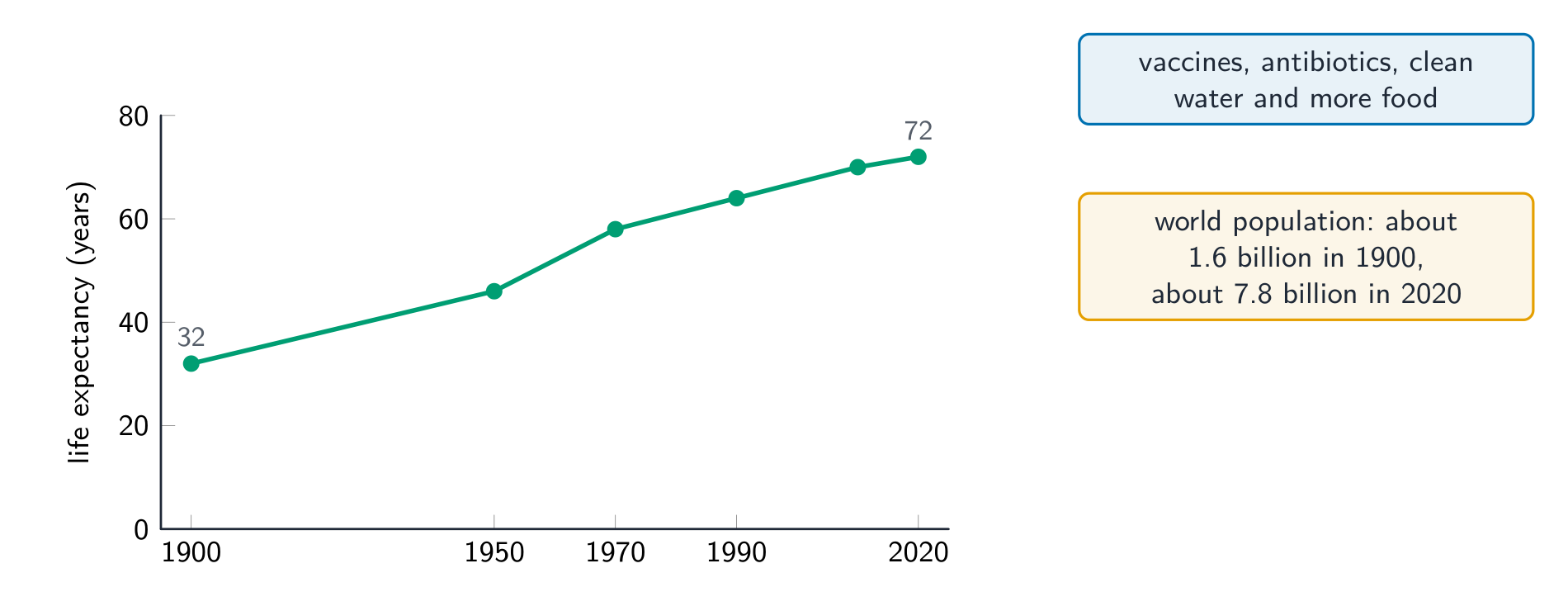
- Life expectancy rose from about 32 years in 1900 to about 72 in 2020; vaccines and antibiotics saved hundreds of millions of lives.
- The Green Revolution fed a population that grew from about 1.6 billion in 1900 to about 7.8 billion in 2020.
Evidence of change, evidence of a limit, or the degree?
Sort each element of a final extent answer.
World population rose from about 1.6 billion (1900) to about 7.8 billion (2020). How many times larger? (one decimal place)
Dificuldade 2/5 · Moedas 140 + pequeno bônus na primeira conclusão hoje
7.8 ÷ 1.6 ≈ 4.9.
Worked example: weighing a vaccine
- Change: smallpox was eradicated by 1980; polio cases fell by over 99% after 1988.
- Limit: in 2020, about 20 million children a year still missed basic vaccines, mostly in poor and war-torn areas.
- Degree: the capability was general; the benefit was not — science was transformative, but uneven in who it reached.
By how much did polio cases fall after 1988?
Dificuldade 1/5 · Moedas 100 + pequeno bônus na primeira conclusão hoje
Evidence of change.
The case for limits
- Diseases of poverty — malaria, tuberculosis, cholera — still kill millions.
- Technology also raised wartime casualties, from machine guns to nuclear weapons, and added to environmental pressure.
Match each to its category.
Dificuldade 2/5 · Moedas 140 + pequeno bônus na primeira conclusão hoje
Three parts.
A final extent routine
- State the degree in your claim: "to a large but uneven extent".
- Give the strongest change, the strongest limit, and explain why one outweighs the other.
"Uneven" is not the same as "small". Science changed the world enormously; the limit is that its benefits reached people unequally.
An uneven change must be a small change.
Dificuldade 1/5 · Moedas 100 + pequeno bônus na primeira conclusão hoje
It can be very large but unequal.
After 1900, science and technology transformed life: smallpox eradicated, lives about 40 years longer, food for billions more. But diseases of poverty persisted, millions still missed vaccines, and technology made war deadlier — change was very large, but uneven.
To what extent did science and technology change the world after 1900?
Extent.