Responses to Globalisation
Introduzido| English | Significado |
|---|---|
| structural adjustment | Conditions attached to IMF and World Bank loans requiring governments to cut spending, sell state firms and open markets. |
The battle of Seattle, November 1999
- On 30 November 1999, about 40 000 people filled the streets of Seattle, where trade ministers were meeting at the World Trade Organization. Trade unionists, environmentalists and farmers from many countries said global trade rules harmed workers and the environment. Police used tear gas, the opening session was delayed, and the talks ended without agreement.
- After 1980, people and states responded to globalisation in many ways: protest, local alternatives, and choosing what to accept.
Why did protesters gather in Seattle in 1999?
Dificuldade 1/5 · Moedas 100 + pequeno bônus na primeira conclusão hoje
Protest against an institution.
A variety of forms
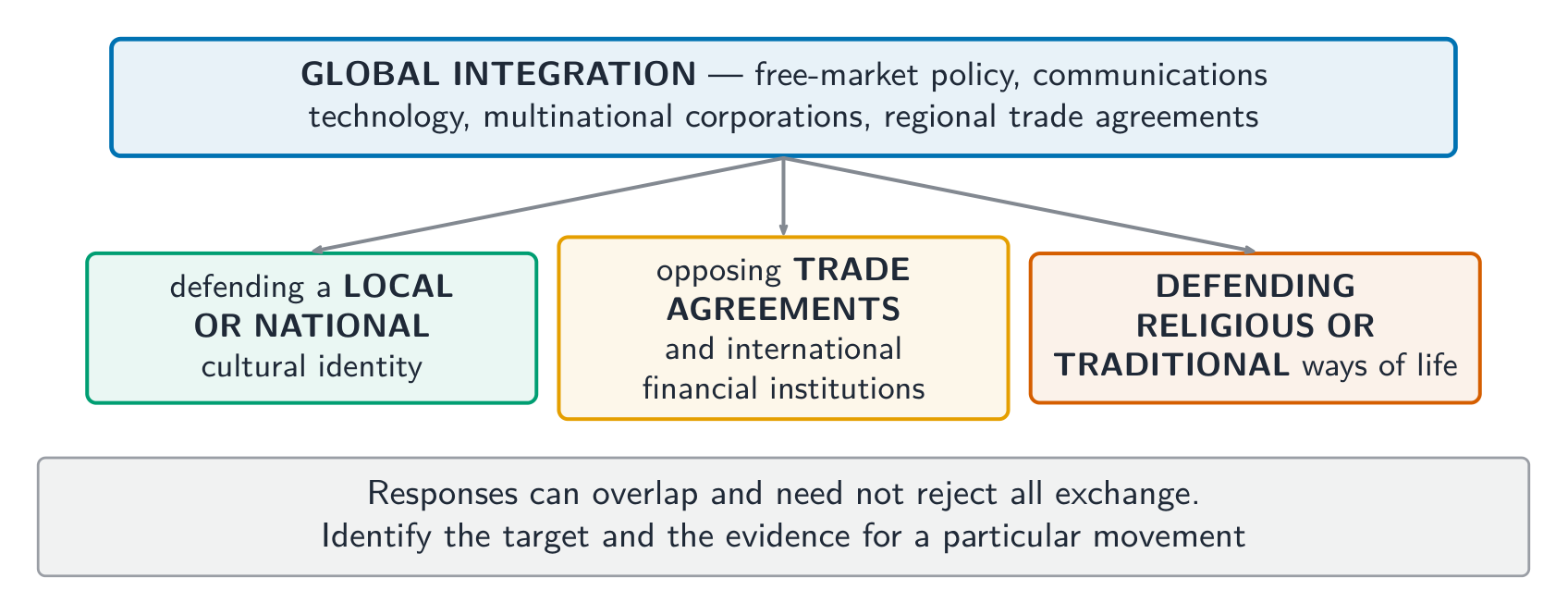
- Some opposed global institutions; some built local alternatives; some states regulated or adapted what came in.
- Responses could overlap.
Responses to globalisation could overlap.
Dificuldade 1/5 · Moedas 100 + pequeno bônus na primeira conclusão hoje
A state could protest and regulate at once.
Opposing an institution
- Critics attacked the IMF and World Bank for structural adjustment 结构调整: loans that required governments to cut spending and sell state firms.
- In Bolivia in 2000, protests in Cochabamba forced the government to cancel a water privatisation backed by the World Bank.
Which kind of response is this?
Sort each response to globalisation.
What did IMF structural adjustment require?
Dificuldade 1/5 · Moedas 100 + pequeno bônus na primeira conclusão hoje
Conditions on loans.
Worked example: a protest against an IMF condition
- Condition: in 1997–98, during the Asian financial crisis, Indonesia received IMF loans that required spending cuts.
- Response: when fuel subsidies were cut in May 1998, prices rose sharply, and protests and riots spread.
- Result: President Suharto, in power for 32 years, resigned on 21 May 1998. Critics said the conditions had made the crisis worse.
Suharto resigned in 1998 after 32 years in power. In which year had he come to power?
Dificuldade 2/5 · Moedas 140 + pequeno bônus na primeira conclusão hoje
1998 − 32.
Building a local alternative
- Some countries developed their own social media and online platforms instead of using foreign ones, such as WeChat in China and VK in Russia.
- These kept data and markets under local control.
Regulation and selective adoption
- States set rules on what can cross borders, such as limits on foreign films or data.
- Others adopted a foreign form but changed its content, such as local versions of global TV shows.
Match each to its kind of response.
Dificuldade 2/5 · Moedas 140 + pequeno bônus na primeira conclusão hoje
Three kinds.
Responses to globalisation were not only "for" or "against". Many people and states accepted some parts, rejected others and adapted the rest.
Every response to globalisation was simply for or against it.
Dificuldade 1/5 · Moedas 100 + pequeno bônus na primeira conclusão hoje
Many were selective.
After 1980, responses to globalisation included protest against institutions, as at Seattle (1999) and against IMF conditions in Indonesia (1998), building local alternatives such as domestic platforms, and regulating or adapting what crossed borders.
Explain the different ways people responded to globalisation after 1980.
Categories.