Disease and Population
Introduzido| English | Significado |
|---|---|
| malaria/mæˈleərɪə/ | A disease spread by mosquitoes that causes fever and still kills hundreds of thousands of people each year, mostly in Africa. |
| pandemic | An outbreak of disease that spreads across many countries or the whole world, such as the 1918 influenza. |
Five cases in Los Angeles, June 1981
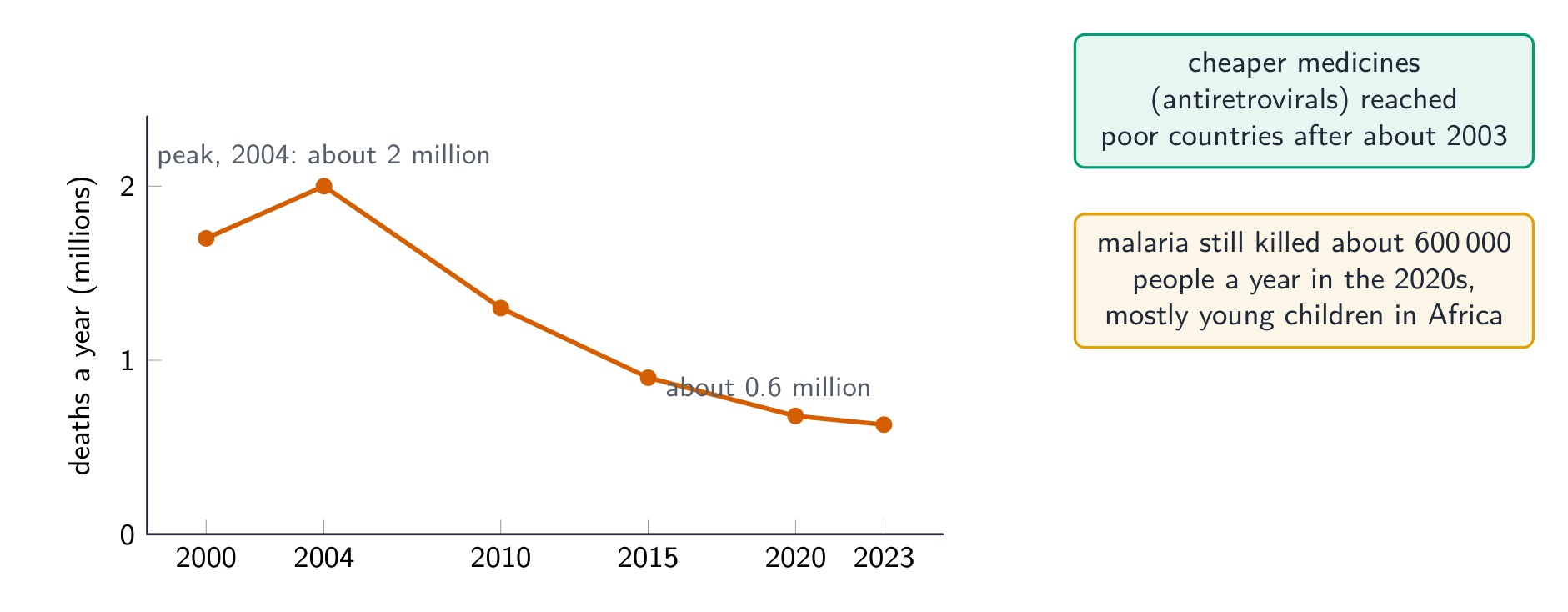
- On 5 June 1981, a US government health report described five young men in Los Angeles with a rare lung infection. Their immune systems had failed. The new disease was later named AIDS, caused by HIV. By 2020, about 36 million people worldwide had died from it, most of them in sub-Saharan Africa. In the 1990s, new drugs turned HIV from a death sentence into a disease people could live with.
- After 1900, some diseases persisted, new epidemics emerged, and medicine advanced fast.
What changed HIV in the 1990s?
Dificuldade 1/5 · Moedas 100 + pequeno bônus na primeira conclusão hoje
Treatment.
Three categories of disease
- Diseases of poverty: malaria, tuberculosis and cholera, spread by poor water, housing and health care.
- New epidemics: the 1918 influenza, HIV/AIDS and Ebola; diseases of longer life: heart disease and Alzheimer's.
Match each disease to its category.
Dificuldade 2/5 · Moedas 140 + pequeno bônus na primeira conclusão hoje
Three categories.
Diseases of poverty persisted
- Malaria 疟疾 still killed about 600 000 people a year in the 2020s, mostly young children in Africa.
- Cheap tools — bed nets and medicines — reduced deaths, but poverty slowed progress.
Follow disease and medicine together
The CED pairs medical advance with the diseases that persisted, and the pairing is the point.
Worked example: an epidemic and social disruption
- Epidemic: the 1918 influenza pandemic 大流行病 killed perhaps 50 million people worldwide — more than World War I.
- Disruption: schools, theatres and churches closed; in India alone, perhaps 12–17 million died.
- Advance: it pushed governments to build public health systems and, later, flu vaccines in the 1940s.
The 1918 influenza killed perhaps 50 million; World War I killed about 17 million. How many million more?
Dificuldade 2/5 · Moedas 140 + pequeno bônus na primeira conclusão hoje
50 − 17.
Medical advances
- Penicillin (discovered 1928, mass-produced from the 1940s) made bacterial infections curable.
- Vaccines ended smallpox (1980) and nearly ended polio.
Which were medical advances after 1900?
Dificuldade 2/5 · Moedas 140 + pequeno bônus na primeira conclusão hoje
Bloodletting is older and harmful.
Diseases of longer life
- As life expectancy rose — from about 32 years worldwide in 1900 to about 72 in 2020 — more people lived long enough to get heart disease, cancer and Alzheimer's.
- These became leading causes of death in rich countries.
World life expectancy rose from about 32 (1900) to about 72 (2020). By how many years?
Dificuldade 2/5 · Moedas 140 + pequeno bônus na primeira conclusão hoje
72 − 32.
More cases of heart disease did not mean worse health. It often came from people living longer, not from a new danger.
More cases of heart disease always mean worse health.
Dificuldade 1/5 · Moedas 100 + pequeno bônus na primeira conclusão hoje
Often people live longer.
After 1900, diseases of poverty such as malaria persisted, epidemics such as the 1918 influenza and HIV/AIDS caused disruption and drove medical advances, and longer lives made heart disease and Alzheimer's more common.
Explain how disease affected societies after 1900.
Effects.