Reactions to Power
Introduzido| English | Significado |
|---|---|
| nonviolence/ˌnɒnˈvaɪələns/ | não violência |
| military–industrial complex | The close link between a country's armed forces and the companies that make weapons, which together push for more military spending. |
| terrorism | The use of violence against civilians to spread fear for political aims. |
A walk to the sea, March 1930
- On 12 March 1930, Mohandas Gandhi left his ashram near Ahmedabad with 78 followers and walked about 385 km to the coast at Dandi. On 6 April he picked up a handful of salt, breaking the British law that only the government could make or sell it. Across India, people made salt illegally, and about 60 000 were arrested, including Gandhi.
- In the 20th century, some people opposed war and violence, while others — including states — made conflict worse.
Why did Gandhi pick up salt at Dandi in 1930?
Dificuldade 1/5 · Moedas 100 + pequeno bônus na primeira conclusão hoje
A planned act of civil disobedience.
Nonviolence as a method
- Nonviolence 非暴力 was a planned method, not just a refusal to fight: leaders trained marchers, chose laws to break and accepted arrest.
- Gandhi in India, Martin Luther King Jr. in the United States and Nelson Mandela in South Africa promoted it to bring political change.
Which leaders promoted nonviolence?
Dificuldade 2/5 · Moedas 140 + pequeno bônus na primeira conclusão hoje
Pinochet ruled by force.
Nonviolence elsewhere
- In the Montgomery bus boycott (1955–56), Black residents refused to ride buses for 381 days until the Supreme Court ended bus segregation.
- Mandela's African National Congress used nonviolent campaigns for decades before turning to armed struggle after police killed 69 protesters at Sharpeville in 1960.
How many days did the Montgomery bus boycott last?
Dificuldade 2/5 · Moedas 140 + pequeno bônus na primeira conclusão hoje
1955–56.
Worked example: sorting reactions to power
- Nonviolent political change: the Salt March (1930) and the Montgomery bus boycott (1955–56).
- States that intensified conflict: in Chile, General Augusto Pinochet seized power in 1973; his government killed or "disappeared" over 3000 people. Spain under Franco and Uganda under Idi Amin also ruled through military force.
- Violence against civilians: groups such as Shining Path in Peru and al-Qaeda attacked civilians on purpose.
Which reaction to power is this?
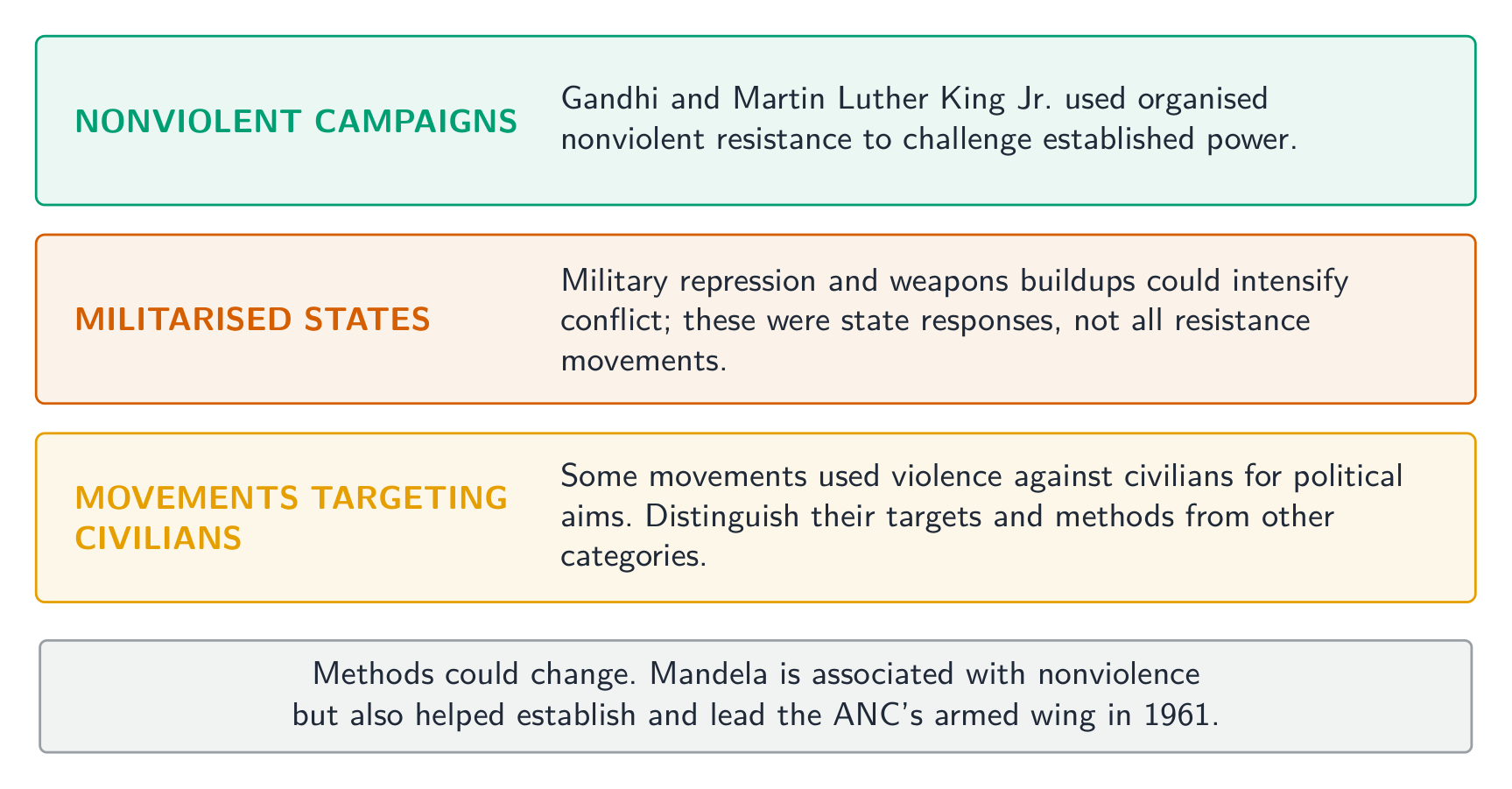
Sort each case into the subtopic's four categories.
Match each example to its type of reaction.
Dificuldade 2/5 · Moedas 140 + pequeno bônus na primeira conclusão hoje
Three reactions.
The military–industrial complex
- In 1961, US President Eisenhower warned against the military–industrial complex 军工复合体: arms makers and the military together pushing for more weapons.
- The global arms trade grew during the Cold War, feeding many regional wars.
What did Eisenhower warn about in 1961?
Dificuldade 1/5 · Moedas 100 + pequeno bônus na primeira conclusão hoje
Arms makers and the military pushing for more weapons.
Violence against civilians
- Terrorism 恐怖主义 is the use of violence against civilians to spread fear for political aims.
- Al-Qaeda's attacks of 11 September 2001 killed nearly 3000 people, and led to long wars in Afghanistan and Iraq.
Nonviolence was not passive. It took organisation, discipline and the willingness to suffer arrest or attack — and it worked by making the government's violence visible to the world.
Nonviolence meant doing nothing and waiting for change.
Dificuldade 1/5 · Moedas 100 + pequeno bônus na primeira conclusão hoje
It was organised and disciplined.
In the 20th century, Gandhi, King and Mandela used planned nonviolent action, such as the Salt March, to bring political change. Others intensified conflict: military regimes like Pinochet's, the growing arms trade, and groups like al-Qaeda that attacked civilians.
Compare nonviolent movements with those who intensified conflict in the 20th century.
Comparison.