New Borders, New Economies
Introduzido| English | Significado |
|---|---|
| metropoles/ˈmetrəpəʊlz/ | metrópoles |
A canal taken back, July 1956
- On 26 July 1956, Egypt's president Gamal Abdel Nasser announced to a crowd in Alexandria that Egypt would nationalise the Suez Canal, owned mostly by British and French shareholders. Its fees would pay for the Aswan High Dam. Britain, France and Israel invaded in October, but pressure from the US and the Soviet Union forced them to withdraw. Egypt kept the canal.
- After independence, new states inherited borders, moved people and tried to direct their own economies — while many ties to old empires survived.
Why did Nasser nationalise the Suez Canal?
Dificuldade 1/5 · Moedas 100 + pequeno bônus na primeira conclusão hoje
Development.
Withdrawal left lines on a map
- New states mostly kept the borders that empires had drawn, often splitting or joining peoples without their consent.
- In 1964, the Organisation of African Unity agreed to keep colonial borders to avoid endless wars.
Why did the OAU agree in 1964 to keep colonial borders?
Dificuldade 1/5 · Moedas 100 + pequeno bônus na primeira conclusão hoje
Inherited borders.
And moved people
- Partition (1947) moved about 15 million people between India and Pakistan.
- Many people from former colonies moved to the metropoles 宗主国 — the old imperial centres — such as South Asians and Caribbeans to Britain and Algerians to France.
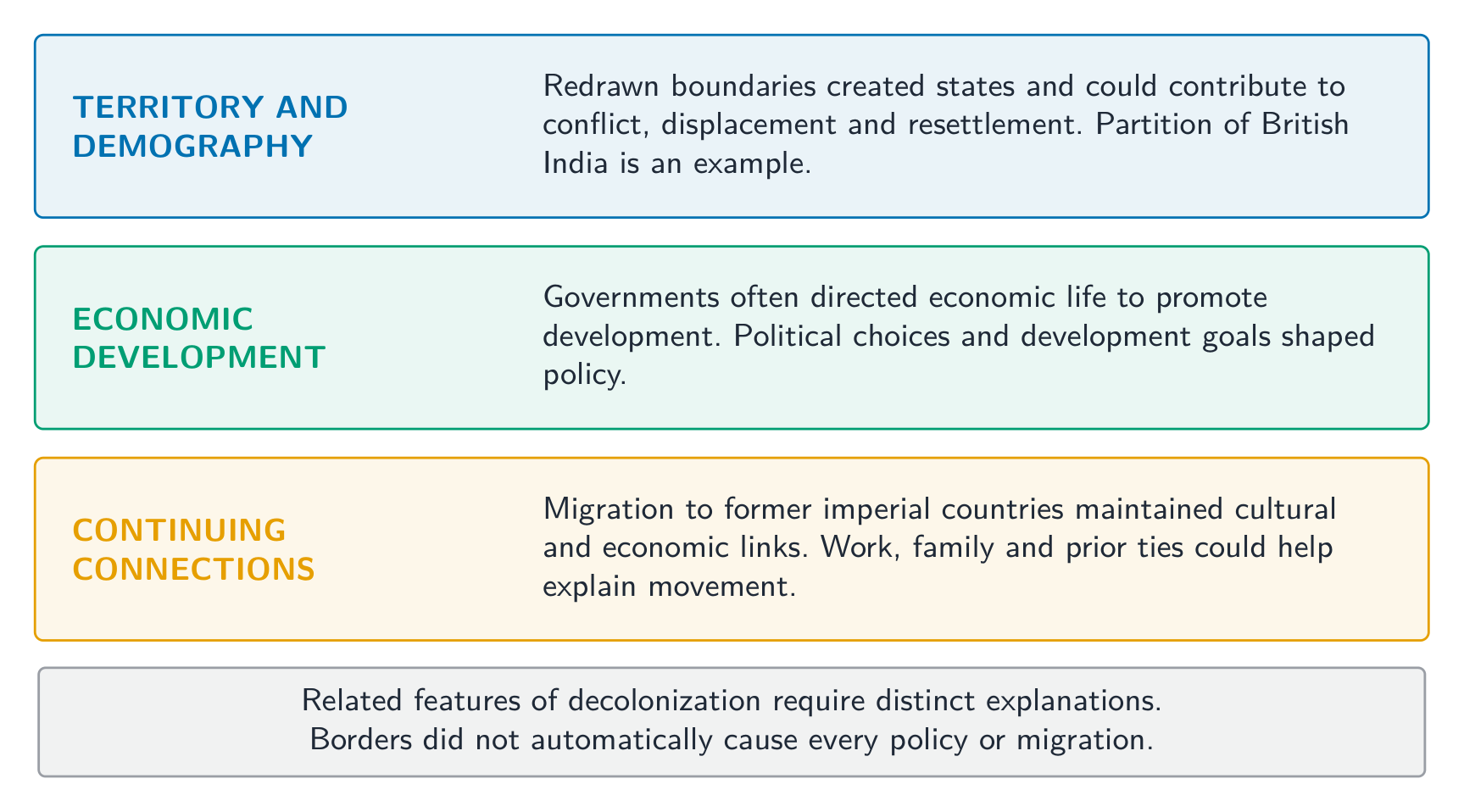
Follow what a new state inherited
Independence is where the examinable problem starts, not where it ends.
Worked example: new states directed their economies
- Egypt: Nasser nationalised the Suez Canal (1956) and built the Aswan High Dam (finished 1970) to control floods and produce electricity.
- India: Nehru's Five Year Plans from 1951 built steel plants and dams under state direction.
- Ghana: Nkrumah built the Akosombo Dam (1965) to power an aluminium industry. Each state used planning to try to escape dependence on raw-material exports.
Match each leader to a project.
Dificuldade 2/5 · Moedas 140 + pequeno bônus na primeira conclusão hoje
State-directed development.
The canal was nationalised in 1956 and the dam finished in 1970. How many years later?
Dificuldade 2/5 · Moedas 140 + pequeno bônus na primeira conclusão hoje
1970 − 1956.
Ties survived the empires
- Many former colonies still traded mainly with their old rulers and used their languages.
- France kept troops and a shared currency, the CFA franc, in many West African states.
Changes and continuities
- Change: new flags, governments and development plans.
- Continuity: colonial borders, economic dependence and migration to the metropoles.
Match each to change or continuity.
Dificuldade 2/5 · Moedas 140 + pequeno bônus na primeira conclusão hoje
Changes and continuities.
Independence did not end economic dependence. Many new states still relied on exporting a few raw materials to their former rulers.
Independence ended economic dependence at once.
Dificuldade 1/5 · Moedas 100 + pequeno bônus na primeira conclusão hoje
Many still relied on raw materials.
New states kept colonial borders and saw large migrations, including to the metropoles. Leaders such as Nasser, Nehru and Nkrumah used state planning — the Suez Canal, Five Year Plans, dams — to develop, but many economic ties to the old empires survived.
Explain the changes and continuities for states after independence.
Continuity and change.