Roads to Independence
Introduzido| English | Significado |
|---|---|
| Partition/pɑːˈtɪʃn/ | The division of British India in 1947 into the separate states of India and Pakistan. |
| autonomy/ɔːˈtɒnəmi/ | The right of a region or group to govern itself, partly or fully, within a larger state. |
| Biafra | The south-eastern region of Nigeria that tried to become independent from 1967 to 1970, causing a civil war and famine. |
"At the stroke of the midnight hour", August 1947
- Just before midnight on 14 August 1947, Jawaharlal Nehru told India's assembly: "At the stroke of the midnight hour, when the world sleeps, India will awake to life and freedom." British rule ended — but the land was split into India and Pakistan. In the Partition 印巴分治 that followed, about 15 million people crossed the new borders, and perhaps a million were killed in religious violence.
- After 1945, colonies won independence, some by negotiation and some by armed struggle.
About how many million people crossed the new borders in Partition?
Dificuldade 2/5 · Moedas 140 + pequeno bônus na primeira conclusão hoje
Perhaps a million were killed.
Autonomy or independence
- Some movements first sought autonomy 自治 — self-government inside an empire — before demanding full independence.
- Between 1945 and 1975, more than 70 new states were created, most in Asia and Africa.
Two routes
- Negotiated independence: India (1947) and the Gold Coast, which became Ghana under Kwame Nkrumah in 1957, after strikes, boycotts and elections.
- Armed struggle: Algeria fought France from 1954 to 1962; Angola fought Portugal from 1961 to 1975.
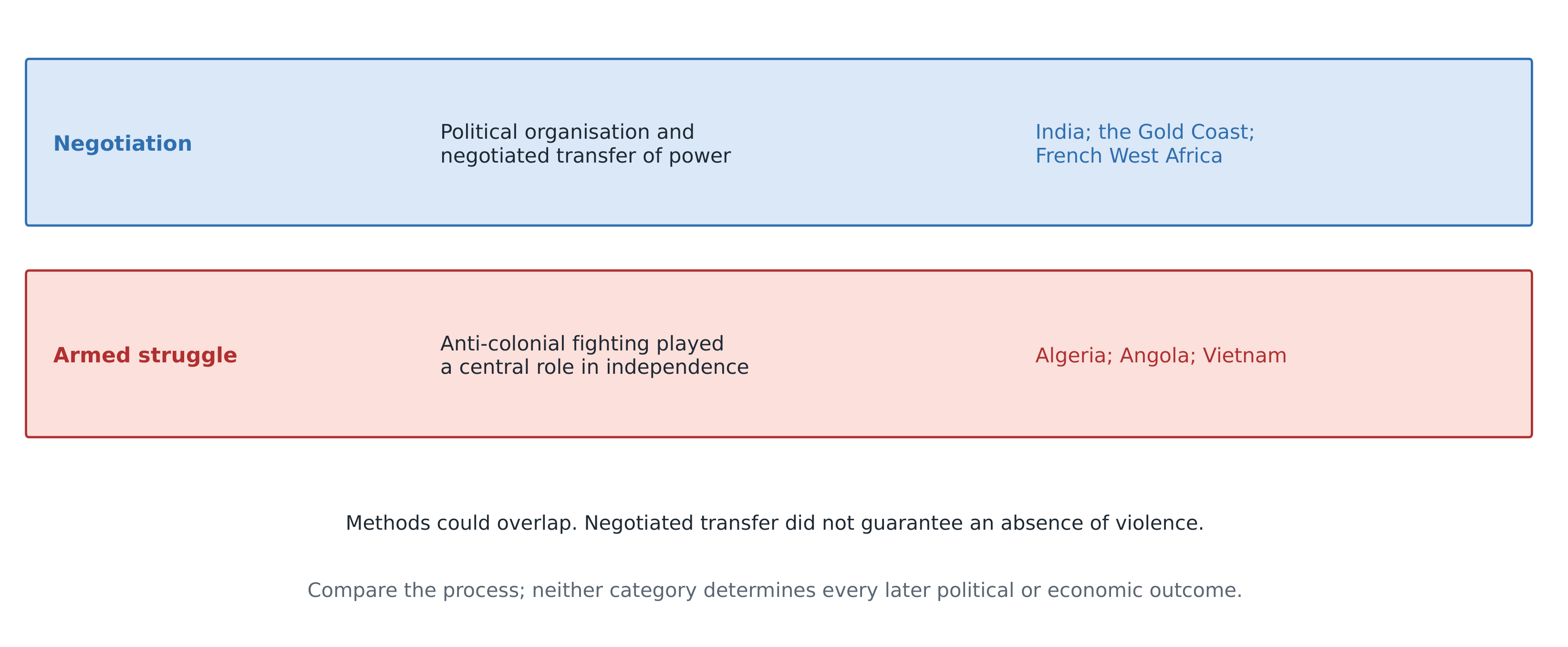
Negotiated, armed, or a boundary movement?
Sort each case by the CED's categories.
Match each country to its route.
Dificuldade 2/5 · Moedas 140 + pequeno bônus na primeira conclusão hoje
Different routes.
Algeria's war lasted from 1954 to 1962. How many years?
Dificuldade 2/5 · Moedas 140 + pequeno bônus na primeira conclusão hoje
1962 − 1954.
Worked example: what decided the route
- Settlers: Algeria had about 1 million French settlers, who refused to leave; settler colonies like Algeria and Kenya saw more violence.
- The empire's will: Britain, weakened by war, negotiated; Portugal's dictatorship fought until its own revolution in 1974.
- Result: Algeria's war killed hundreds of thousands; Ghana's independence came through elections.
What made armed struggle more likely?
Dificuldade 2/5 · Moedas 140 + pequeno bônus na primeira conclusão hoje
Settlers and the empire's will.
Movements inside movements
- In British India, the Muslim League led by Muhammad Ali Jinnah demanded a separate state, Pakistan.
- In Nigeria, the Igbo-led region of Biafra 比夫拉 tried to break away in 1967; the civil war and famine killed perhaps a million people before Biafra surrendered in 1970.
What did the Muslim League demand?
Dificuldade 1/5 · Moedas 100 + pequeno bônus na primeira conclusão hoje
Led by Jinnah.
Inherited borders
- Most new states kept colonial borders, drawn without regard to ethnic or religious groups.
- These borders caused conflict, as in Partition and Biafra.
Negotiated independence was not always peaceful. India's independence was negotiated, but Partition caused mass violence and displacement.
Negotiated independence was always peaceful.
Dificuldade 1/5 · Moedas 100 + pequeno bônus na primeira conclusão hoje
Partition caused mass violence.
After 1945, colonies became independent by negotiation, like India and Ghana, or by armed struggle, like Algeria and Angola. Settlers and the empire's will shaped the route, and movements such as the Muslim League and Biafra challenged the borders that empires left behind.
Compare the processes of independence in India and Algeria.
Comparison.