Communism in China, and Redistribution
Introduzido| English | Significado |
|---|---|
| land reform | Redistributing land from large owners to peasants. |
| planned economy/plænd ɪˈkɒnəmi/ | An economy in which the government, not the market, decides what to produce, how much and at what price. |
| White Revolution | The Shah of Iran's 1963 program of modernising reforms, including land redistribution and votes for women. |
Land to the tiller, June 1950
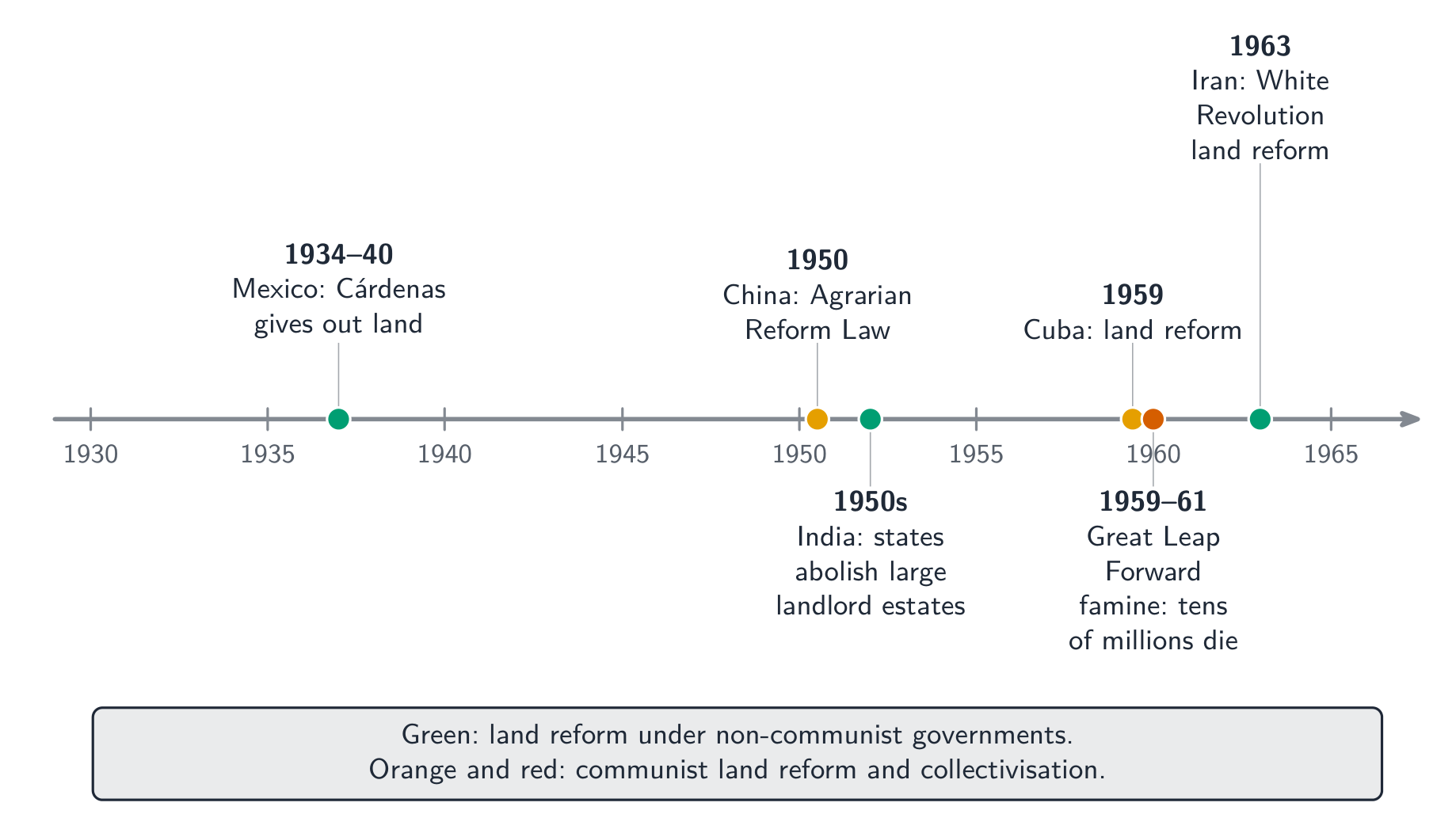
- In June 1950, China's new government passed the Agrarian Reform Law. Land was taken from landlords and given to peasants. By 1952, about 300 million peasants had received land — the largest land transfer in history to that time. Communists had promised land to peasants since the 1920s, and the promise had won them support in the countryside.
- In the 20th century, communists came to power in China, and many states redistributed land or directed their economies.
By 1952, about how many million peasants had received land in China?
Dificuldade 2/5 · Moedas 140 + pequeno bônus na primeira conclusão hoje
The Agrarian Reform Law of 1950.
Why the communists won
- Internal tension: after 1927, the Nationalists under Chiang Kai-shek and the Communists under Mao Zedong fought a civil war.
- Japanese aggression: Japan's invasion (1937–45) weakened the Nationalists, while Communist guerrillas gained support. The People's Republic was founded on 1 October 1949.
Which helped the Communists win in China?
Dificuldade 2/5 · Moedas 140 + pequeno bônus na primeira conclusão hoje
Internal and external causes.
Why land was the issue
- Most people in China, India and Iran were peasants, and a small number of landlords owned much of the land.
- Land reform 土地改革 — breaking up large estates — promised fairness and more food.
Cause, state-directed economy, or a redistribution movement?
Sort each item in this subtopic.
Why was land the central issue?
Dificuldade 1/5 · Moedas 100 + pequeno bônus na primeira conclusão hoje
Inequality in land.
Worked example: the Great Leap Forward
- Aim: in 1958, the Great Leap Forward tried to catch up with Britain's industry in 15 years. Peasants were organised into large communes and made steel in backyard furnaces.
- Problems: farm work was neglected, and officials reported false harvests.
- Result: a famine in 1959–61 caused tens of millions of deaths, and the program was ended. A planned economy 计划经济 can move resources fast, but false information can cause disaster.
The Great Leap aimed to catch up with Britain in 15 years from 1958. In which year?
Dificuldade 2/5 · Moedas 140 + pequeno bônus na primeira conclusão hoje
1958 + 15.
State-directed economies
- The Soviet Union's Five Year Plans (from 1928) built heavy industry quickly.
- Many states copied state planning, from China to India's own Five Year Plans after 1951.
Redistribution elsewhere
- In Kerala, India, an elected communist government passed land reforms (1957, 1969) giving land to tenants.
- In Iran, the Shah's White Revolution 白色革命 (1963) broke up large estates as part of a modernising program.
Match each to its type.
Dificuldade 2/5 · Moedas 140 + pequeno bônus na primeira conclusão hoje
Three kinds.
Land reform was not only a communist policy. Non-communist governments, such as Iran's monarchy and Japan under US occupation, also redistributed land.
Only communist governments redistributed land.
Dificuldade 1/5 · Moedas 100 + pequeno bônus na primeira conclusão hoje
Iran's monarchy did too.
Civil war and Japan's invasion helped the Communists win China in 1949, and their land reform gave land to about 300 million peasants. State planning, from Soviet Five Year Plans to the Great Leap Forward, sought rapid growth, and land redistribution spread from Kerala to Iran.
Explain why land reform was so widespread in the 20th century.
Causation and comparison.