Justifying Empire
Introduzido| English | Significado |
|---|---|
| Social Darwinism/ˈsəʊʃl ˈdɑːwɪnɪzəm/ | darwinismo social |
| civilising mission/ˈsɪvəlaɪzɪŋ ˈmɪʃn/ | The claim that imperial powers had a duty to bring their culture, religion and way of life to the peoples they ruled. |
A poem to an empire, February 1899
- In February 1899, as the United States debated taking over the Philippines, the British writer Rudyard Kipling published a poem called "The White Man's Burden". It urged Americans to rule other peoples as a duty, calling them "half-devil and half-child". American critics and Filipino writers attacked it at once, but its title became a famous phrase for the idea that empire was a gift.
- In the 19th century, imperialists justified empire with ideas of race, nation and religion.
What did Kipling's "The White Man's Burden" urge?
Dificuldade 1/5 · Moedas 100 + pequeno bônus na primeira conclusão hoje
Empire as a duty.
Four justifications
- Racial ideas, such as Social Darwinism; nationalism pointed outward.
- The civilising mission; and the religious goal of converting people.
Social Darwinism
- Social Darwinism 社会达尔文主义 wrongly applied Darwin's ideas about nature to human groups, claiming that "stronger" races should rule "weaker" ones.
- It gave a false scientific look to racism and was used to justify conquest in Africa and Asia.
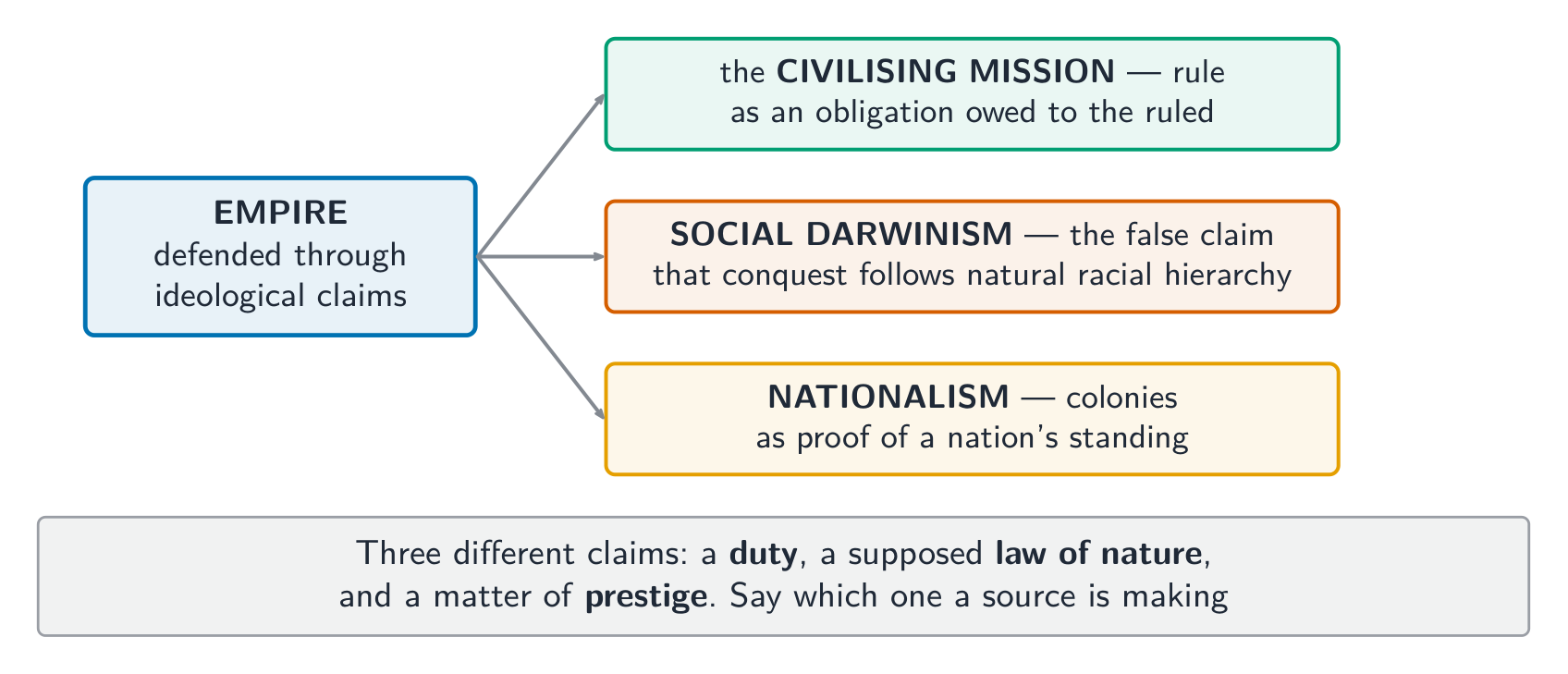
Which kind of ideology is this?
Sort each justification by the CED's three categories.
What did Social Darwinism claim?
Dificuldade 1/5 · Moedas 100 + pequeno bônus na primeira conclusão hoje
A false claim.
Worked example: what a justification tells us
- Source: Jules Ferry, a former French prime minister, told parliament in July 1885 that "the superior races have a right … and a duty to civilise the inferior races".
- Claim: a civilising mission 教化使命 — empire as a duty to bring progress.
- What it reveals: the speech tells us about French beliefs and politics, not about the colonised people. Ferry also argued that colonies gave France markets and prestige.
Which reasons did Ferry give for colonies?
Dificuldade 2/5 · Moedas 140 + pequeno bônus na primeira conclusão hoje
Ferry in 1885.
A justification for empire tells us mainly about the beliefs of the person who made it.
Dificuldade 1/5 · Moedas 100 + pequeno bônus na primeira conclusão hoje
It is evidence about the justifier.
Nationalism pointed outward
- Colonies became a sign of national greatness: Germany sought "a place in the sun", and newly united Italy invaded Ethiopia in 1895–96.
- Rival empires competed for land to avoid falling behind.
Religious missions
- Christian missionaries built schools, clinics and churches in Africa and Asia; by 1900, thousands worked in Africa.
- Some missionaries also criticised colonial abuses, as in the campaign against Leopold's Congo.
Match each to its type of justification.
Dificuldade 2/5 · Moedas 140 + pequeno bônus na primeira conclusão hoje
Three kinds.
Social Darwinism was not real science. Darwin described species in nature; there is no biological basis for ranking human races.
Social Darwinism was real science.
Dificuldade 1/5 · Moedas 100 + pequeno bônus na primeira conclusão hoje
No biological basis for ranking races.
Imperialists justified empire with Social Darwinism, the civilising mission, outward nationalism and religious missions. Kipling's "White Man's Burden" and Ferry's 1885 speech show that these ideas tell us most about the beliefs of those who held them.
Explain how imperialists justified empire in the 19th century.
Ideas.