Reactions to the Industrial Economy
Introduzido| English | Significado |
|---|---|
| labour unions/ˈleɪbə ˈjuːnɪənz/ | sindicatos |
| socialism/ˈsəʊʃəlɪzəm/ | socialismo |
| communism/ˈkɒmjuːnɪzəm/ | comunismo |
The dockers' sixpence, August 1889
- In August 1889, dock workers in London went on strike. Most were hired by the hour and often found no work at all. They demanded a wage of sixpence an hour — "the docker's tanner". About 100 000 workers joined, and supporters as far away as Australia sent about 30 000 pounds to feed the strikers' families. After five weeks, the employers gave in.
- In the 19th century, people responded to industrial society by organising, by reforming it and by proposing to replace it.
The dockers demanded sixpence an hour. At that rate, how many pence for a 10-hour day?
Dificuldade 2/5 · Moedas 140 + pequeno bônus na primeira conclusão hoje
6 × 10.
Workers organised
- Labour unions 工会 bargained for higher wages, shorter hours and safer conditions.
- At first many governments banned unions; Britain legalised them in 1871.
What did labour unions bargain for?
Dificuldade 1/5 · Moedas 100 + pequeno bônus na primeira conclusão hoje
Better terms.
Governments reformed
- Britain's Factory Act of 1833 limited children's working hours; cities built sewers and clean water.
- Germany under Bismarck introduced health insurance (1883) and old-age pensions (1889).
Which kind of response is this?
Sort each reaction to the industrial economy.
Match each reform to its country.
Dificuldade 2/5 · Moedas 140 + pequeno bônus na primeira conclusão hoje
Reforms.
Worked example: new ideologies
- Socialism 社会主义: workers or the state should own the main industries and share wealth more equally.
- Communism 共产主义: Marx and Engels's Communist Manifesto (1848) argued that workers would overthrow capitalism and create a classless society.
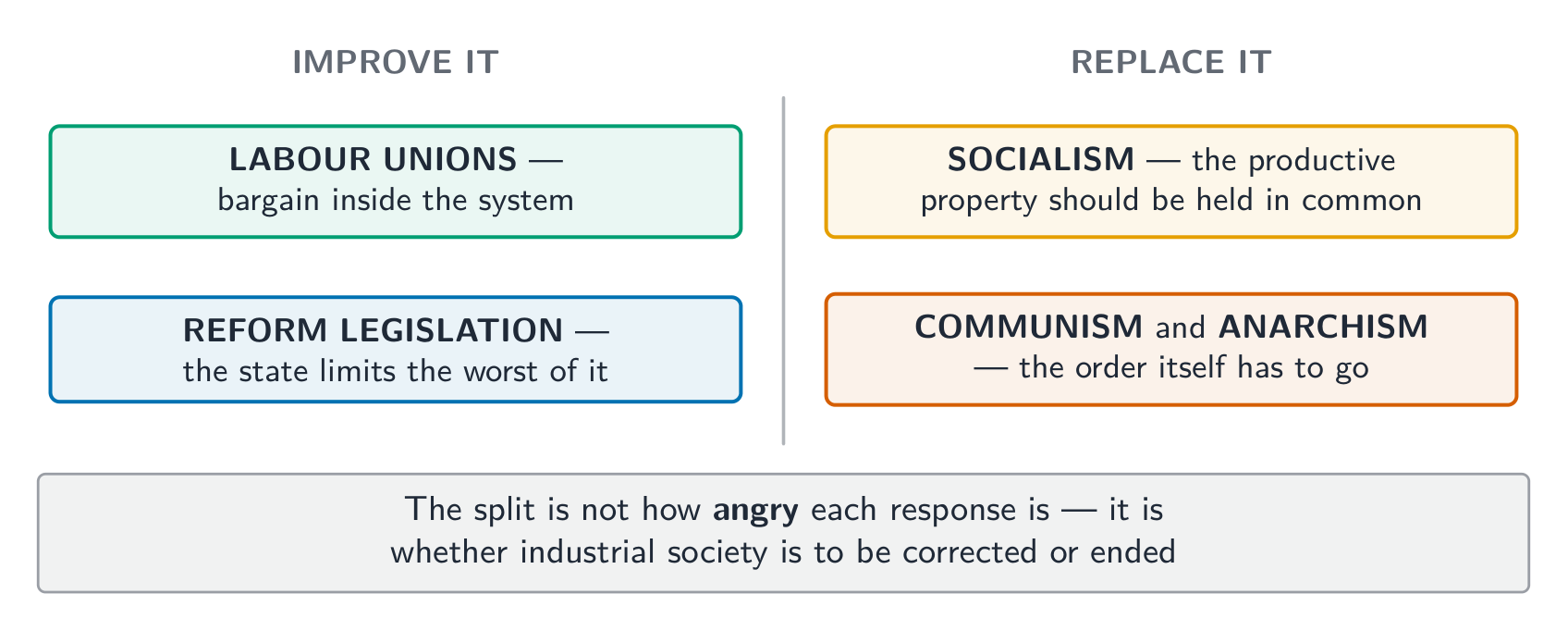
- Difference from unions: unions wanted better terms inside industrial capitalism; Marx wanted to replace it.
Put these in order.
Dificuldade 3/5 · Moedas 200 + pequeno bônus na primeira conclusão hoje
1833, 1848, 1861, 1889.
Reform outside the industrial core
- The Ottoman Tanzimat reforms (1839–76) modernised the army, law and schools.
- In China, the Self-Strengthening Movement (1861–95) built arsenals and shipyards, but kept Confucian government.
Sorting the responses
- Organise or reform: unions, factory laws, social insurance.
- Replace: socialism and communism. Catch up: Ottoman and Qing modernisation.
Match each to its kind of response.
Dificuldade 2/5 · Moedas 140 + pequeno bônus na primeira conclusão hoje
Three kinds.
Socialism and unions were not the same. Many unions only wanted better wages within capitalism, while socialists wanted to change who owned industry.
All unions wanted to replace capitalism.
Dificuldade 1/5 · Moedas 100 + pequeno bônus na primeira conclusão hoje
Many wanted better terms within it.
Workers organised unions, as in the 1889 London dock strike; governments passed factory laws and social insurance; socialists and communists proposed replacing capitalism; and states like the Ottomans and Qing tried to catch up through modernisation.
Compare unions and communism as responses to industrial capitalism.
Comparison.