New Classes, New Cities
Introduzido| English | Significado |
|---|---|
| industrial working class/ɪnˈdʌstrɪəl ˈwɜːkɪŋ klæs/ | classe operária industrial |
| middle class/ˈmɪdl klæs/ | classe média |
A young German walks through Manchester, 1842–44
- In 1842, Friedrich Engels, aged 22, went to work at his family's cotton mill in Manchester, England. He spent two years walking through workers' districts, where families lived in damp cellars beside open sewers. In 1845 he published The Condition of the Working Class in England. In parts of Manchester at that time, the average age at death for labourers was about 17, partly because so many children died.
- Industrialisation created new social classes, divided women's lives by class and made cities grow faster than they could cope.
What did Engels describe in 1845?
Dificuldade 1/5 · Moedas 100 + pequeno bônus na primeira conclusão hoje
The Condition of the Working Class in England.
Two new classes
- The industrial working class 工业工人阶级: men, women and children who worked for wages in factories and mines.
- The middle class 中产阶级: factory owners, managers, merchants, doctors and lawyers, who grew richer and gained political power.
Match each person to their class.
Dificuldade 2/5 · Moedas 140 + pequeno bônus na primeira conclusão hoje
New classes.
Class divided women's lives
- Working-class women and girls worked long hours in mills or as servants for low wages.
- Middle-class women were expected to stay at home and run the household — the "separate spheres" ideal.
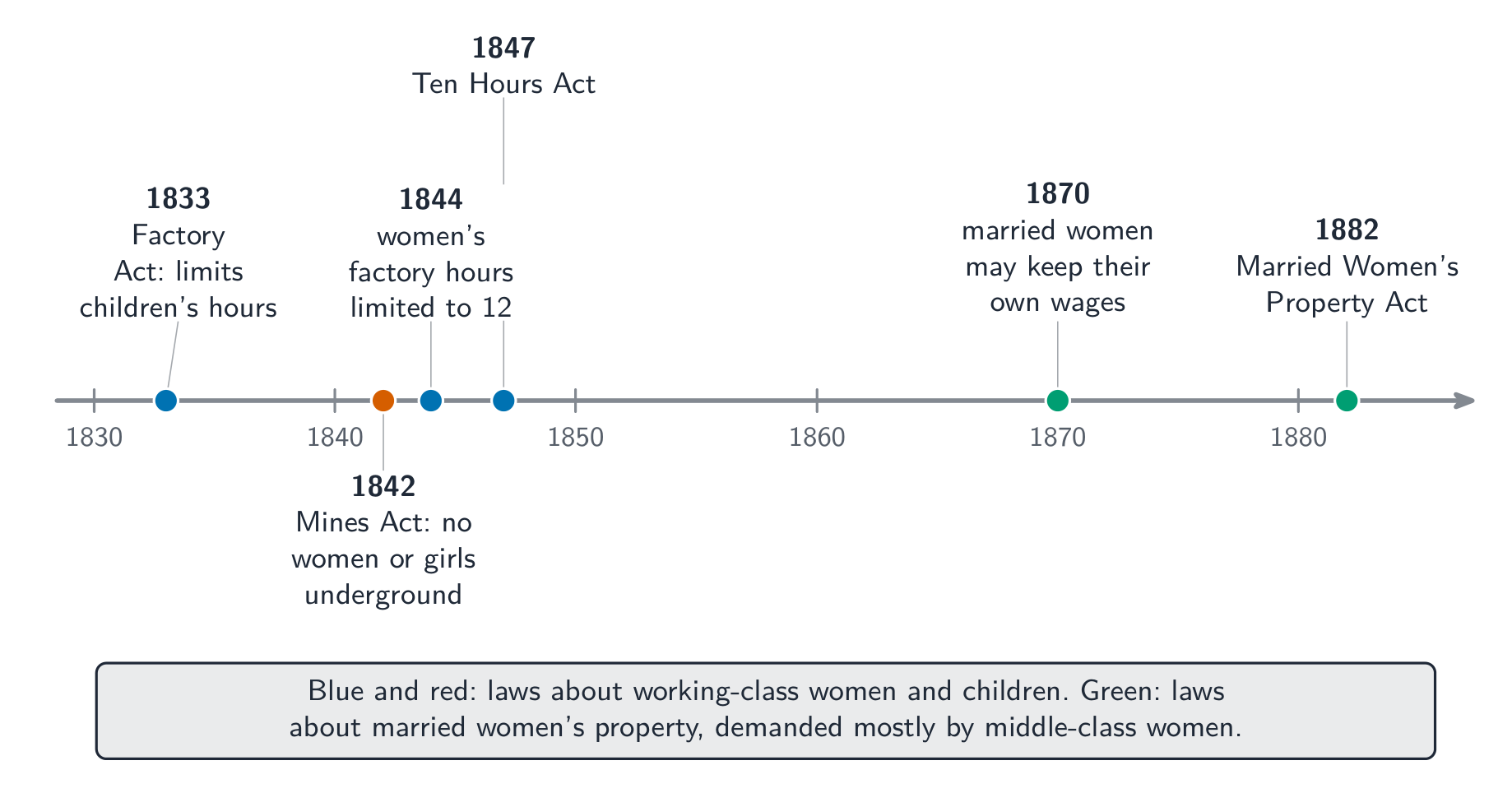
New class, gendered experience, or urban challenge?
Sort each development in industrial society.
What was the "separate spheres" ideal?
Dificuldade 1/5 · Moedas 100 + pequeno bônus na primeira conclusão hoje
Class divided women's lives.
Worked example: a city that could not cope
- Growth: Manchester grew from about 75 000 people in 1801 to about 300 000 in 1851 — four times as many.
- Problems: houses were built back to back, without clean water or sewers; cholera killed thousands in 1832 and 1849.
- Responses: Britain's Public Health Act (1848) let towns build sewers and water supplies, and London's sewer system was built after the "Great Stink" of 1858.
Manchester grew from about 75 000 to about 300 000. How many times as large?
Dificuldade 2/5 · Moedas 140 + pequeno bônus na primeira conclusão hoje
300 000 ÷ 75 000.
Standards of living
- In the short run, many workers lived worse than farmers; in the long run, real wages rose after about 1850.
- The middle class enjoyed new comforts, such as large homes and servants.
Beyond Britain
- The same changes followed industry to Germany, the United States, Russia and Japan.
- In Japan, young women made up most of the workers in silk mills by the 1890s.
Match each to its category.
Dificuldade 2/5 · Moedas 140 + pequeno bônus na primeira conclusão hoje
Three categories.
Industrialisation did not make life better for everyone at once. "For some" is the key: owners and the middle class gained first, while many workers lived in danger and poverty for decades.
Industrialisation improved life for everyone at once.
Dificuldade 1/5 · Moedas 100 + pequeno bônus na primeira conclusão hoje
Only for some at first.
Industrialisation created a working class and a growing middle class. Working-class women worked for wages while middle-class women stayed at home. Cities like Manchester grew four times over in 50 years, bringing cholera and pollution until public health reforms.
Explain how industrialisation changed social structures and cities.
Change.