Free Trade, Firms and Finance
Introduzido| English | Significado |
|---|---|
| stock markets/stɒk ˈmɑːkɪts/ | mercados de ações |
| laissez-faire capitalism/ˈleɪsez feə ˈkæpɪtəlɪzəm/ | capitalismo laissez-faire |
| transnational/trænˈsnæʃənl/ | transnacional |
| limited-liability corporations/ˈlɪmɪtɪd ˌlaɪəˈbɪlɪti ˌkɔːpəˈreɪʃnz/ | corporações de responsabilidade limitada |
A bank for the China trade, March 1865
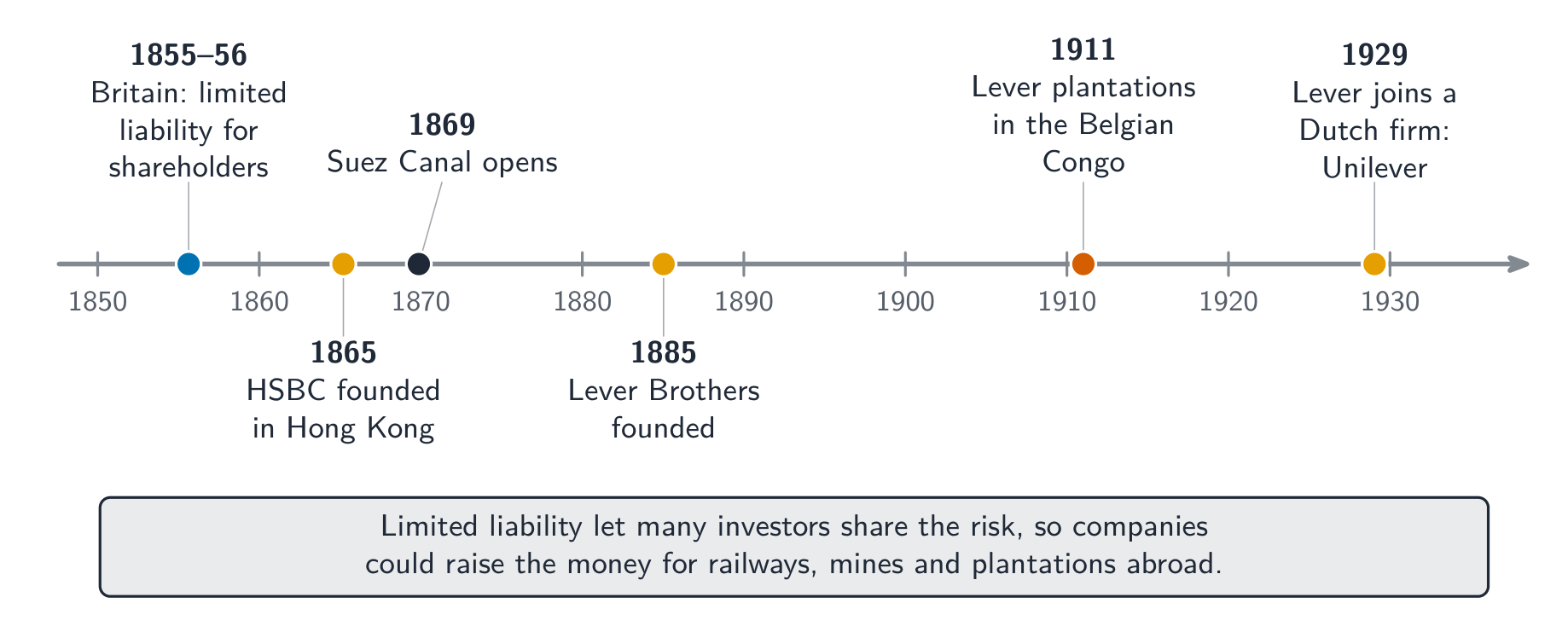
- In March 1865, Thomas Sutherland, a Scottish shipping manager, opened the Hongkong and Shanghai Banking Corporation (HSBC) in Hong Kong, with a branch in Shanghai a month later. Its purpose was to finance trade between China, Europe and India. It grew into one of the world's largest banks. Firms like HSBC show how money and companies began to cross borders in the 19th century.
- In the 19th century, new ideas and institutions — free trade, corporations and stock markets — spread industrial capitalism.
What was HSBC founded to do in 1865?
Dificuldade 1/5 · Moedas 100 + pequeno bônus na primeira conclusão hoje
A bank for the China trade.
Mercantilism gave way
- Under mercantilism, states protected their own trade and tried to export more than they imported.
- Adam Smith's The Wealth of Nations (1776) argued for laissez-faire capitalism 自由放任资本主义: markets work best with little government control. Britain ended its Corn Laws in 1846 and moved to free trade.
What did Adam Smith argue?
Dificuldade 1/5 · Moedas 100 + pequeno bônus na primeira conclusão hoje
Laissez-faire.
Firms outgrew their countries
- Transnational 跨国的 businesses operated in many countries: HSBC in banking, and Lever Brothers (later Unilever) in soap made from palm oil from West Africa.
- They needed huge amounts of money to build railways, mines and factories.
System, ideology, or institution?
Sort each item into the objective's three categories.
Match each to its category.
Dificuldade 2/5 · Moedas 140 + pequeno bônus na primeira conclusão hoje
System, ideology, institution.
Worked example: limited liability
- Rule: Britain's Limited Liability Act (1855) meant shareholders could lose only the money they invested, not their homes or savings.
- Method: an investor buys 100 pounds of shares; if the firm fails with large debts, the investor loses only the 100 pounds.
- Effect: more people were willing to invest, so limited-liability corporations 有限责任公司 could raise huge sums for railways and factories.
An investor buys 250 pounds of shares in a limited-liability firm that fails with large debts. What is the most the investor can lose, in pounds?
Dificuldade 2/5 · Moedas 140 + pequeno bônus na primeira conclusão hoje
Only what was invested.
Stock markets
- Stock markets 股票市场 in London, New York and elsewhere let investors buy and sell shares easily.
- Money from Britain flowed to railways in the US, Argentina and India.
What it all produced
- Global industrial production rose fast, and trade between continents grew.
- The system also brought financial crises, such as the Panic of 1873, which spread from Vienna to New York.
Put these in order.
Dificuldade 3/5 · Moedas 200 + pequeno bônus na primeira conclusão hoje
1776, 1846, 1855, 1865.
Laissez-faire did not mean no government at all. States still built infrastructure, protected property and, in many countries, kept tariffs.
Laissez-faire meant there was no government role at all.
Dificuldade 1/5 · Moedas 100 + pequeno bônus na primeira conclusão hoje
States still built infrastructure and protected property.
In the 19th century, laissez-faire ideas replaced mercantilism, transnational firms like HSBC and Unilever grew, and limited liability and stock markets let investors fund industry across the world — spreading industrial capitalism, and its crises, globally.
Explain how new financial institutions spread industrial capitalism.
Causation.