States That Industrialised on Purpose
Introduzido| English | Significado |
|---|---|
| Iwakura Mission | The Japanese government delegation that toured the United States and Europe from 1871 to 1873 to study Western industry, schools and government. |
| Meiji Era/ˈmeɪdʒi ˈɪərə/ | Era Meiji |
A government goes abroad to learn, 1871
- In December 1871, about 50 Japanese officials and students, led by Iwakura Tomomi, sailed for San Francisco. The Iwakura Mission 岩仓使节团 spent nearly two years in the United States and Europe, visiting factories, shipyards, schools and parliaments. Its members returned convinced that Japan must industrialise quickly or be dominated like China.
- In the 19th century, some states outside Western Europe industrialised on purpose, using government power.
What did the Iwakura Mission conclude?
Dificuldade 1/5 · Moedas 100 + pequeno bônus na primeira conclusão hoje
Learning from the West.
Industrialisation as policy
- In Britain, industry grew mostly through private business. In Egypt and Japan, rulers directed it.
- Their aim: keep the value of raw materials at home and stay strong against Western powers.
In Egypt and Japan, industry was directed by the government.
Dificuldade 1/5 · Moedas 100 + pequeno bônus na primeira conclusão hoje
Unlike Britain's private model.
Egypt under Muhammad Ali
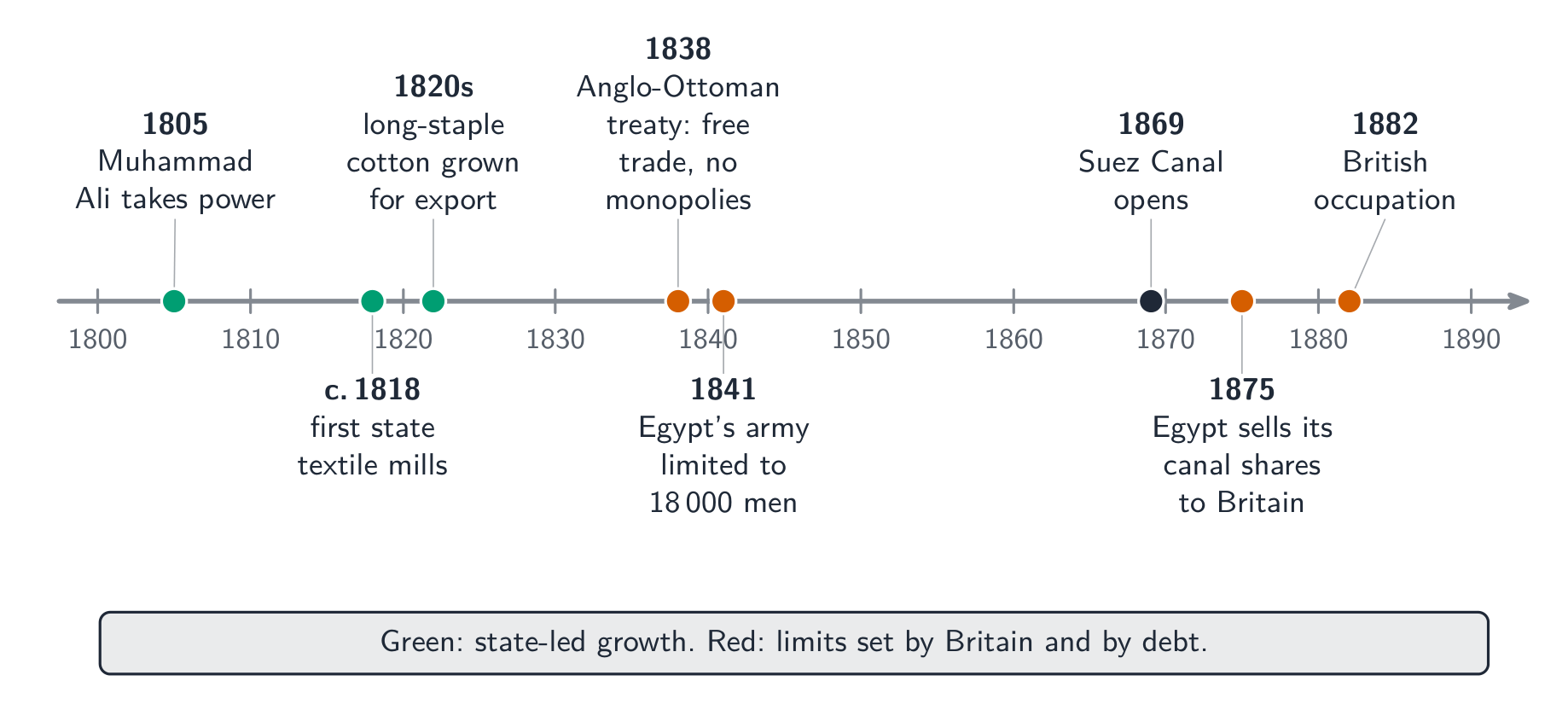
- From about 1805, Muhammad Ali, the ruler of Egypt, built state-owned textile mills, arms factories and a modern army.
- He forced farmers to grow cotton and sold it through a state monopoly.
Cause, method, or effect?
Sort each element of state-sponsored industrialisation.
Worked example: Japan in the Meiji Era
- Cause: in 1853, US warships under Commodore Perry forced Japan to open its ports.
- Method: in the Meiji Era 明治时代 (1868–1912), the government built railways, telegraphs and model factories, such as the Tomioka silk mill (1872), then sold many to private firms.
- Effect: by 1905, Japan defeated Russia in war and became a regional power with its own empire.
Match each to cause, method or effect.
Dificuldade 2/5 · Moedas 140 + pequeno bônus na primeira conclusão hoje
Japan's industrialisation.
The Meiji Era lasted from 1868 to 1912. How many years?
Dificuldade 2/5 · Moedas 140 + pequeno bônus na primeira conclusão hoje
1912 − 1868.
Two models, one goal
- Both Egypt and Japan used the state to start industry.
- Japan's reforms lasted; Egypt's mills declined after the 1840s, when British pressure forced it to open its markets and Muhammad Ali's army was cut.
Why Egypt fell behind
- Cheaper British cloth competed with Egyptian mills, and Egypt had little coal.
- Later, Egypt's rulers borrowed heavily, and in 1882 Britain occupied Egypt.
Why did Egypt's industrialisation fail?
Dificuldade 2/5 · Moedas 140 + pequeno bônus na primeira conclusão hoje
Outside pressure and resources.
Industrialisation was not only a Western story. Egypt and Japan tried state-led industrialisation; Japan succeeded, and Egypt's failure came partly from outside pressure.
Only Western countries tried to industrialise in the 19th century.
Dificuldade 1/5 · Moedas 100 + pequeno bônus na primeira conclusão hoje
Egypt and Japan did too.
Egypt under Muhammad Ali and Meiji Japan used state power to industrialise, building mills, railways and armies. Japan, pushed by the US in 1853, succeeded and became a regional power; Egypt's effort faded under British competition and pressure, ending in occupation in 1882.
Compare state-led industrialisation in Egypt and Japan.
Comparison.