Resistance to State Power
Introduzido| English | Significado |
|---|---|
| Maroon societies/məˈruːn səˈsaɪətiz/ | Communities of people who had escaped slavery, usually hidden in forests or mountains, such as Palmares in Brazil. |
Knotted cords and a revolt, August 1680
- In August 1680, runners carried knotted cords to Pueblo villages across New Mexico. Each knot marked a day until the rising. The leader, Popé, had been whipped by Spanish officials for practising his religion. On 10 August, the Pueblo rose together, killed about 400 Spanish colonists and priests and drove about 2000 survivors south to El Paso. Spain did not return for 12 years.
- From 1450 to 1750, as states grew more powerful, many groups resisted them.
The Pueblo drove the Spanish out in 1680, and Spain returned 12 years later. In which year?
Dificuldade 2/5 · Moedas 140 + pequeno bônus na primeira conclusão hoje
1680 + 12.
Centralisation produced resistance
- Rulers raised taxes, built armies and limited the power of nobles.
- Nobles, peasants, colonised peoples and enslaved people resisted in different ways.
Elites resisted too
- In France, nobles and judges rose against the crown in the Fronde (1648–53); the young Louis XIV later built Versailles partly to control the nobility.
- In Russia, Peter the Great reduced the power of the old nobles, the boyars, and made them serve the state.
Who is resisting, and what?
Sort each case by the kind of group that resisted.
Who rose against the French crown in the Fronde?
Dificuldade 1/5 · Moedas 100 + pequeno bônus na primeira conclusão hoje
Elites resisted too.
Worked example: colonised peoples resisted
- Pueblo Revolt (1680): Pueblo peoples drove the Spanish out of New Mexico for 12 years.
- Metacom's War (1675–76): Native nations in New England, led by Metacom (King Philip), fought English settlers; about 600 colonists and perhaps 3000 Native people died.
- Comparison: both resisted land loss and religious pressure; the Pueblo won a period of freedom, while Metacom's War ended in defeat.
How did the Pueblo Revolt and Metacom's War differ in result?
Dificuldade 1/5 · Moedas 100 + pequeno bônus na primeira conclusão hoje
Comparison.
Enslaved people organised
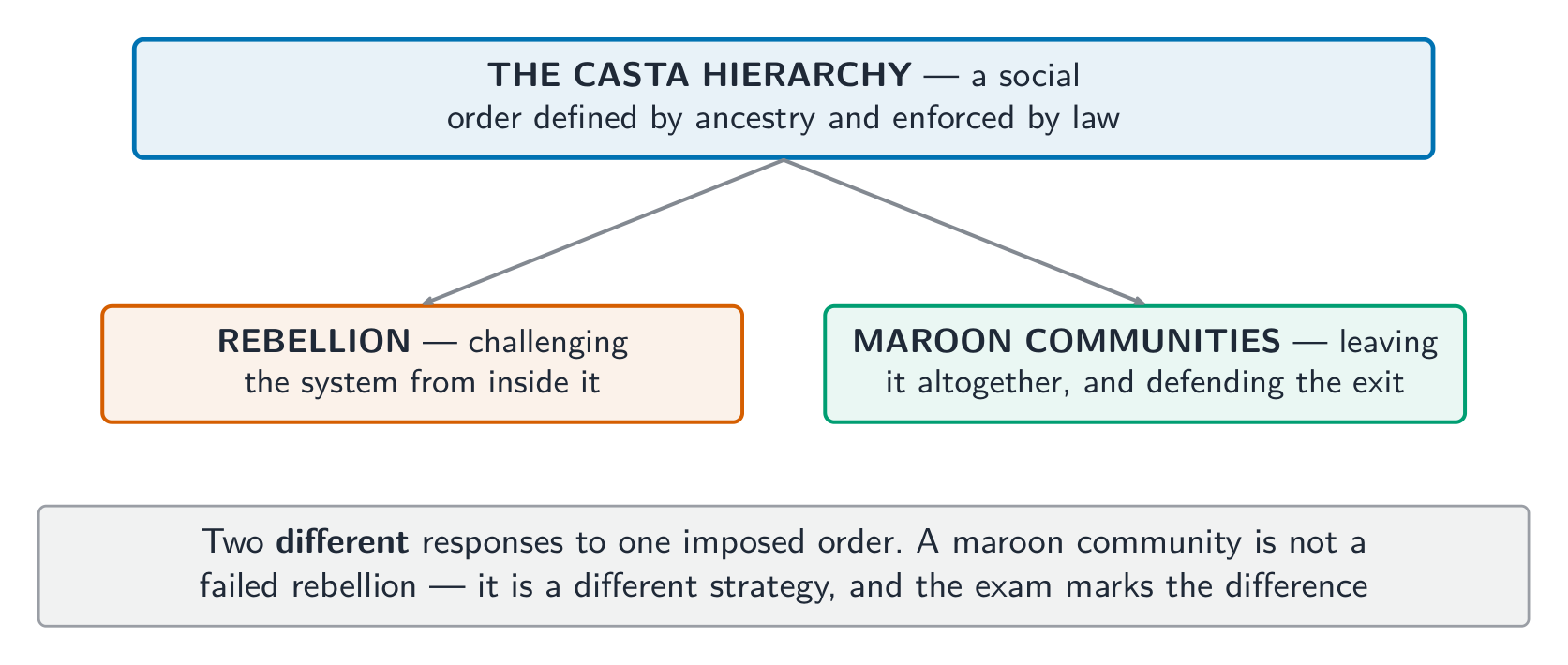
- Escaped enslaved people formed Maroon societies 逃亡奴隶社区 in forests and mountains. Palmares in Brazil held perhaps 10 000 people for most of the 17th century until 1694.
- In North America, enslaved people resisted by running away, slowing work and, in the Stono Rebellion (1739), armed revolt.
Match each revolt to who resisted.
Dificuldade 2/5 · Moedas 140 + pequeno bônus na primeira conclusão hoje
Who is resisting.
Resistance as evidence
- Revolts show where state power pressed hardest: on taxes, land, religion and labour.
- States often answered with force but sometimes changed policies — Spain later allowed Pueblo religious practices more freedom.
Put these in order.
Dificuldade 3/5 · Moedas 200 + pequeno bônus na primeira conclusão hoje
1648, 1675, 1680, 1694.
Resistance was not only by the poor. Nobles in the Fronde and boyars in Russia resisted centralising rulers too.
Only the poor resisted state power.
Dificuldade 1/5 · Moedas 100 + pequeno bônus na primeira conclusão hoje
Nobles did too.
As states centralised from 1450 to 1750, nobles (the Fronde), colonised peoples (the Pueblo Revolt, Metacom's War) and enslaved people (Palmares, Stono) resisted. These revolts show where state power pressed hardest.
Explain why groups resisted state power between 1450 and 1750.
Causation.