The Columbian Exchange
Introduzido| English | Significado |
|---|---|
| Columbian Exchange/kəˈlʌmbɪən eksˈtʃeɪndʒ/ | Intercâmbio Colombiano |
| plantation/plænˈteɪʃn/ | plantation |
An emperor dies of smallpox, December 1520
- In 1520, smallpox reached Tenochtitlan, the Aztec capital, probably carried by an enslaved African man in a Spanish expedition. The Aztecs had no immunity. The new emperor, Cuitláhuac, who had just driven Cortés out of the city, died of it after about 80 days in power. When the Spanish returned in 1521, the weakened city fell.
- After 1492, plants, animals, diseases and people crossed the Atlantic in both directions — the Columbian Exchange 哥伦布大交换.
Why did smallpox kill so many in Tenochtitlan?
Dificuldade 1/5 · Moedas 100 + pequeno bônus na primeira conclusão hoje
A new disease.
A biological exchange, both ways
- From the Americas to Afro-Eurasia: maize, potatoes, cassava, tomatoes, cacao and tobacco.
- From Afro-Eurasia to the Americas: horses, cattle, pigs, wheat, sugar cane — and diseases.
Match each to the direction it travelled.
Dificuldade 2/5 · Moedas 140 + pequeno bônus na primeira conclusão hoje
Both directions.
Disease hit first and hardest
- Smallpox, measles and influenza killed vast numbers of Native Americans. Central Mexico's population may have fallen from about 20 million in 1519 to about 1–2 million by 1600.
- Malaria came with enslaved Africans and spread in tropical regions.
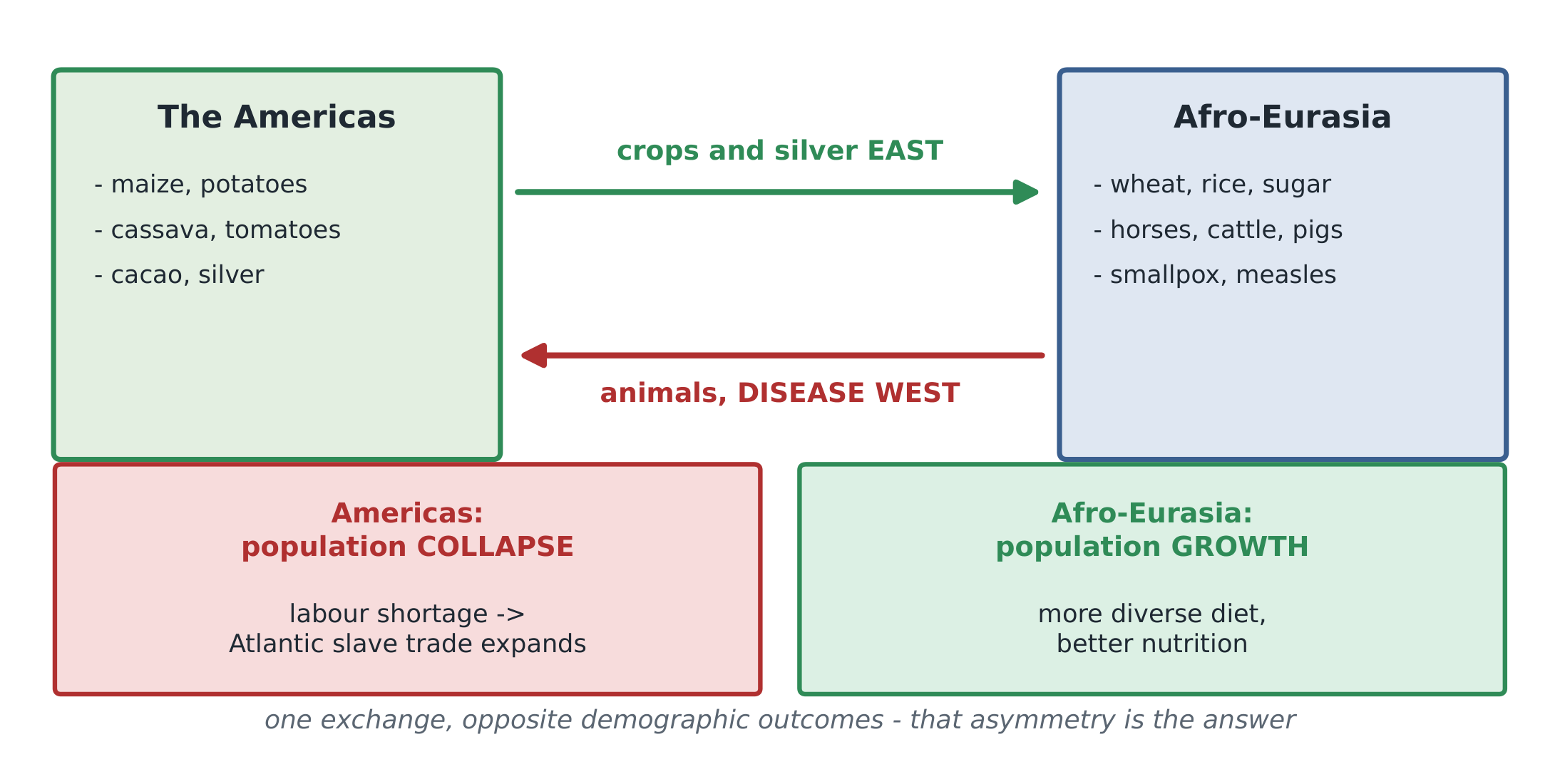
Follow the Columbian Exchange both ways
The CED insists on both directions and on the demographic consequence that follows.
Central Mexico fell from about 20 million to about 2 million. What percentage was lost?
Dificuldade 2/5 · Moedas 140 + pequeno bônus na primeira conclusão hoje
(20 − 2) ÷ 20.
Worked example: American crops fed the Old World
- Crop: the potato grew well in cool, poor soils and gave more food per hectare than wheat.
- Spread: it reached Europe in the 1570s; maize and sweet potatoes reached China in the 16th century.
- Effect: more food supported population growth — China's population roughly doubled in the 18th century, to about 300 million by 1800.
China's population roughly doubled to about 300 million by 1800. About what was it at the start of the century?
Dificuldade 2/5 · Moedas 140 + pequeno bônus na primeira conclusão hoje
300 ÷ 2.
Cash crops are a different category
- Sugar, tobacco and later cotton were grown for sale on plantations 种植园 — large estates worked by enslaved Africans.
- The demand for plantation labour drove the Atlantic slave trade.
Which were plantation cash crops?
Dificuldade 2/5 · Moedas 140 + pequeno bônus na primeira conclusão hoje
Potatoes were a food crop.
What went west
- Horses changed life on the American Plains: groups such as the Comanche became mounted hunters and warriors.
- Cattle and pigs spread across the Americas and changed the land.
The exchange was not equal. Both sides gained new foods, but Native Americans suffered catastrophic population loss from disease.
The Columbian Exchange affected both sides equally.
Dificuldade 1/5 · Moedas 100 + pequeno bônus na primeira conclusão hoje
Native Americans suffered catastrophic loss.
After 1492, the Columbian Exchange carried American crops like potatoes and maize to Afro-Eurasia, feeding population growth, and brought horses, cattle, sugar and deadly diseases to the Americas. Smallpox killed millions — including the emperor Cuitláhuac in 1520 — and plantations drove the slave trade.
Explain the effects of the Columbian Exchange on the Americas and Afro-Eurasia.
Comparison of effects.