Legitimacy and Revenue
Introduzido| English | Significado |
|---|---|
| devshirme/ˈdevʃɜːm/ | The Ottoman system of taking Christian boys, converting them to Islam and training them as soldiers or officials loyal to the sultan. |
| divine right/dɪˈvaɪn raɪt/ | divine right |
| Tax farming/tæks ˈfɑːmɪŋ/ | Tax farming |
| salaried samurai/ˈsælərid ˈsæmjʊəraɪ/ | Japanese warriors under the Tokugawa shoguns who were paid stipends in rice instead of holding their own land. |
Taxes in silver, 1581
- In 1581, Zhang Juzheng, the chief minister of Ming China, extended the "Single Whip" reform across the empire. Many separate taxes and labour duties were combined into one payment in silver. Much of that silver came from Spanish mines at Potosí in South America, carried across the Pacific to Manila. To pay the state, Chinese farmers now had to sell crops for silver.
- From 1450 to 1750, rulers needed ways to win obedience, keep control and raise money.
What did the Single Whip reform require?
Dificuldade 1/5 · Moedas 100 + pequeno bônus na primeira conclusão hoje
Combined into one silver payment.
Rulers needed people they could control
- Rulers wanted officials and soldiers loyal to them, not to local nobles.
- The Ottoman devshirme 德夫希尔梅制度 took Christian boys to train as servants of the sultan.
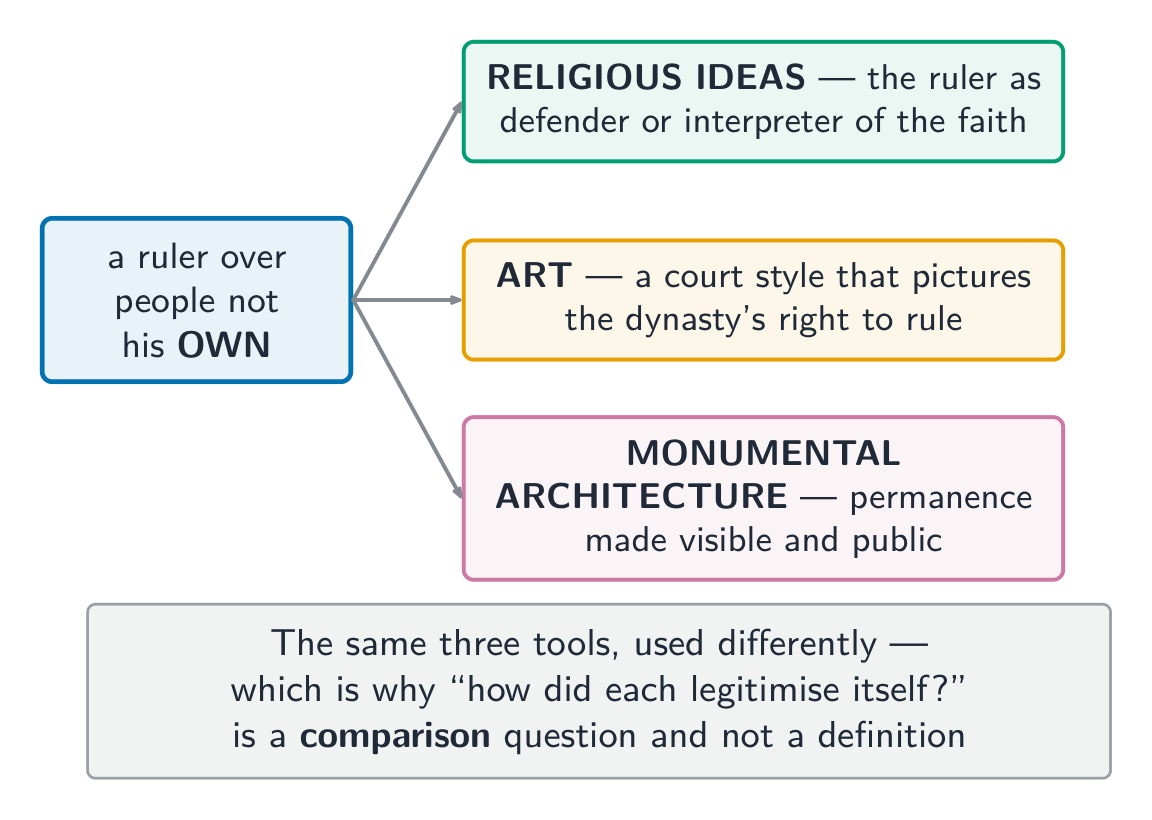
Legitimacy you can see
- Mughal rulers built great mosques and tombs, such as the Taj Mahal (1632–53).
- European kings claimed divine right 君权神授: that their power came from God.
Legitimising, consolidating, or raising revenue?
Sort each method by the job it does.
What did divine right claim?
Dificuldade 1/5 · Moedas 100 + pequeno bônus na primeira conclusão hoje
European legitimacy.
Worked example: three ways to raise money
- Ming China: taxes paid in silver under the Single Whip reform.
- Ottoman Empire: Tax farming 包税制 — private collectors bought the right to collect taxes.
- Mughal Empire: zamindars collected land taxes from peasants. Each method raised money but had a cost: silver tied China to foreign supply, and tax farmers could squeeze peasants.
Consolidating control
- In Japan, the Tokugawa shoguns made samurai live in castle towns and paid them stipends in rice — salaried samurai 领俸禄的武士 depended on the shogun, not their own land.
- Louis XIV kept nobles busy at Versailles so they could not rebel.

Why did paying samurai stipends consolidate the shogun's control?
Dificuldade 1/5 · Moedas 100 + pequeno bônus na primeira conclusão hoje
Dependence.
Every method had a cost
- The Taj Mahal took about 20 000 workers and over 20 years to build.
- When silver supplies fell in the 1630s, Ming finances weakened, a factor in the dynasty's fall in 1644.
Match each to its purpose.
Dificuldade 2/5 · Moedas 140 + pequeno bônus na primeira conclusão hoje
Three purposes.
The Taj Mahal was built from 1632 to 1653. How many years?
Dificuldade 2/5 · Moedas 140 + pequeno bônus na primeira conclusão hoje
1653 − 1632.
Legitimising and consolidating are different. Legitimising makes people accept a ruler's right; consolidating strengthens his control. A monument legitimises; salaried samurai consolidate.
Legitimising and consolidating power mean exactly the same thing.
Dificuldade 1/5 · Moedas 100 + pequeno bônus na primeira conclusão hoje
Acceptance versus control.
From 1450 to 1750, rulers legitimised power with monuments and divine right, consolidated it with loyal servants like the devshirme and salaried samurai, and raised revenue through silver taxes, tax farming and land taxes — each method with its own cost.
Explain how rulers raised revenue between 1450 and 1750, and the costs.
Methods and costs.