The Mongol Empire
Introduzido| English | Significado |
|---|---|
| khanate | A state ruled by a khan; the Mongol Empire split into four khanates, such as the Yuan dynasty in China. |
| Uyghur script | The alphabet of the Uyghur people of Central Asia, which the Mongols adopted to write their own language. |
The fall of Baghdad, February 1258
- In February 1258, a Mongol army under Hülegü, a grandson of Genghis Khan, captured Baghdad, the capital of the Abbasid caliphs for 500 years. The city was looted, the caliph was killed, and tens of thousands of people died. Yet a few years later, Hülegü built a great observatory at Maragha in Persia and brought astronomers from across the Islamic world to work there.
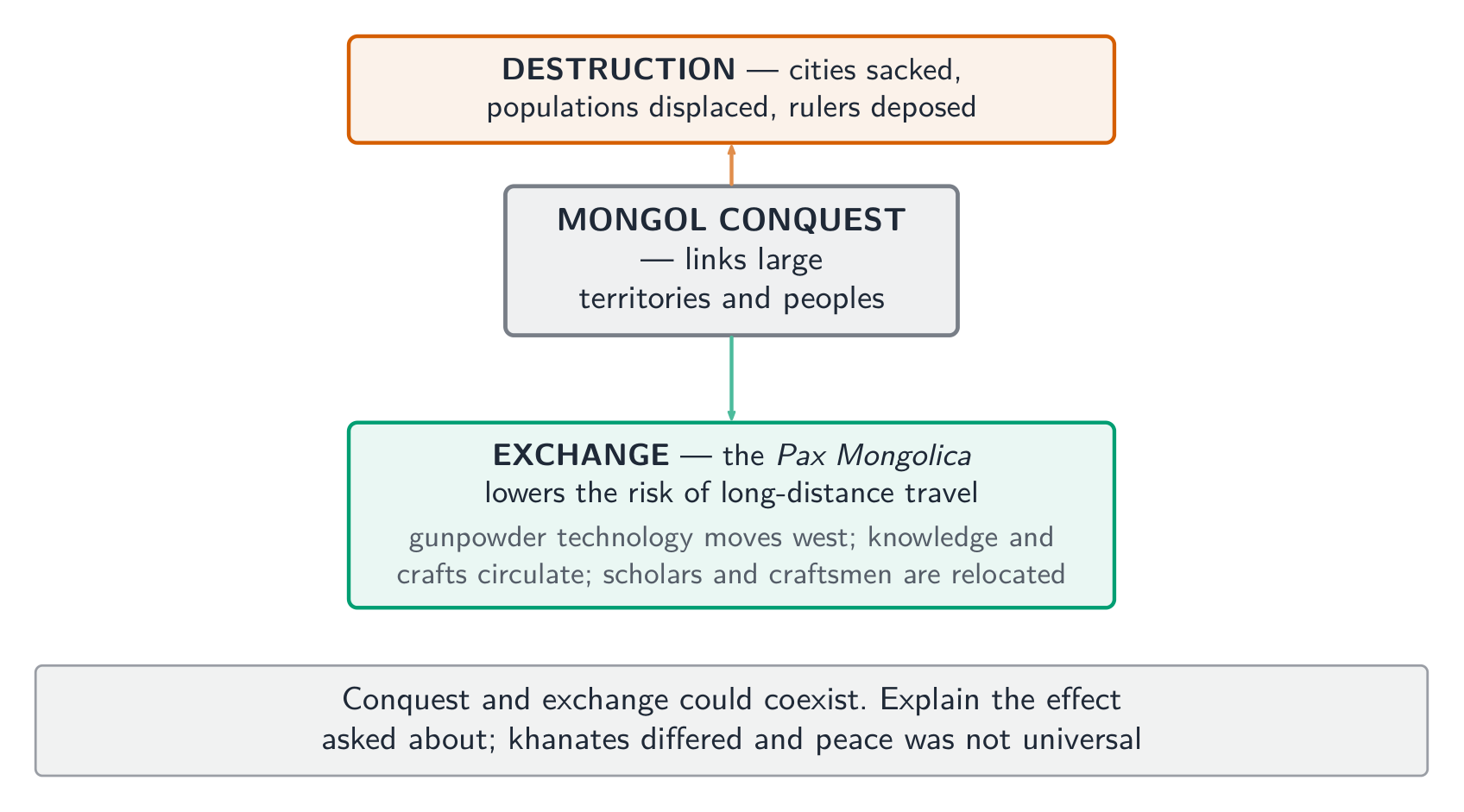
- The Mongol Empire destroyed old empires, but it also connected Eurasia and moved people and knowledge across it.
Baghdad had been the Abbasid capital for about 500 years before 1258. In about which year did it become the capital?
Dificuldade 2/5 · Moedas 140 + pequeno bônus na primeira conclusão hoje
Founded in 762.
Empires fell and were replaced
- From 1206, Genghis Khan united the Mongols; his successors conquered China, Central Asia, Persia and Russia — the largest land empire in history.
- It split into four parts, each a khanate 汗国 (a state ruled by a khan), such as the Yuan dynasty in China and the Ilkhanate in Persia.
Match each khanate to its region.
Dificuldade 2/5 · Moedas 140 + pequeno bônus na primeira conclusão hoje
Four khanates.
Conquest widened the network
- The Mongols protected merchants and kept the Silk Roads under one authority, the Pax Mongolica.
- Messengers used relay stations to cross the empire quickly.
Continuity, change, or a transfer?
Sort each Mongol-era item.
What was the Pax Mongolica?
Dificuldade 1/5 · Moedas 100 + pequeno bônus na primeira conclusão hoje
Conquest widened the network.
Worked example: a relocated astronomer
- Who: in 1267, the Persian astronomer Jamal al-Din travelled to the court of Kublai Khan in China.
- What he brought: models of astronomical instruments and a new calendar.
- Effect: Chinese astronomers, such as Guo Shoujing, built improved instruments and an accurate calendar in 1280. Knowledge moved because the Mongols moved people.
Put these in order.
Dificuldade 3/5 · Moedas 200 + pequeno bônus na primeira conclusão hoje
1206, 1258, 1267, 1280.
Contact moved knowledge
- Greco-Islamic medical knowledge reached western Europe, and Chinese printing and gunpowder spread west.
- The Mongols adopted the Uyghur script 回鹘文 to write their own language, used for laws and records.
Continuity and change
- Change: new khanates replaced the Abbasids, the Song and others.
- Continuity: the Mongols used local Confucian and Islamic officials and institutions to govern, and the trade routes and cities stayed.
Match each to its category.
Dificuldade 2/5 · Moedas 140 + pequeno bônus na primeira conclusão hoje
Continuity, change, transfer.
The Mongols were not only destroyers. Their conquests killed millions, but they also protected trade and moved scholars, artisans and ideas across Eurasia.
The Mongols only destroyed and never built.
Dificuldade 1/5 · Moedas 100 + pequeno bônus na primeira conclusão hoje
They protected trade and moved knowledge.
The Mongols built the largest land empire, destroying states like the Abbasid caliphate in 1258. But they protected the Silk Roads and moved people such as Jamal al-Din, spreading astronomy, medicine and technology, and they governed through local institutions.
Explain the effects of the Mongol Empire on Eurasia.
Effects.