State Building in Africa
Introduzido| English | Significado |
|---|---|
| Hausa kingdoms/ˈhɔːsə ˈkɪŋdəmz/ | Walled city-states such as Kano and Katsina in what is now northern Nigeria, which grew rich from trans-Saharan trade. |
A German explorer gets it wrong, 1871
- In 1871, the German explorer Karl Mauch reached the stone ruins of Great Zimbabwe, in what is now Zimbabwe. He refused to believe that Africans had built them and claimed they were a copy of the Queen of Sheba's palace. For decades, colonial writers repeated such myths. Archaeologists later proved that the Shona people built the city between about 1100 and 1450, with walls up to 11 metres high and no mortar.
- Between 1200 and 1450, African states grew from trade, religion and networks of cities.
Great Zimbabwe was built by the Shona people.
Dificuldade 1/5 · Moedas 100 + pequeno bônus na primeira conclusão hoje
Mauch's claim was a myth.
Great Zimbabwe was built from about 1100 to 1450. Over about how many years?
Dificuldade 2/5 · Moedas 140 + pequeno bônus na primeira conclusão hoje
1450 − 1100.
Great Zimbabwe: a state fed by trade
- Great Zimbabwe's rulers controlled the gold and ivory trade from the interior to the Swahili coast and the Indian Ocean.
- At its height, perhaps 10 000–18 000 people lived there; Chinese porcelain and Persian glass have been found in its ruins.
What was the main source of Great Zimbabwe's wealth?
Dificuldade 1/5 · Moedas 100 + pequeno bônus na primeira conclusão hoje
Trade to the Swahili coast.
Rulers commanded labour
- The Great Enclosure, about 250 metres around, was built of granite blocks fitted without mortar — work that needed a ruler able to command many labourers.
- Its decline after about 1450 may have come from overgrazing and a shift in trade routes north.
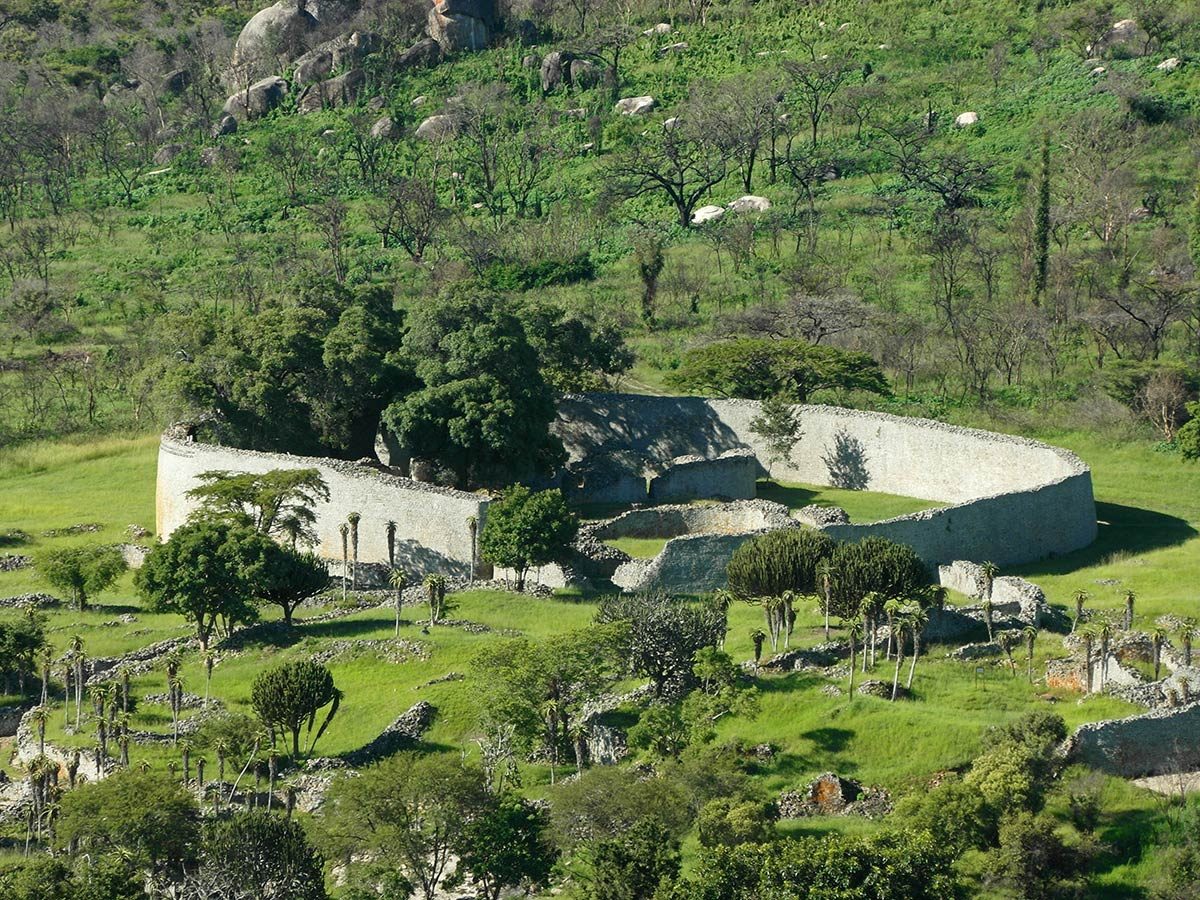
What was this state's source of power?
Sort each case by its power base.
Worked example: Ethiopia, a Christian state
- Source of power: religion and dynastic continuity. Ethiopia's kings had been Christian since the 4th century.
- Evidence: around 1200, King Lalibela built rock-cut churches; from 1270, the Solomonic dynasty claimed descent from King Solomon.
- Continuity: Ethiopia kept its own church and its Ge'ez script for centuries, surrounded by Muslim states.
What did the Solomonic dynasty claim from 1270?
Dificuldade 1/5 · Moedas 100 + pequeno bônus na primeira conclusão hoje
Dynastic legitimacy.
The Hausa kingdoms: a network of cities
- In what is now northern Nigeria, the Hausa kingdoms 豪萨诸王国, such as Kano and Katsina, were walled city-states.
- They grew rich from trans-Saharan trade in cloth, leather and salt, and many rulers adopted Islam.
Three sources of power
- Great Zimbabwe: long-distance trade. Ethiopia: religion and dynasty. The Hausa: a network of trading cities.
- All three were connected to wider trade networks.
Match each state to its source of power.
Dificuldade 2/5 · Moedas 140 + pequeno bônus na primeira conclusão hoje
Three sources.
Africa's great states were built by Africans. The myth that outsiders built Great Zimbabwe was a colonial idea used to deny African achievement.
Outsiders built Great Zimbabwe.
Dificuldade 1/5 · Moedas 100 + pequeno bônus na primeira conclusão hoje
A colonial myth.
From 1200 to 1450, Great Zimbabwe grew rich from the gold trade, Ethiopia drew power from its Christian church and dynasty, and the Hausa kingdoms formed a network of trading cities. Each shows a different source of state power in Africa.
Compare the sources of power of Great Zimbabwe and Ethiopia.
Comparison.