The Federal Role After 1980
Introduzido| English | Significado |
|---|---|
| deregulation/diːˌreɡjʊˈleɪʃn/ | Removing government rules on business. |
| federal deficit | The amount by which the federal government's spending is greater than its income in a year. |
| NAFTA | The 1994 North American Free Trade Agreement, which removed most trade barriers between the US, Canada and Mexico. |
11 000 controllers fired, August 1981
- On 3 August 1981, about 13 000 air traffic controllers went on strike for higher pay and shorter hours. Federal workers were not allowed to strike, and President Reagan gave them 48 hours to return. On 5 August he fired about 11 350 who stayed out and banned them from federal jobs. Private employers took note, and union strikes fell sharply in the 1980s.
- After 1980, conservatives tried to reduce the federal government's role, with real successes and clear limits.
What did Reagan do to the striking air traffic controllers in 1981?
Dificuldade 1/5 · Moedas 100 + pequeno bônus na primeira conclusão hoje
Union strikes fell afterwards.
Policies enacted
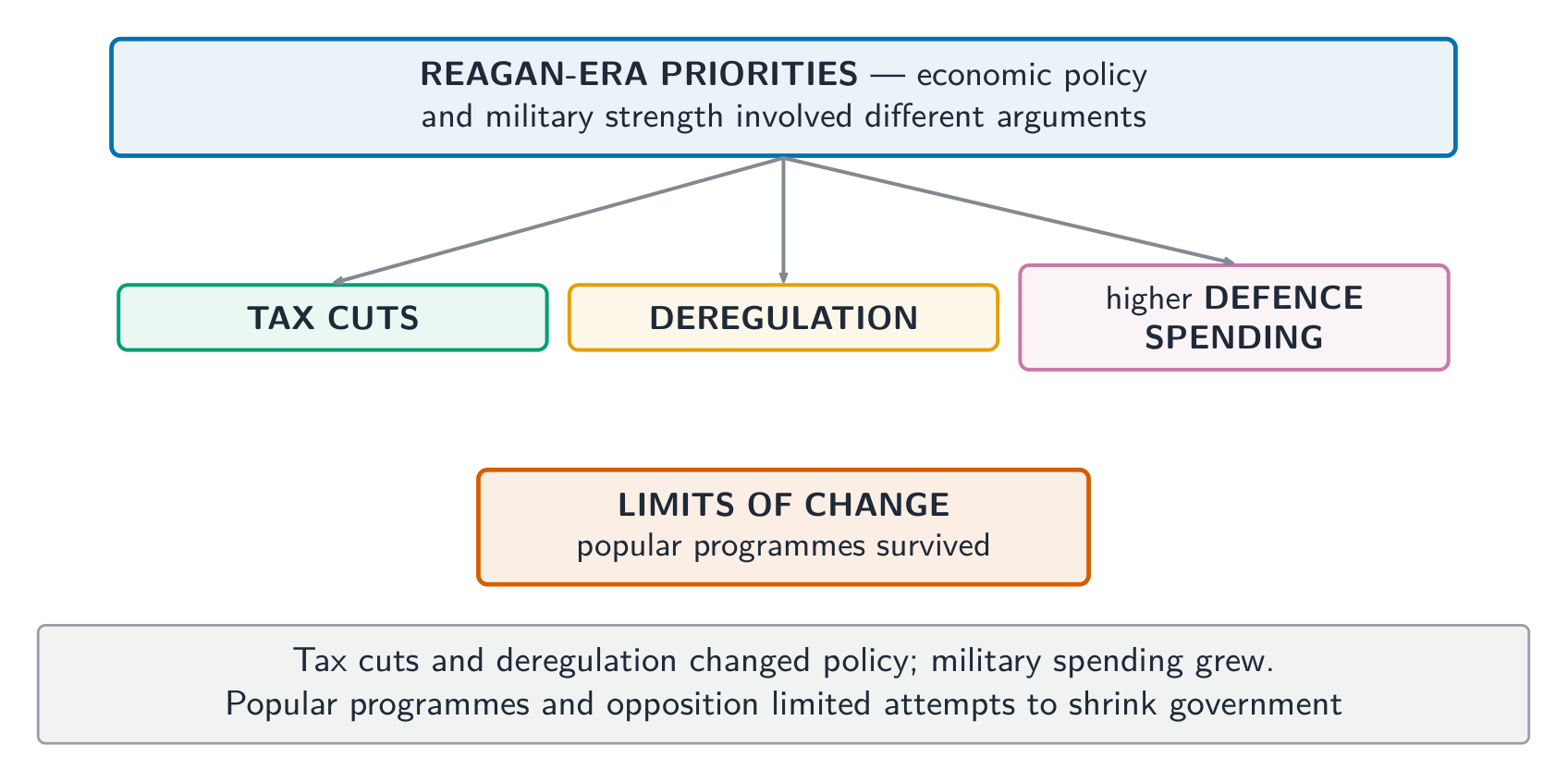
- Tax cuts: the Economic Recovery Tax Act (1981) cut income tax rates by about 25% over three years.
- Deregulation 放松管制: rules for airlines, trucking, banking and energy were relaxed, continuing changes begun under Carter.
Which policies were enacted in the 1980s?
Dificuldade 2/5 · Moedas 140 + pequeno bônus na primeira conclusão hoje
Policies enacted.
The argument and its obstacles
- Reagan said in 1981: "Government is not the solution to our problem; government is the problem."
- But programs such as Social Security and Medicare stayed popular, Democrats controlled the House, and military spending rose — so the federal deficit 联邦赤字 grew.
A policy enacted, an obstacle, or a continuing debate?
Sort each element of the federal-role argument after 1980.
Why did the federal deficit grow under Reagan?
Dificuldade 1/5 · Moedas 100 + pequeno bônus na primeira conclusão hoje
Obstacles to smaller government.
Worked example: the national debt
- Known: the national debt was about 0.9 trillion dollars in 1980 and about 2.9 trillion in 1989.
- Method: 2.9 ÷ 0.9 ≈ 3.2.
- Result: the debt roughly tripled. Tax cuts plus higher military spending, without equal cuts to popular programs, meant government did not shrink as promised.
The debt rose from about 0.9 to about 2.9 trillion dollars. By how many trillion?
Dificuldade 2/5 · Moedas 140 + pequeno bônus na primeira conclusão hoje
2.9 − 0.9.
Debates that continued
- In the 1990s, President Bill Clinton, a Democrat, signed the North American Free Trade Agreement (NAFTA 北美自由贸易协定, 1994) and a 1996 welfare reform that limited cash aid.
- He said in 1996: "The era of big government is over" — but Medicare and Social Security remained.
Match each 1990s policy to its year.
Dificuldade 2/5 · Moedas 140 + pequeno bônus na primeira conclusão hoje
Continued debates.
Cultural debates
- Americans also argued over immigration, diversity, gender roles and the place of religion in public life.
- These debates divided the two parties more sharply from the 1990s.
Conservative presidents did not make the federal government small. Federal spending kept rising in the 1980s; the debt roughly tripled.
Federal spending fell in the 1980s.
Dificuldade 1/5 · Moedas 100 + pequeno bônus na primeira conclusão hoje
It kept rising.
After 1980, Reagan cut taxes, deregulated industries and weakened unions, as in the 1981 controller strike. But popular programs, opposition in Congress and higher military spending kept government large and tripled the debt, and debates over trade, welfare and culture continued into the 1990s.
To what extent did conservatives reduce the federal government's role after 1980?
Extent.