Debates in the Early Republic
Introduzido| English | Significado |
|---|---|
| judicial review/dʒuːˈdɪʃl rɪˈvjuː/ | The power of courts to strike down laws that conflict with the Constitution. |
| strict construction | The view that the federal government may do only what the Constitution clearly allows. |
| states' rights | The view that states hold powers the federal government may not override. |
A commission never delivered, 1803
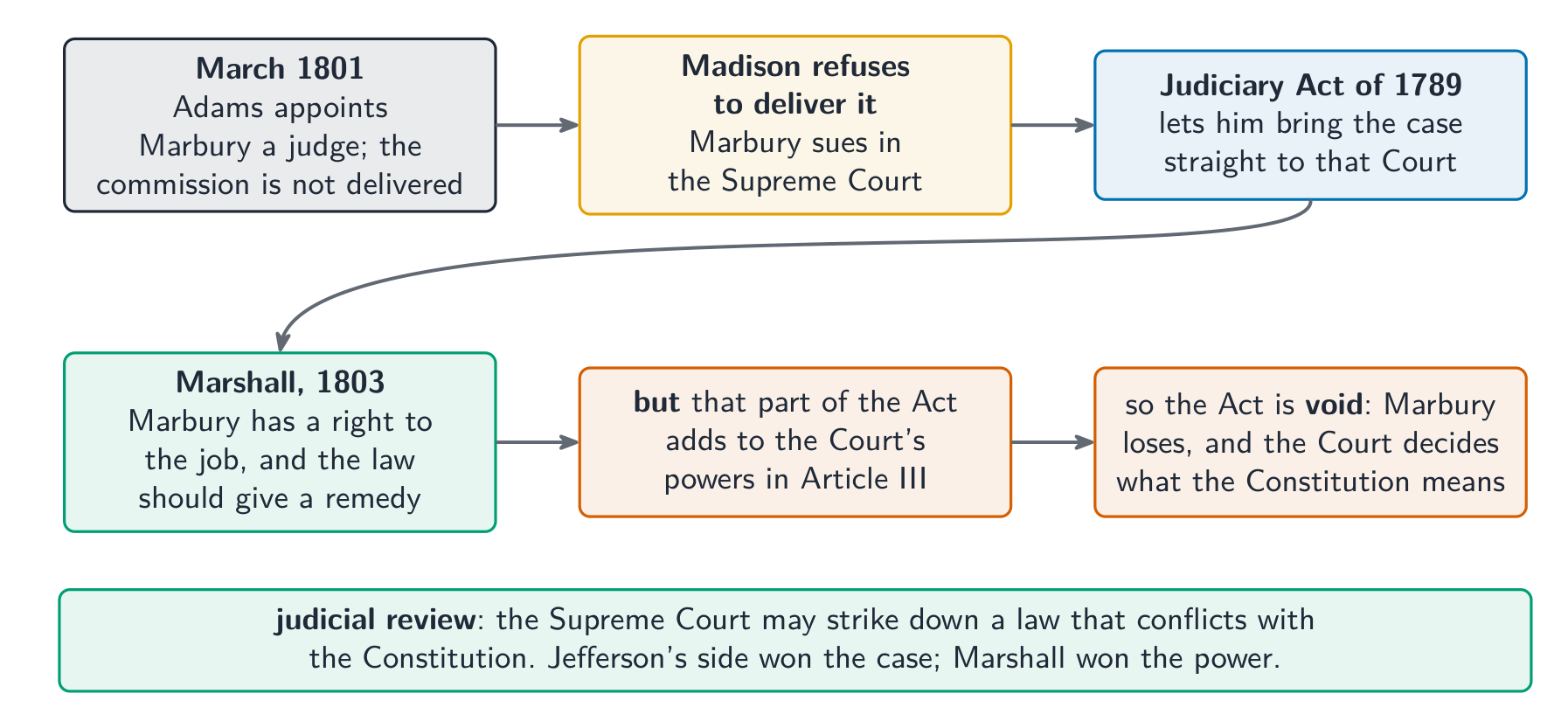
- On his last night in office in March 1801, President John Adams appointed dozens of Federalist judges. One commission, for William Marbury, was not delivered in time, and the new secretary of state, James Madison, refused to deliver it. Marbury sued. In 1803, Chief Justice John Marshall ruled that Marbury deserved the job — but that the law letting him sue in the Supreme Court was unconstitutional, and therefore void.
- In the early republic, Americans argued over how much power the national government had, and who decided.
What power did the Supreme Court claim in Marbury v. Madison?
Dificuldade 1/5 · Moedas 100 + pequeno bônus na primeira conclusão hoje
Judicial review.
The parties kept arguing
- Jefferson's Democratic-Republicans wanted a limited federal government; the Federalists wanted a strong one, a national bank and close ties with Britain.
- The War of 1812 against Britain divided them again; New England Federalists who met at the Hartford Convention (1814–15) to protest were seen as disloyal, and their party collapsed.
The Hartford Convention helped destroy the Federalist Party.
Dificuldade 1/5 · Moedas 100 + pequeno bônus na primeira conclusão hoje
Seen as disloyal.
The Court claims two things
- Judicial review 司法审查: in Marbury v. Madison (1803), the Supreme Court claimed the power to strike down laws that break the Constitution.
- Federal supremacy: in McCulloch v. Maryland (1819), the Court ruled that Congress could create a national bank and that a state could not tax it.
A party issue, a judicial claim, or territorial policy?
Sort each element of early-republic debate.
Match each case to its principle.
Dificuldade 2/5 · Moedas 140 + pequeno bônus na primeira conclusão hoje
Who decides the limit.
In what year was McCulloch v. Maryland decided?
Dificuldade 2/5 · Moedas 140 + pequeno bônus na primeira conclusão hoje
The national bank case.
Worked example: Jefferson and Louisiana
- The principle: Jefferson believed in strict construction 严格解释 — the government could do only what the Constitution clearly allowed.
- The problem: the Constitution said nothing about buying land from a foreign country.
- The choice: Jefferson bought Louisiana anyway in 1803, believing the nation's future mattered more. Even a strict constructionist stretched federal power.
What is strict construction?
Dificuldade 1/5 · Moedas 100 + pequeno bônus na primeira conclusão hoje
Jefferson's principle.
Why these debates belong together
- Each debate asked the same question: how far does federal power reach, and who sets the limit — Congress, the president, the states or the Court?
- Marshall's Court usually answered in favour of national power.
Effects
- Judicial review made the Supreme Court an equal branch of government.
- Rulings like McCulloch strengthened the national government, which helped the economy grow but angered supporters of states' rights 州权.
Judicial review is not written in the Constitution. Marshall claimed it in Marbury v. Madison. It became accepted over time.
Judicial review is clearly written in the Constitution.
Dificuldade 1/5 · Moedas 100 + pequeno bônus na primeira conclusão hoje
Marshall claimed it.
The parties argued over federal power, and the Federalists collapsed after the War of 1812. Marshall's Court claimed judicial review (1803) and federal supremacy (1819), and even Jefferson stretched federal power to buy Louisiana. Each debate asked how far national power reached.
Explain how the Marshall Court strengthened the national government.
Causation.