Interval for a Difference of Means
Introduzido| English | Significado |
|---|---|
| paired/peəd/ | pareado |
| independent samples/ˌɪndɪˈpendənt ˈsæmplz/ | amostras independentes |
Pair before calculating the uncertainty
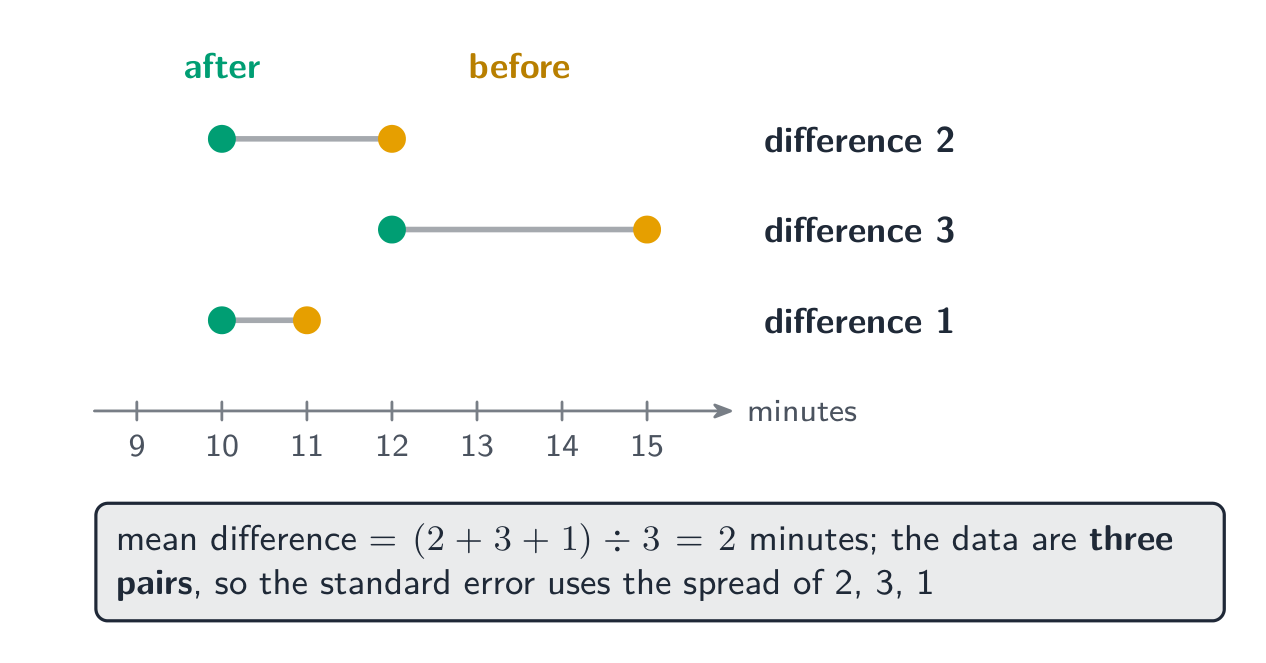
- The same three runners have before/after times (12,10), (15,12) and (11,10) minutes. Take before minus after.
- The paired differences are 2, 3 and 1 minutes, giving a mean difference of 2. The observational units for this analysis are three pairs, not six independent measurements.
Independent or paired?
- Comparing two means starts with one crucial question about the design. Independent samples 独立样本: two separate groups (e.g. treatment vs. control).
- Paired (matched-pairs) 配对: two measurements on the same or matched subjects (before/after). The design decides which procedure you use — get it right first.
The two-sample interval
- For independent samples, use a two-sample $t$-interval for $\mu_1 - \mu_2$: $$(\bar{x}_1 - \bar{x}_2) \pm t^{*}\sqrt{\frac{s_1^2}{n_1} + \frac{s_2^2}{n_2}}$$
- Choose $t^*$ using Welch degrees of freedom (calculator), or the conservative smaller $n_i-1$. The variance estimates add under the root (each group's $\frac{s^2}{n}$). Check random design, independence between groups, the 10% condition when sampling without replacement, and the data shape in each group.
The paired interval
- For paired data, first compute each pair's difference $d = x_1 - x_2$. Then run a one-sample $t$-interval on the differences:
- $$\bar{d} \pm t^{*}\frac{s_d}{\sqrt{n}}$$$n$ is the number of pairs; $df = n - 1$. Check random design and independence across pairs, and inspect the differences for skew/outliers.
Measuring the same runners before and after training is which design?
Dificuldade 1/5 · Moedas 100 + pequeno bônus na primeira conclusão hoje
Same subjects measured twice → paired.
For paired data, the correct interval is...
Dificuldade 1/5 · Moedas 100 + pequeno bônus na primeira conclusão hoje
Collapse pairs to differences, then one-sample t.
For a two-sample t-interval, the two variances are added under the square root.
Dificuldade 1/5 · Moedas 100 + pequeno bônus na primeira conclusão hoje
SE = √(s1²/n1 + s2²/n2).
Analyzing paired data as two independent samples gives the correct standard error.
Dificuldade 1/5 · Moedas 100 + pequeno bônus na primeira conclusão hoje
It ignores dependence within pairs. The resulting standard error need not always be larger; analyse the paired differences.
The key question that decides the procedure is...
Dificuldade 1/5 · Moedas 100 + pequeno bônus na primeira conclusão hoje
Linked → paired; unlinked → two-sample.
Match the design to the shape check for its t analysis.
Dificuldade 2/5 · Moedas 140 + pequeno bônus na primeira conclusão hoje
Paired analysis works with differences as the observations. Marginal normal-looking groups do not automatically establish a suitable differences distribution.
Which are needed for a paired t analysis?
Dificuldade 2/5 · Moedas 140 + pequeno bônus na primeira conclusão hoje
The within-pair relationship is the reason to use differences. Independence is required across the observational pairs.
Match the method to the design
- Paired data analyzed as two independent samples → wrong standard error, wrong answer. Independent data forced into a paired test → also wrong.
- The tell: is each value in group $1$ naturally linked to one in group $2$? If yes → paired; if no → two-sample.
The design dictates the procedure. If subjects are matched or measured twice (before/after), it's paired — collapse to differences and use a one-sample $t$-interval. If the two groups are separate and unlinked, it's a two-sample $t$-interval. Using the two-sample formula on paired data ignores the within-pair dependence and generally gives the wrong standard error. The direction of the error depends on the relationship within pairs.
Measure each runner's time before and after training.
- Same runners, two measurements → paired.
- Compute differences $d = \text{before} - \text{after}$ for each runner.
- Build a one-sample $t$-interval on the $d$'s (not a two-sample interval).
Carry the reasoning to a new case
- The paired standard error uses the variability of the differences.
- Ignoring pairing does not always inflate the standard error; its effect depends on the within-pair relationship.
For before/after pairs (12,10), (15,12), (11,10) minutes, compute the mean before-minus-after difference.
Dificuldade 2/5 · Moedas 140 + pequeno bônus na primeira conclusão hoje
The differences 2, 3 and 1 sum to 6, so the mean across three pairs is 2.
Comparing two means: independent samples use a two-sample $t$-interval $(\bar{x}_1 - \bar{x}_2) \pm t^{*}\sqrt{\frac{s_1^2}{n_1} + \frac{s_2^2}{n_2}}$; paired data collapse to differences and use a one-sample $t$-interval $\bar{d} \pm t^{*}\frac{s_d}{\sqrt{n}}$. Match the method to the design, checking conditions for both groups.
Write from a paired study
- The same 20 people are measured before and after a training week.
- Treat the 20 people as 20 pairs and form one difference per person.
The same 20 people are measured before and after training. Should the two sets of measurements be analysed as independent samples? Explain the t procedure.
Two measurements on one person are paired.
What kind of study is before and after on the same people?
Dificuldade 1/5 · Moedas 100 + pequeno bônus na primeira conclusão hoje
The pair is the person.