Random and Non-Random Patterns
Introduzido| English | Significado |
|---|---|
| randomness/ˈrændəmnəs/ | aleatoriedade |
| probability/ˌprɒbəˈbɪlɪti/ | probabilidade |
| chance/tʃæns/ | acaso |
| long-run relative frequency/lɒŋ rʌn ˈrelətɪv ˈfriːkwənsi/ | frequência relativa de longo prazo |
Order out of chaos
- A single random outcome is unpredictable — but many of them form a stable pattern.
- Randomness 随机性 means individual results vary and can't be foreseen one at a time.
- Yet over many repetitions, the proportions settle down to something predictable.
- Probability is the math of that long-run stability.
Could it be just chance?
- The core question: is a result a real effect, or could it happen by chance 偶然?
- Random variation alone can produce streaks and clusters that look meaningful.
- To judge "surprising," we compare what we saw against what chance would do.
- If chance can easily produce it, it isn't strong evidence of anything.
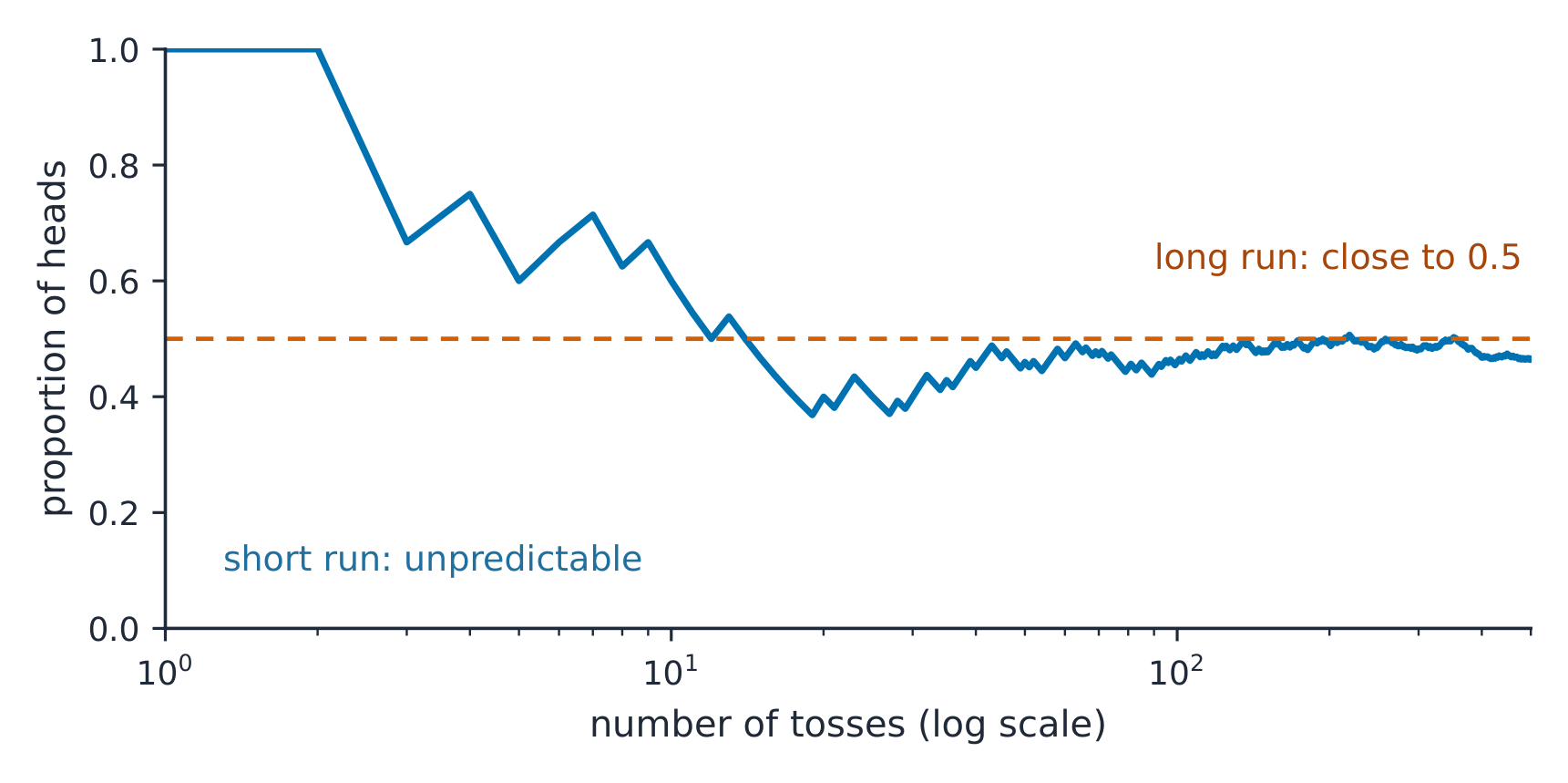
Random in the short run, predictable in the long run: the proportion of heads settles near 0.5
Probability = long-run frequency
- Probability 概率 is the long-run relative frequency 长期相对频率 of an outcome.
- $P(\text{heads}) = 0.5$ means: over many tosses, about half land heads.
- It's not a promise about the next toss — it's about the long run.
- A probability is always a number between $0$ and $1$.
Why we need a model
- To decide if data are surprising, we need a probability model to compare against.
- The model says what outcomes chance should produce, and how often.
- Then "surprising" = far from what the model predicts.
- Units 4–5 build these models so later units can test claims.
Probability describes the long run, not the next trial. "$P=0.5$" does not mean heads and tails must alternate, or that a run of $5$ heads is "due" to end — each toss is fresh. The law of averages ("I'm due for a win") is a fallacy; chance has no memory. The stability appears only over many repetitions.
Flip a fair coin.
- Short run: $5$ flips could easily be HHHHH — chance is streaky.
- Long run: over $10{,}000$ independent flips, the fraction of heads is likely to be close to $0.5$, but no finite run guarantees a particular fraction.
- So $P(\text{heads}) = 0.5$ is a statement about the long run, not any single flip.
Randomness makes individual outcomes vary unpredictably, but over many repetitions the relative frequency stabilizes. Probability is that long-run relative frequency, always between $0$ and $1$. We need a probability model to judge whether an observed result is surprising or just chance.
Write from this case
- A spinner is spun thousands of times.
- The proportion of red settles near one value.
A spinner is spun thousands of times under the same conditions, and the proportion landing on red settles near one value. What does that proportion estimate?
Probability is what the proportion approaches.
Over thousands of repeated spins under the same conditions, the proportion of red stabilizes. What does it estimate?
Dificuldade 1/5 · Moedas 100 + pequeno bônus na primeira conclusão hoje
The long-run proportion is the probability.
A probability from 0 to 1
Probability lives on a scale from 0 (impossible) to 1 (certain).
Probability is best described as the long-run...
Dificuldade 1/5 · Moedas 100 + pequeno bônus na primeira conclusão hoje
Probability = long-run relative frequency over many repetitions.
After 5 heads in a row on a fair coin, tails is 'due' and more likely on the next flip.
Dificuldade 1/5 · Moedas 100 + pequeno bônus na primeira conclusão hoje
Each flip is independent — chance has no memory. That's the law-of-averages fallacy.
What is the largest value a probability can take?
Dificuldade 2/5 · Moedas 140 + pequeno bônus na primeira conclusão hoje
Probabilities range from 0 to 1.
The property that individual outcomes vary and can't be predicted one at a time is called ___.
Dificuldade 1/5 · Moedas 100 + pequeno bônus na primeira conclusão hoje
Randomness produces short-run variability but long-run stability.
Why do we need a probability model?
Dificuldade 1/5 · Moedas 100 + pequeno bônus na primeira conclusão hoje
The model says what chance should do, so we can spot the surprising.