Secant, Cosecant, and Cotangent · Secante, Cossecante e Cotangente
| English | Português |
|---|---|
| reciprocal/rɪˈsɪprəkl/ | recíproco |
| secant/ˈsiːkənt/ | secante |
| cosecant/ˈkəʊsekənt/ | cossecante |
| cotangent/ˈkəʊtændʒənt/ | cotangente |
| vertical asymptote/ˈvɜːtɪkl ˈæsɪmptəʊt/ | assíntota vertical |
Three more from flipping
- Sine, cosine, and tangent have three partners built by flipping them over.
- Each new function is simply $1$ divided by one of the originals.
- They appear whenever a ratio is easier written "upside down".
- Their graphs inherit their asymptotes from wherever the originals hit zero.
Três mais por inverter
- Seno, cosseno e tangente têm três parceiros construídos invertendo-os.
- Cada nova função é simplesmente $1$ dividido por um dos originais.
- Elas aparecem sempre que uma razão é mais fácil escrita "ao contrário".
- Seus gráficos herdam suas assíntotas de onde os originais tocam zero.
The three reciprocals
- Secant 正割 is the reciprocal 倒数 of cosine: $\sec x = \dfrac{1}{\cos x}$.
- Cosecant 余割 is the reciprocal of sine: $\csc x = \dfrac{1}{\sin x}$.
- Cotangent 余切 is the reciprocal of tangent: $\cot x = \dfrac{1}{\tan x} = \dfrac{\cos x}{\sin x}$.
- A handy memory hook: "co-" and the base function never match up (secant pairs with cosine).
Os três recíprocos
- Secante 正割 é o recíproco 倒数 do cosseno: $\sec x = \dfrac{1}{\cos x}$.
- Cossecante 余割 é o recíproco do seno: $\csc x = \dfrac{1}{\sin x}$.
- Cotangente 余切 é o recíproco da tangente: $\cot x = \dfrac{1}{\tan x} = \dfrac{\cos x}{\sin x}$.
- Um gancho mnemônico útil: "co-" e a função base nunca combinam (secante par com cosseno).
The cosine wave whose reciprocal is secant · A onda cossenoidal cujo recíproco é secante
y = cos x
Secant is 1 divided by cosine. Wherever this cosine wave crosses zero, secant blows up to an asymptote. · Secante é 1 dividido por cosseno. Sempre que esta onda cossenoidal cruza zero, secante explode em uma assíntota.
The · A secant function is defined as… · A função secante é definida como…
Secant is the reciprocal · recíproco of cosine: $\sec x = \dfrac{1}{\cos x}$. · Secante é o recíproco do cosseno: $\sec x = \dfrac{1}{\cos x}$.
Which pairing is correct? · Qual combinação está correta?
Cosecant is $1/\sin$ and · e cotangent is $1/\tan = \cos/\sin$ — the reciprocals of sine and tangent. · Cossecante é $1/\sin$ e cotangente é $1/\tan = \cos/\sin$ — os recíprocos do seno e da tangente.
Select all · todos correct reciprocal identities. · Selecione todas as identidades recíprocas corretas.
Secant is $1/\cos$, not $\sin$. The other three are correct reciprocal definitions. · Secante é $1/\cos$, não $\sin$. As outras três são definições recíprocas corretas.
Where they blow up
- A reciprocal is undefined when the original is zero — you cannot divide by zero.
- So secant has a vertical asymptote 竖直渐近线 wherever $\cos x = 0$.
- Cosecant blows up wherever $\sin x = 0$; cotangent wherever $\sin x = 0$ too.
- Between the asymptotes, each curve swoops up toward $\pm\infty$.
Onde elas explodem
- Um recíproco é indefinido quando o original é zero — você não pode dividir por zero.
- Então secante tem uma assíntota vertical 竖直渐近ta sempre que $\cos x = 0$.
- Cossecante explode sempre que $\sin x = 0$; cotangente sempre que $\sin x = 0$ também.
- Entre as assíntotas, cada curva sobe em direção a $\pm\infty$.
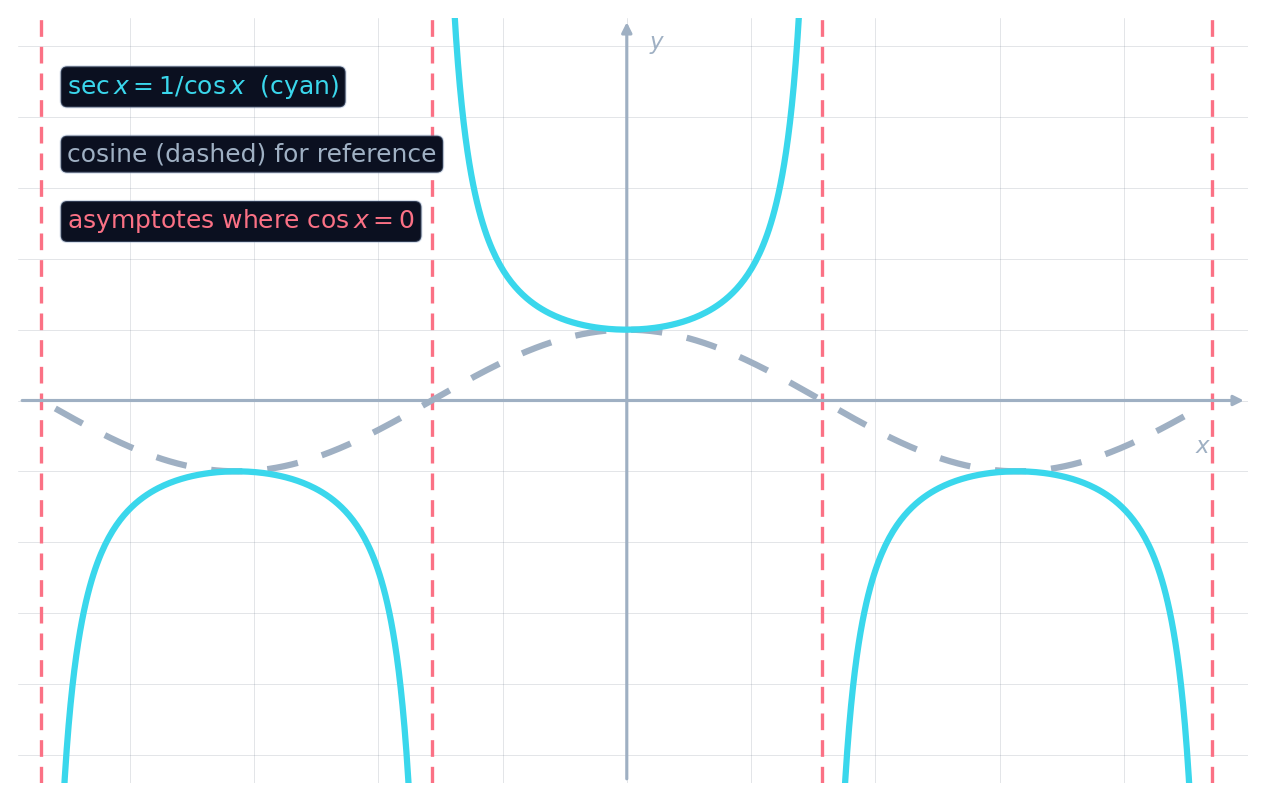
Secant has a vertical ____ wherever $\cos x = 0$, because you cannot divide by zero. · Secante possui uma ____ vertical sempre que $\cos x = 0$, pois você não pode dividir por zero.
Since $\sec x = 1/\cos x$, a zero cosine makes secant undefined — a vertical asymptote. · Como $\sec x = 1/\cos x$, um cosseno zero torna secante indefinido — uma assíntota vertical.
Secant's output never lies strictly between $-1$ and · e $1$. · A saída de secante nunca fica estritamente entre $-1$ e $1$.
Since $|\cos x| \le 1$, its reciprocal $|\sec x| \ge 1$ — secant is always at least $1$ in size. · Como $|\cos x| \le 1$, seu recíproco $|\sec x| \ge 1$ — secante é sempre pelo menos $1$ em magnitude.
Their shape
- Because $|\cos x| \le 1$, its reciprocal secant satisfies $|\sec x| \ge 1$.
- So secant never enters the strip between $-1$ and $1$ — it lives outside it.
- Each secant "U" sits above a cosine peak or below a cosine trough.
- Cosecant looks the same, shifted to match sine instead of cosine.
Sua forma
- Como $|\cos x| \le 1$, seu recíproco secante satisfaz $|\sec x| \ge 1$.
- Então secante nunca entra na faixa entre $-1$ e $1$ — vive fora dela.
- Cada "U" de secante fica acima de um pico de cosseno ou abaixo de um vale de cosseno.
- Cossecante parece o mesmo, deslocado para coincidir com o seno em vez do cosseno.
Why they are useful
- Some formulas are cleaner with secant or cotangent than with a fraction of sine and cosine.
- The Pythagorean identities come in secant and cosecant forms too.
- In calculus, the derivative of tangent is $\sec^2 x$ — the reciprocals show up naturally.
- Knowing all six trig functions lets you pick the simplest one for the job.
Por que são úteis
- Algumas fórmulas são mais limpas com secante ou cotangente do que com uma fração de seno e cosseno.
- As identidades pitagóricas também existem em formas de secante e cossecante.
- No cálculo, a derivada da tangente é $\sec^2 x$ — os recíprocos aparecem naturalmente.
- Conhecer as seis funções trigonométricas permite escolher a mais simples para a tarefa.
Do not confuse the reciprocal $\sec x = \tfrac{1}{\cos x}$ with the inverse $\cos^{-1} x = \arccos x$. Despite the similar names, one is "one over cosine" and the other is "the angle with this cosine" — completely different functions.
Não confunda o recíproco $\sec x = \tfrac{1}{\cos x}$ com a inversa $\cos^{-1} x = \arccos x$. Apesar dos nomes semelhantes, um é "um sobre cosseno" e o outro é "o ângulo com este cosseno" — funções completamente diferentes.
Evaluate $\sec\tfrac{\pi}{3}$ and explain why $\csc 0$ is undefined.
- $\cos\tfrac{\pi}{3} = \tfrac12$, so $\sec\tfrac{\pi}{3} = \tfrac{1}{1/2} = 2$.
- $\csc 0 = \tfrac{1}{\sin 0} = \tfrac{1}{0}$, which is undefined.
- So $x = 0$ is a vertical asymptote of cosecant.
Avalie $\sec\tfrac{\pi}{3}$ e explique por que $\csc 0$ é indefinido.
- $\cos\tfrac{\pi}{3} = \tfrac12$, logo $\sec\tfrac{\pi}{3} = \tfrac{1}{1/2} = 2$.
- $\csc 0 = \tfrac{1}{\sin 0} = \tfrac{1}{0}$, que é indeterminada.
- Então $x = 0$ é uma assíntota vertical de cossecante.
Secant, cosecant, and cotangent are the reciprocals of cosine, sine, and tangent. Each has a vertical asymptote wherever its base function is zero, and secant/cosecant outputs never fall strictly between $-1$ and $1$.
Secante, cossecante e cotangente são os recíprocos do cosseno, seno e tangente. Cada uma tem uma assíntota vertical sempre que sua função base é zero, e as saídas de secante/cossecante nunca caem estritamente entre $-1$ e $1$.