Torque and Work
Introduzido| English | Significado |
|---|---|
| rotational work/rəʊˈteɪʃənl wɜːk/ | trabalho rotacional |
| rotational power/rəʊˈteɪʃənl ˈpaʊə/ | potência rotacional |
Turning effort into spin
- Crank a winch and the drum speeds up.
- Push a merry-go-round around and around, and you feel the effort add up.
- The longer you push through the turn, the faster it spins.
- A turning force acting through an angle changes a spin's energy.
Work done by a torque
- The rotational work 转动功 done by a constant torque is:
- Torque times the angle $\theta$ turned, in radians.
- It mirrors $W = Fd$, with torque for force and angle for distance.
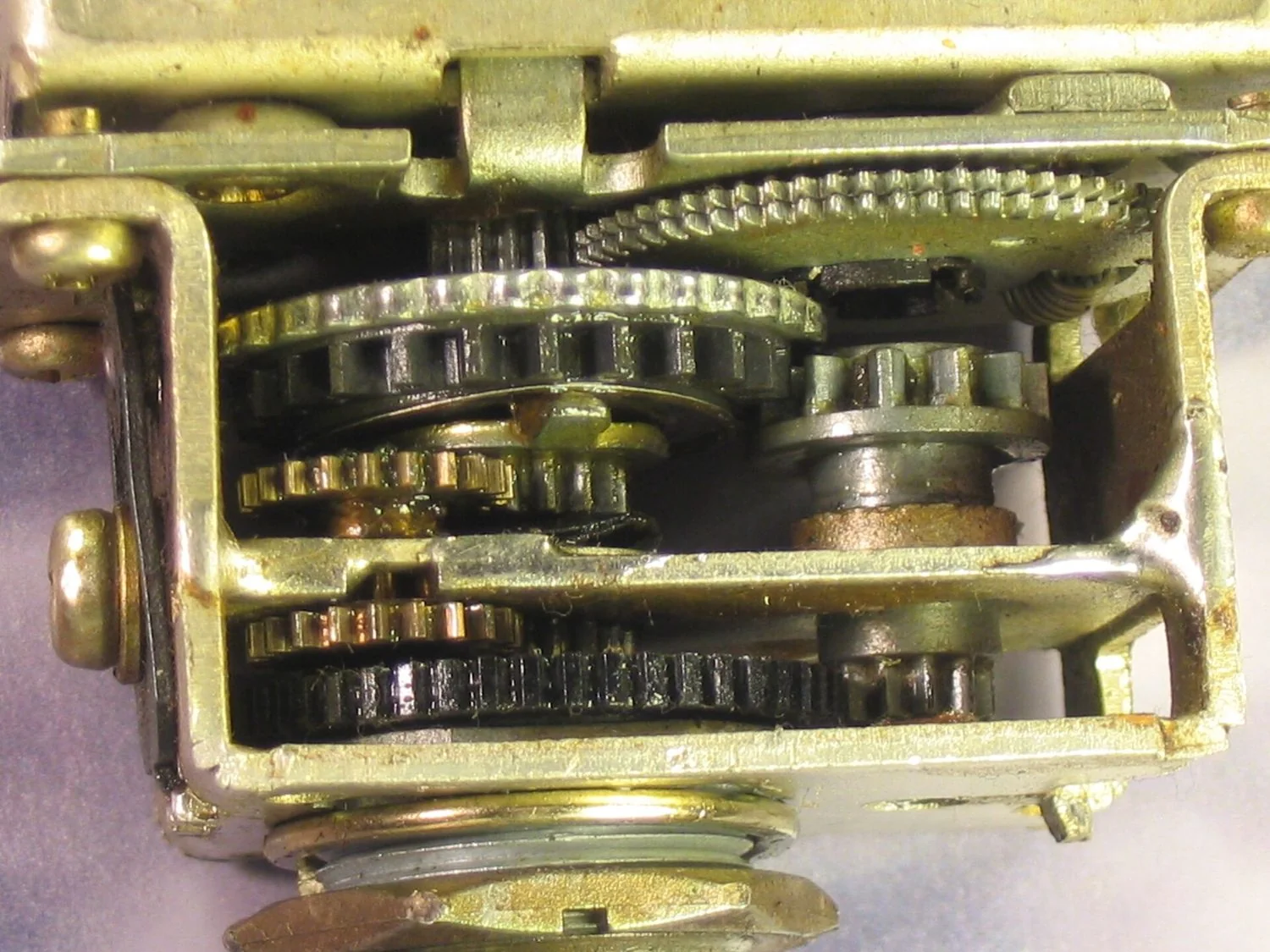
Gear sizes alone do not determine torque, inertia or losses
A constant torque of $6\ \text{N}\cdot\text{m}$ turns a wheel through $\theta = 4\ \text{rad}$. The work done (in J)?
Dificuldade 2/5 · Moedas 140 + pequeno bônus na primeira conclusão hoje
$W = \tau\theta = 6 \times 4 = 24\ \text{J}$.
Match each rotational quantity to its linear twin.
Dificuldade 2/5 · Moedas 140 + pequeno bônus na primeira conclusão hoje
$W = \tau\theta$ mirrors $W = Fd$; $P = \tau\omega$ mirrors $P = Fv$.
Work becomes spin energy
- For a rigid body with constant inertia rotating about a fixed axis, net rotational work equals the change in rotational kinetic energy:
- Do positive work and the object spins faster.
- Same idea as the linear work-energy theorem.
Positive net rotational work makes a spinning object speed up.
Dificuldade 1/5 · Moedas 100 + pequeno bônus na primeira conclusão hoje
$W_{net} = \Delta K_{rot}$; positive work raises the rotational kinetic energy, so $\omega$ rises.
Rotational power
- Rotational power 转动功率 is the rate of doing rotational work:
- Torque times angular speed — the twin of $P = Fv$.
- A motor's power sets how quickly it spins a load up.
Work done by a torque
A constant torque turning through an angle does work in proportion to that angle.
A motor delivers $\tau = 4\ \text{N}\cdot\text{m}$ to a shaft spinning at $\omega = 10\ \text{rad/s}$. The power (in W)?
Dificuldade 2/5 · Moedas 140 + pequeno bônus na primeira conclusão hoje
$P = \tau\omega = 4 \times 10 = 40\ \text{W}$.
A motor applies $\tau = 5\ \text{N}\cdot\text{m}$ while a wheel turns through $\theta = 2\pi\ \text{rad}$ (one full turn).
- Work: $W = \tau\theta = 5 \times 2\pi \approx 31.4\ \text{J}$.
- If that turn takes $2\ \text{s}$ at steady speed, average power $\approx 15.7\ \text{W}$.
If the torque changes with angle, the work done is...
Dificuldade 1/5 · Moedas 100 + pequeno bônus na primeira conclusão hoje
$W = \int \tau\, d\theta$ -- the area under $\tau$ versus $\theta$.
In $W = \tau\theta$, the angle must be measured in ____.
Dificuldade 1/5 · Moedas 100 + pequeno bônus na primeira conclusão hoje
Rotational SI formulas need the angle in radians.
Keep $\theta$ in radians for $W = \tau\theta$, and use the signed torque component along the fixed rotation axis. The formula $W = \tau\theta$ is for a constant torque; if torque changes with angle, integrate $W = \int \tau\, d\theta$ — the area under a torque-angle graph.
A torque acting through an angle does rotational work $W = \tau\theta$ (the twin of $W = Fd$), and that work changes the spin energy: $W_{net} = \Delta K_{rot}$. The rate of doing it is rotational power $P = \tau\omega$, mirroring $P = Fv$. Keep angles in radians, and integrate when the torque varies.
Write from the data: find the rotational work
- A constant torque of 5 N m turns a shaft through 3 rad.
- Find the work.
A constant torque of 5 N m turns a wheel through 3 rad. How much work is done?
5 times 3 is 15.
A constant torque of 5 N m turns a shaft through 3 rad in the torque direction. How much work does it do?
Dificuldade 1/5 · Moedas 100 + pequeno bônus na primeira conclusão hoje
Torque times angle is 5 times 3. Other options — 24 J (the lesson work); 5 J (the torque used as work).