Magnetic Fields of Current-Carrying Wires and the Biot-Savart Law
Introduzido| English | Significado |
|---|---|
| permeability/ˌpɜːməˈbɪlɪti/ | permeabilidade |
| Biot–Savart law/ˈbɪɒt ˈsævɑːt lɔː/ | lei de Biot–Savart |
| solenoid/ˈsəʊlənɔɪd/ | solenoide |
A wire carrying current becomes a magnet
- In 1820 Oersted saw a compass twitch beside a live wire.
- A moving charge — a current — makes its own magnetic field.
- So electricity and magnetism are two sides of one thing.
- This lesson finds the field a current creates.
A current-carrying wire produces its own magnetic field.
Dificuldade 1/5 · Moedas 100 + pequeno bônus na primeira conclusão hoje
Oersted showed a current deflects a compass — it makes a field.
The field circles a straight wire
- Around a long straight wire the field forms circles: $B = \dfrac{\mu_0 I}{2\pi r}$.
- $\mu_0$ is the permeability 磁导率 of free space.
- The field is stronger near the wire and fades as $1/r$.
- Point your right thumb along the current; your fingers curl the way $\vec B$ goes.
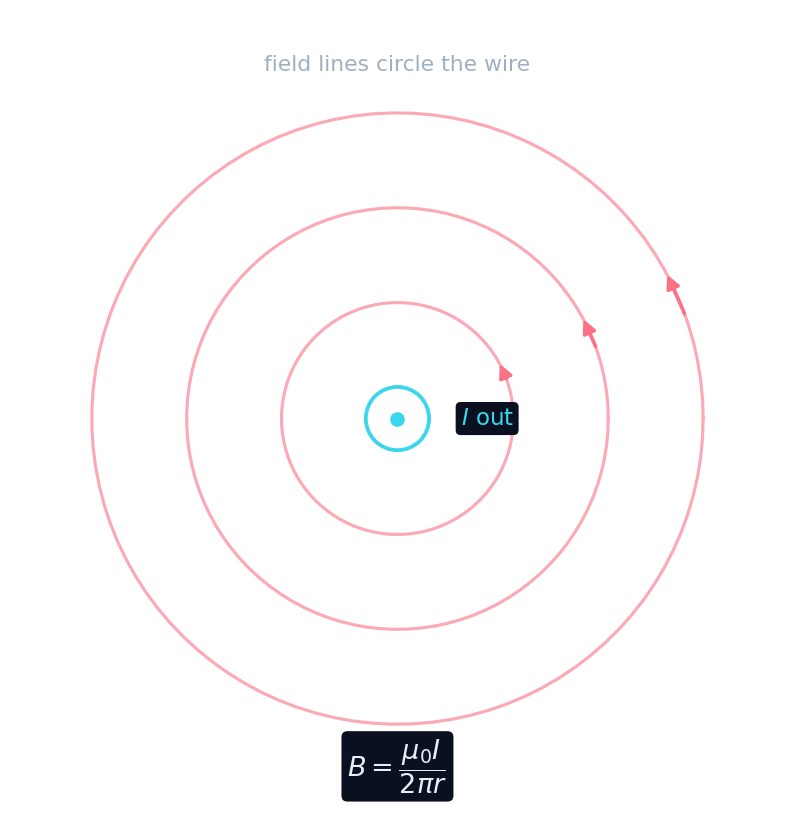
The magnetic field around a long straight wire forms:
Dificuldade 1/5 · Moedas 100 + pequeno bônus na primeira conclusão hoje
Field lines circle the wire; $B = \mu_0 I/2\pi r$.
The straight-wire field strength falls off with distance as:
Dificuldade 1/5 · Moedas 100 + pequeno bônus na primeira conclusão hoje
$B = \mu_0 I/2\pi r$ — a $1/r$ falloff.
A wire carries $10\ \text{A}$. At $r = 0.2\ \text{m}$, $B = \mu_0 I/2\pi r$ with $\mu_0 = 4\pi\times10^{-7}$. Find $B$ (in μT).
Dificuldade 2/5 · Moedas 140 + pequeno bônus na primeira conclusão hoje
$B = \dfrac{(4\pi\times10^{-7})(10)}{2\pi(0.2)} = 1\times10^{-5}\ \text{T} = 10\ \mu\text{T}$.
The Biot–Savart law
- To find the field from any shape, add up tiny current bits.
- The Biot–Savart law 毕奥-萨伐尔定律 gives $d\vec B = \dfrac{\mu_0}{4\pi}\dfrac{I\,d\vec\ell\times\hat r}{r^2}$, with $\hat r$ from the element to the field point.
- Its magnitude is $dB = \dfrac{\mu_0 I\,d\ell\sin\theta}{4\pi r^2}$: a radial element ($\theta=0$) contributes zero.
- Integrate over the whole wire to get the total field.
Loops and solenoids concentrate the field
- Bend the wire into a loop and the field lines gather through its centre.
- Stack many loops into a solenoid 螺线管; a long, tightly wound solenoid has an approximately uniform field inside, far from its ends.
- A solenoid behaves just like a bar magnet, with N and S ends.
- More turns or more current makes a stronger electromagnet.
Magnetic field of a wire
The magnetic field around a long straight wire weakens as one over the distance from it.
Many current loops stacked together form a ____, which acts like a bar magnet.
Dificuldade 1/5 · Moedas 100 + pequeno bônus na primeira conclusão hoje
A long, tightly wound solenoid gives an approximately uniform interior field away from its ends.
Select todos true statements about a current's magnetic field.
Dificuldade 2/5 · Moedas 140 + pequeno bônus na primeira conclusão hoje
Circular lines, Biot–Savart integration, solenoid = bar magnet. The field wraps around, not outward.
Fields add as vectors
- When several currents are near, their fields superpose.
- Add the $\vec B$ vectors from each source at the point of interest.
- Two parallel wires can reinforce or cancel between them.
- This superposition is how we build up any real field.
Find the field $0.1\ \text{m}$ from a wire carrying $5\ \text{A}$. ($\mu_0 = 4\pi\times10^{-7}$.)
- $B = \dfrac{\mu_0 I}{2\pi r} = \dfrac{(4\pi\times10^{-7})(5)}{2\pi(0.1)}$.
- $B = 1\times10^{-5}\ \text{T}$, circling the wire.
The straight-wire field falls off as $1/r$ (not $1/r^2$), and it wraps around the wire rather than pointing away from it. Don't picture magnetic field lines shooting outward like electric field lines from a charge — they form closed circles.
A current makes a magnetic field: a straight wire gives circular lines with $B = \mu_0 I / 2\pi r$ (right-hand grip, permeability $\mu_0$). The Biot–Savart law adds up each current element; solenoids concentrate the field into a bar-magnet shape. Fields superpose.
Write from the data given
- A long straight wire carries 8 amperes. The point is 0.20 m from the wire.
- Use $\mu_0=4\pi\times10^{-7}\ \dfrac{\text{T}\cdot\text{m}}{\text{A}}$. Find the field and describe the field lines.
Find the field 0.20 m from a long straight wire carrying 8 amperes in vacuum. Use mu0 = 4 pi times 10 to the minus 7 tesla metres per ampere. Do the field lines point radially outward?
2 times 10 to the minus 7 times 8 divided by 0.20 is 8 times 10 to the minus 6 tesla.
A long straight wire in vacuum carries 8 amperes. What is its field 0.20 m away? Use mu0 = 4 pi times 10 to the minus 7 tesla metres per ampere.
Dificuldade 1/5 · Moedas 100 + pequeno bônus na primeira conclusão hoje
2 times 10 to the minus 7 times 40 is 8 times 10 to the minus 6 tesla, in circles.