Double-Slit Interference and Diffraction Gratings
Introduzido| English | Significado |
|---|---|
| diffraction grating/dɪˈfrækʃn ˈɡreɪtɪŋ/ | rede de difração |
Shine light through two slits — and get stripes, not two lines
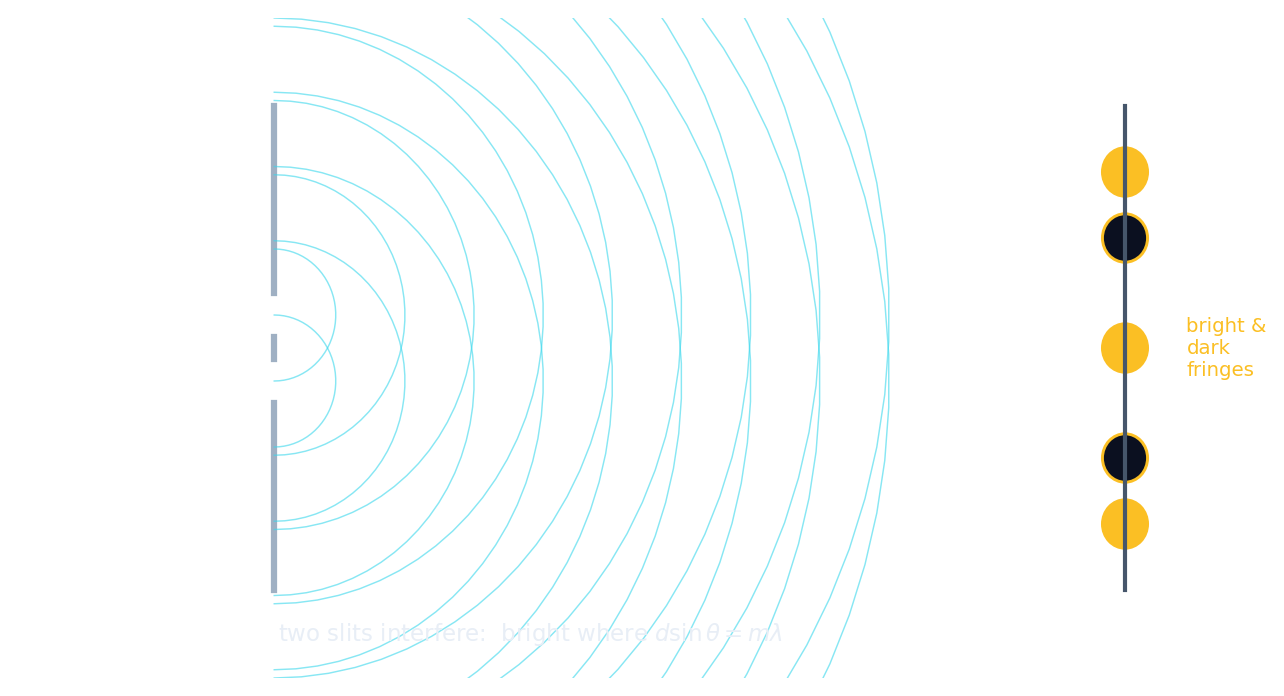
- Send light through two narrow slits and the screen shows a row of bright and dark stripes.
- Not two bright lines as you'd expect — an interference pattern.
- This is Young's double-slit experiment, and it proved light is a wave.
- The same idea, with thousands of slits, becomes a diffraction grating.
How the fringes form
- Light spreads (diffracts) from each slit, and the two sets of waves overlap and interfere.
- Where they arrive in phase, they add — a bright fringe.
- Where equal-amplitude waves arrive 180° out of phase, they cancel: a dark fringe.
- The pattern is a direct picture of constructive and destructive interference.
Two waves interfering
Vary the phase: in-phase displacements add; equal-amplitude waves 180° apart cancel.
The double-slit interference pattern is evidence that light is a:
Dificuldade 1/5 · Moedas 100 + pequeno bônus na primeira conclusão hoje
Interference is a wave phenomenon, so the fringes prove light is a wave.
The bright-fringe condition
- For coherent slits emitting in phase, bright fringes occur at whole-wavelength path differences; with equal amplitudes, dark fringes occur at odd half-wavelength differences.
- In the far field, $d\sin\theta = m\lambda$, with integer $m$ and $\theta$ measured from the central axis, perpendicular to the slit plane.
- Closer slits (smaller $d$) or a longer wavelength spread the fringes further apart.
- Measuring the fringe spacing lets you calculate the wavelength of the light.
A bright fringe forms where the path difference from the two slits is:
Dificuldade 1/5 · Moedas 100 + pequeno bônus na primeira conclusão hoje
Bright fringes need $d\sin\theta = m\lambda$ — a whole number of wavelengths.
In a small-angle double-slit setup with wavelength and screen distance fixed, halving slit separation d makes the fringe spacing:
Dificuldade 1/5 · Moedas 100 + pequeno bônus na primeira conclusão hoje
At small angles, $s = \lambda D/d$. With $\lambda$ e $D$ fixed, replacing $d$ by $d/2$ doubles $s$.
A dark fringe forms where waves from the two slits arrive in phase.
Dificuldade 1/5 · Moedas 100 + pequeno bônus na primeira conclusão hoje
In-phase waves give a bright fringe. For coherent equal-amplitude waves, cancellation requires a phase difference of 180° modulo 360°, not just any nonzero phase difference.
Diffraction gratings
- A diffraction grating 衍射光栅 has thousands of fine slits packed together.
- It splits light into very sharp, bright spots — far cleaner than two slits.
- It also spreads different colours by different angles, making a spectrum.
- Gratings are used in spectrometers to identify the elements in stars and samples.
A device with thousands of fine slits that splits light into sharp spots is a diffraction ____.
Dificuldade 1/5 · Moedas 100 + pequeno bônus na primeira conclusão hoje
A diffraction grating gives very sharp, bright maxima.
Select todos true statements about the double slit and gratings.
Dificuldade 2/5 · Moedas 140 + pequeno bônus na primeira conclusão hoje
Bright = whole-wavelength path difference; interference proves light is a wave; gratings make spectra. The pattern is interference, not independent torches.
The double-slit fringes come from interference, not from the slits acting as tiny torches — that's why you get a pattern of stripes, not two bright bars. Bright fringes need a path difference of a whole number of wavelengths ($d\sin\theta = m\lambda$); odd half-wavelengths give dark fringes for coherent, initially in-phase slits with equal amplitudes.
In a double-slit setup, the slit separation is halved. What happens to the fringe spacing?
- For small angles with wavelength $\lambda$ and screen distance $D$ fixed, fringe spacing is $s = \lambda D/d$; halving $d$ doubles $s$.
- The bright stripes move further apart on the screen.
Young's double slit makes bright and dark fringes by interference — bright where $d\sin\theta = m\lambda$ (whole-number path difference). Closer slits or longer wavelengths spread the fringes wider. A diffraction grating (thousands of slits) gives sharp spots and splits light into a spectrum.
Write from the data: find the path difference
- Light of wavelength 600 nm passes through two slits.
- The second bright fringe from the centre needs a path difference of two wavelengths. Find that path difference.
Light of wavelength 600 nm falls on a double slit. For the second bright fringe out from the centre, the path difference is two wavelengths. What is that path difference, in nanometres?
Two wavelengths of 600 nm make 1200 nm.
Coherent in-phase light of wavelength 600 nm illuminates two slits. What is the path difference for the second bright fringe from the centre (m = 2)?
Dificuldade 1/5 · Moedas 100 + pequeno bônus na primeira conclusão hoje
The second bright fringe needs two wavelengths.