Reflection · Reflexão
| English | Português |
|---|---|
| law of reflection/lɔː ɒv rɪˈflekʃn/ | lei da reflexão |
| normal/ˈnɔːml/ | normal |
Light bounces off a mirror at a precise angle
- Shine a torch at a mirror and the beam bounces off — but not just anywhere.
- It leaves at exactly the same angle it arrived, mirror-flipped.
- This is the law of reflection 反射定律, obeyed by every mirror and shiny surface.
- Get this one rule and mirror images make perfect sense.
A luz reflete num espelho em um ângulo preciso
- Aponte uma lanterna para um espelho e o feixe rebota — mas não em qualquer lugar.
- Ele sai exatamente no mesmo ângulo em que chegou, invertido pelo espelho.
- Esta é a lei da reflexão 反射定律, obedecida por todo espelho e superfície brilhante.
- Entenda esta regra e as imagens refletidas farão perfeito sentido.
The law of reflection
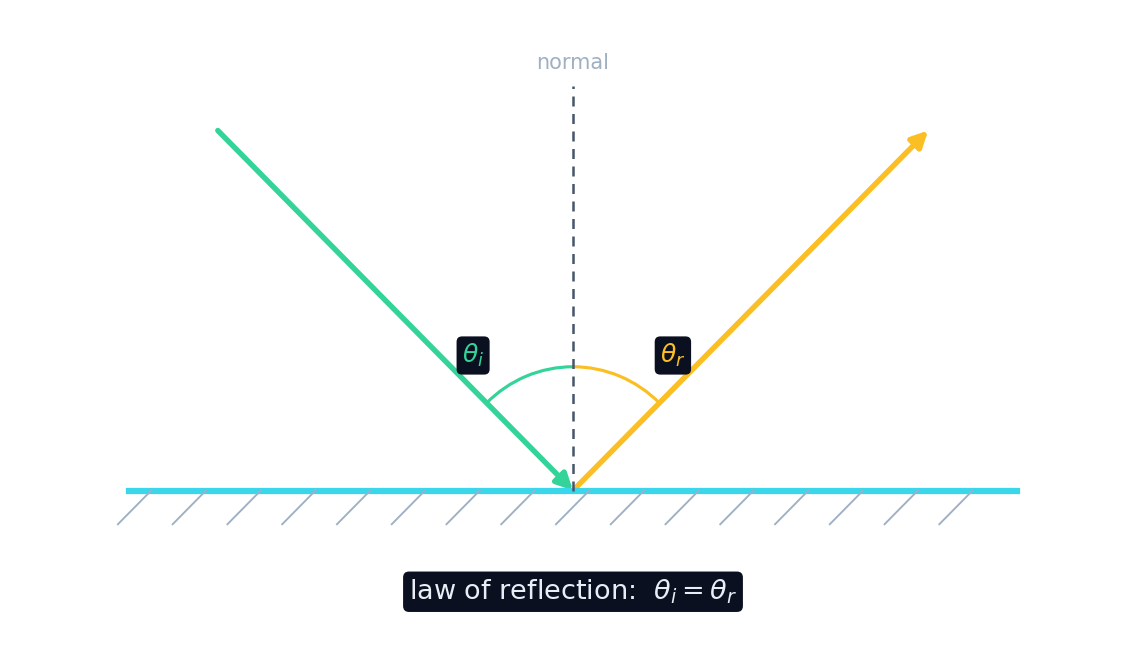
- Angles are measured from the normal 法线 — the line perpendicular to the surface.
- The angle of incidence equals the angle of reflection: $\theta_i = \theta_r$.
- The incoming ray, the reflected ray and the normal all lie in one plane.
- This holds no matter what the angle — steep or shallow.
A lei da reflexão
- Os ângulos são medidos a partir da normal 法线 — a linha perpendicular à superfície.
- O ângulo de incidência é igual ao ângulo de reflexão: $\theta_i = \theta_r$.
- O raio incidente, o raio refletido e a normal estão todos num mesmo plano.
- Isso vale para qualquer ângulo — íngreme ou raso.
A ray strikes a mirror at $30^\circ$ to the normal. At what angle to the normal does it reflect, in degrees? · Um raio incide num espelho a $30^\circ$ em relação à normal. A que ângulo em relação à normal ele reflete, em graus?
$\theta_r = \theta_i = 30^\circ$ by the law of reflection. · $\theta_r = \theta_i = 30^\circ$ pela lei da reflexão.
The law of reflection states that: · A lei da reflexão afirma que:
$\theta_i = \theta_r$, both measured from the normal. · $\theta_i = \theta_r$, ambos medidos a partir da normal.
Smooth vs rough surfaces
- A smooth surface (a mirror) reflects a beam neatly — specular reflection.
- A rough surface scatters light every which way — diffuse reflection.
- Both obey $\theta_i = \theta_r$ at each tiny point; the roughness just points the normals every way.
- Diffuse reflection is why you can see this page from any angle.
Superfícies lisas vs ásperas
- Uma superfície lisa (um espelho) reflete um feixe ordenadamente — reflexão especular.
- Uma superfície áspera dispersa a luz em todas as direções — reflexão difusa.
- Ambas seguem $\theta_i = \theta_r$ em cada ponto minúsculo; a aspereza apenas aponta as normais em todas as direções.
- Reflexão difusa é o motivo pelo qual você pode ver esta página de qualquer ângulo.
Why can you read this page from many angles? · Por que pode ler esta página de muitos ângulos?
The rough paper scatters light diffusely, so it reaches your eyes from any angle. · O papel áspero dispersa a luz difusamente, atingindo seus olhos de qualquer ângulo.
Select all · todos true statements about reflection. · Selecione todas as afirmações verdadeiras sobre reflexão.
Reflection obeys $\theta_i = \theta_r$ from the normal, smooth = specular. Rough surfaces still obey it at each point. · A reflexão obedece $\theta_i = \theta_r$ em relação à normal; superfícies lisas = especulares. Superfícies rugosas ainda obedecem em cada ponto.
Always measure from the normal
- The single most common slip is measuring the angle from the surface instead of the normal.
- The normal is the perpendicular line; angles in optics are always taken from it.
- A ray hitting a mirror "flat" ($\theta_i \approx 90^\circ$ from the normal) grazes off almost flat.
- A ray straight down the normal ($\theta_i = 0$) reflects straight back.
Sempre meça a partir da normal
- O erro mais comum é medir o ângulo a partir da superfície em vez da normal.
- A normal é a linha perpendicular; ângulos em óptica são sempre tomados a partir dela.
- Um raio atingindo um espelho "deitado" ($\theta_i \approx 90^\circ$ da normal) desliza quase paralelo.
- Um raio descendo pela normal ($\theta_i = 0$) reflete direto de volta.
The law of reflection · A lei da reflexão
For a mirror, the angle of reflection always equals the angle of incidence - a straight line through the origin. · Para um espelho, o ângulo de reflexão é sempre igual ao ângulo de incidência — uma linha reta pela origem.
In optics, angles are always measured from the ____ (the perpendicular line). · Em óptica, os ângulos são sempre medidos a partir da ____ (a linha perpendicular).
The normal is perpendicular to the surface; all optics angles use it. · A normal é perpendicular à superfície; todos os ângulos de óptica usam-na.
A ray at $30^\circ$ to the mirror surface is at $60^\circ$ to the normal. · Um raio a $30^\circ$ da superfície do espelho está a $60^\circ$ da normal.
Surface and normal are perpendicular, so the two angles add to $90^\circ$. · A superfície e a normal são perpendiculares, então os dois ângulos somam $90^\circ$.
Always measure the angles from the normal (the perpendicular), not from the mirror surface. A ray at $30^\circ$ to the surface is at $60^\circ$ to the normal — and $60^\circ$ is what goes into $\theta_i = \theta_r$.
Sempre meça os ângulos a partir da normal (a perpendicular), não da superfície do espelho. Um raio em $30^\circ$ para a superfície está em $60^\circ$ para a normal — e $60^\circ$ é o que entra em $\theta_i = \theta_r$.
A ray strikes a mirror at $30^\circ$ to the normal. At what angle does it reflect?
- By the law of reflection, $\theta_r = \theta_i = 30^\circ$ to the normal.
The total angle between the incoming and outgoing rays is $60^\circ$.
Um raio atinge um espelho em $30^\circ$ em relação à normal. Em que ângulo ele reflete?
- Pela lei da reflexão, $\theta_r = \theta_i = 30^\circ$ em relação à normal.
O ângulo total entre os raios incidente e emergente é $60^\circ$.
The law of reflection: the angle of incidence equals the angle of reflection ($\theta_i = \theta_r$), both measured from the normal. Smooth surfaces give clear specular reflection; rough ones give scattered diffuse reflection. Always measure from the normal.
A lei da reflexão: o ângulo de incidência é igual ao ângulo de reflexão ($\theta_i = \theta_r$), ambos medidos a partir da normal. Superfícies lisas dão reflexão especular clara; ásperas dão reflexão difusa dispersa. Sempre meça a partir da normal.