The Process of Charging
Introduzido| English | Significado |
|---|---|
| electron/ɪˈlektrɒn/ | elétron |
That doorknob spark — where did the charge come from?
- Walk across a carpet and touch a doorknob: snap — a tiny shock.
- You picked up extra electrons 电子 from the carpet, then dumped them into the metal.
- Charging is really just electrons moving from one object to another.
- There are a few tidy ways to make an object charged.
Charging by friction
- Rub two different materials together and electrons transfer from one to the other.
- One object ends up with extra electrons (negative), the other short of them (positive).
- The balloon-and-hair and carpet-and-shoe effects both work this way.
- No charge is created — it is only moved.
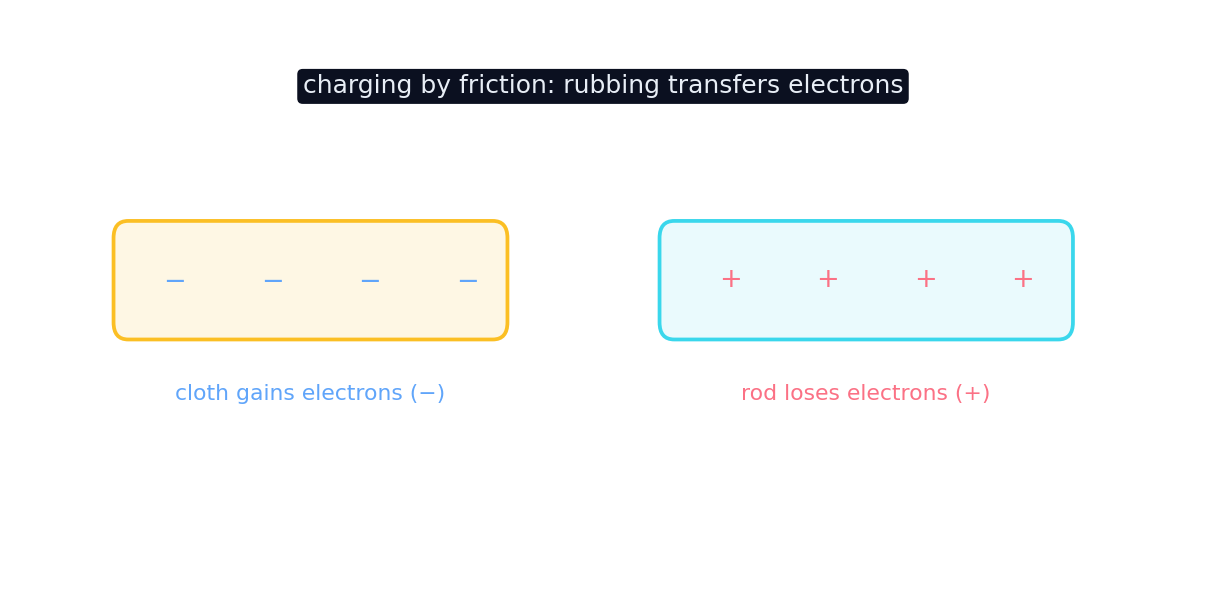
Rub up a charge
Rub the balloon and watch electrons transfer, then see it attract a wall or hair.
Charging by friction transfers ____ from one material to the other.
Dificuldade 1/5 · Moedas 100 + pequeno bônus na primeira conclusão hoje
Rubbing moves electrons; one object gains them, the other loses them.
Conduction and induction
- Charging by conduction — touch a charged object to a neutral one; charge flows across by contact.
- Charging by induction — bring a charge near (without touching), and it rearranges charge in the other object.
- To give a conductor net charge by induction, earth it while the charged object is nearby; disconnect the earth before removing the object.
- Without earthing or separating conductors, a nearby charge only redistributes charge; the neutral conductor stays neutral overall.
Charging by induction differs from conduction because it:
Dificuldade 1/5 · Moedas 100 + pequeno bônus na primeira conclusão hoje
The charged inducing object never touches the conductor. A temporary earth connection lets electrons enter or leave; remove the earth first, then the inducing object, to retain net charge.
Select todos genuine methods of charging an object.
Dificuldade 2/5 · Moedas 140 + pequeno bônus na primeira conclusão hoje
Friction, conduction and induction all charge objects. Heating alone does not.
Charge is conserved
- Conservation of charge: charge is never created or destroyed, only transferred.
- If one object gains $-5\ \text{units}$, another gains $+5$ — the total is unchanged.
- In everyday charging it is always electrons that move (protons stay locked in nuclei).
- So a "positive" object is really one that has lost some electrons.
In ordinary charging, which particles actually move between objects?
Dificuldade 1/5 · Moedas 100 + pequeno bônus na primeira conclusão hoje
Electrons transfer; protons stay locked in the nuclei.
A positively charged object has:
Dificuldade 1/5 · Moedas 100 + pequeno bônus na primeira conclusão hoje
A positive object has lost electrons, leaving more protons than electrons.
When one object gains negative charge, another object must lose the same amount.
Dificuldade 1/5 · Moedas 100 + pequeno bônus na primeira conclusão hoje
Charge is conserved: it is transferred, never created or destroyed.
In ordinary charging, it is electrons that move — never protons. A positively charged object has lost electrons, not gained protons. And no charge is ever created: what one object gains, another loses (conservation of charge).
A glass rod is rubbed with silk and becomes positive with charge $+3\ \text{units}$.
- The rod lost $3\ \text{units}$ of electrons.
- The silk gained exactly $3\ \text{units}$ of electrons, becoming $-3$ — the total stays zero.
Charging moves electrons between objects — by friction (rubbing), conduction (contact) or induction (nearby, no contact). Charge is conserved: what one gains, another loses. A positive object has lost electrons, never gained protons.
Write from the data: find the cloth charge
- A neutral rod and a neutral cloth are rubbed together.
- The rod ends at positive 3 nC. Find the cloth's charge.
A neutral rod is rubbed on a neutral cloth. The rod ends with a charge of positive 3 nC. What is the cloth's charge, and what is the total charge of rod plus cloth?
The positive rod lost electrons to the cloth. Conservation gives the cloth −3 nC and total charge zero.
An initially neutral rod and neutral cloth are rubbed together, isolated from other objects. The rod ends at +3 nC. What is the cloth's charge?
Dificuldade 1/5 · Moedas 100 + pequeno bônus na primeira conclusão hoje
The cloth gained electrons from the rod, so its charge is −3 nC. The total is +3 nC − 3 nC = 0; +3 nC or zero on the cloth would violate conservation.