Angular Momentum and Angular Impulse · Momento Angular e Impulso Angular
| English | Português |
|---|---|
| angular momentum/ˈæŋɡjʊlə məʊˈmentəm/ | momento angular |
Why a spinning top refuses to fall over
- A stationary top topples at once; spin it and it stands, defying gravity for a surprisingly long time.
- Spinning things resist changes to their rotation — they have angular momentum 角动量.
- It is the rotational cousin of ordinary (linear) momentum.
- To change it, you must apply a torque over time — an angular impulse.
Por que uma pião giratório se recusa a cair
- Um pião parado tomba imediatamente; se girar, ele fica em pé, desafiando a gravidade por um tempo surpreendentemente longo.
- Coisas giratórias resistem a mudanças em sua rotação — elas possuem momento angular 角动量.
- É o par rotacional do momento ordinário (linear).
- Para alterá-lo, você deve aplicar um torque ao longo do tempo — um impulso angular.
Angular momentum
- Angular momentum is $L = I\omega$ — rotational inertia times angular velocity.
- It is the twin of $p = mv$, with $I$ for mass and $\omega$ for velocity.
- Its units are $\text{kg}\cdot\text{m}^2/\text{s}$, and it points along the spin axis.
- The faster the spin or the larger the $I$, the more angular momentum.
Momento Angular
- Momento angular é $L = I\omega$ — inércia rotacional vezes velocidade angular.
- É o par de $p = mv$, com $I$ para massa e $\omega$ para velocidade.
- Suas unidades são $\text{kg}\cdot\text{m}^2/\text{s}$, e aponta ao longo do eixo de rotação.
- Quanto mais rápida a rotação ou maior a $I$, maior o momento angular.
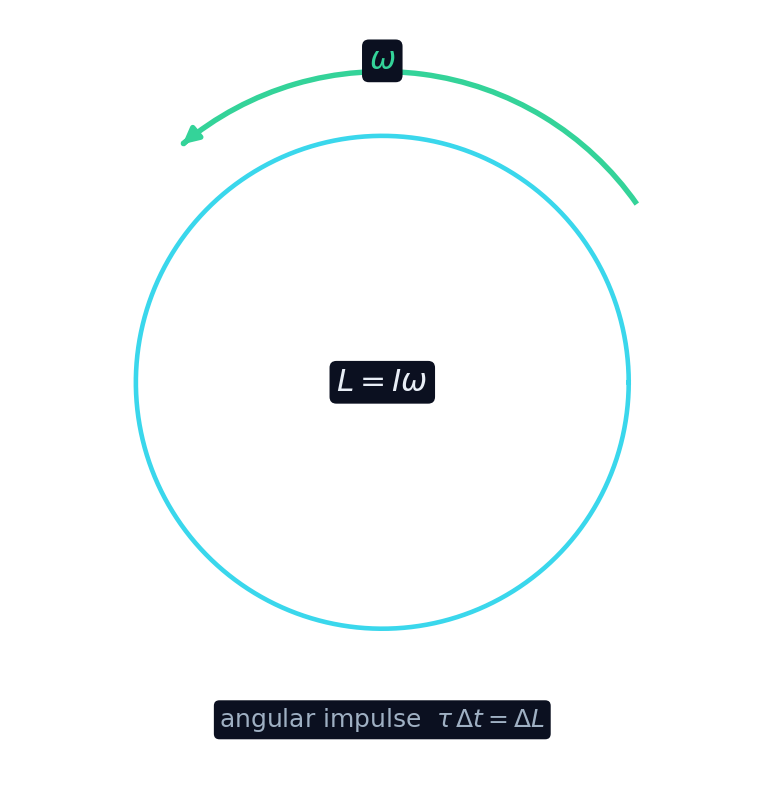
Spin carries angular momentum · O giro carrega momento angular
Change the spin to feel how angular momentum L = Iω builds with faster rotation. · Mude o giro para sentir como o momento angular L = Iω aumenta com rotações mais rápidas.
A disk with $I = 2\ \text{kg}\cdot\text{m}^2$ spins at $\omega = 5\ \tfrac{\text{rad}}{\text{s}}$. What is its angular momentum, in $\text{kg}\cdot\text{m}^2/\text{s}$? · Um disco com $I = 2\ \text{kg}\cdot\text{m}^2$ gira a $\omega = 5\ \tfrac{\text{rad}}{\text{s}}$. Qual é seu momento angular, em $\text{kg}\cdot\text{m}^2/\text{s}$?
$L = I\omega = 2 \times 5 = 10\ \text{kg}\cdot\text{m}^2/\text{s}$.
Angular momentum is the rotational twin of linear momentum $p = mv$. Which is its formula? · O momento angular é o par rotacional do momento linear $p = mv$. Qual é sua fórmula?
$L = I\omega$ — inertia times angular velocity, the twin of $mv$. · $L = I\omega$ — inércia vezes velocidade angular, o par de $mv$.
Angular impulse changes it
- An angular impulse is a torque acting over time: $\tau\,\Delta t$.
- It equals the change in angular momentum: $\tau\,\Delta t = \Delta L$.
- This is the rotational twin of $F\,\Delta t = \Delta p$.
- A long-lasting torque, or a large one, produces a big change in spin.
Impulso Angular o altera
- Um impulso angular é um torque atuando ao longo do tempo: $\tau\,\Delta t$.
- É igual à variação do momento angular: $\tau\,\Delta t = \Delta L$.
- Este é o par rotacional de $F\,\Delta t = \Delta p$.
- Um torque de longa duração, ou grande, produz uma grande mudança na rotação.
An angular impulse is a torque acting over ____. · Um impulso angular é um torque atuando durante ____.
Angular impulse $= \tau\,\Delta t$, and it equals the change in angular momentum. · Impulso angular $= \tau\,\Delta t$, e ele é igual à mudança no momento angular.
A torque of $4\ \text{N·m}$ acts for $2\ \text{s}$. By how much does the angular momentum change, in $\text{kg}\cdot\text{m}^2/\text{s}$? · Um torque de $4\ \text{N·m}$ atua por $2\ \text{s}$. Em quanto o momento angular muda, em $\text{kg}\cdot\text{m}^2/\text{s}$?
$\Delta L = \tau\,\Delta t = 4 \times 2 = 8\ \text{kg}\cdot\text{m}^2/\text{s}$.
Angular momentum resists tipping
- A large angular momentum makes an object "gyroscopically" stubborn — it holds its axis.
- This steadies spinning tops, bicycle wheels, footballs thrown with spin, and satellites.
- To turn the axis you must supply a torque; without one, the axis stays put.
- The bigger $L$ is, the harder the object is to knock off its spin.
Momento Angular resiste a tombar
- Um grande momento angular torna um objeto "giroscopicamente" teimoso — ele mantém seu eixo.
- Isso estabiliza piões giratórios, rodas de bicicleta, bolas de futebol arremessadas com giro e satélites.
- Para virar o eixo, você deve fornecer um torque; sem ele, o eixo permanece fixo.
- Quanto maior a $L$, mais difícil é derrubar o objeto de sua rotação.
Angular momentum · Momento angular $I\omega$ and rotational kinetic energy $\tfrac12 I\omega^2$ are the same quantity. · Momento angular $I\omega$ e energia cinética rotacional $\tfrac12 I\omega^2$ são a mesma quantidade.
They differ: $L$ is linear in $\omega$, energy is quadratic. They are distinct quantities. · Elas diferem: $L$ é linear em $\omega$, energia é quadrática. São quantidades distintas.
Select all · todos effects that come from a large angular momentum. · Selecione todos os efeitos decorrentes de um grande momento angular.
Large $L$ makes spinning objects hold their axis. Falling speed is unrelated to angular momentum. · Grande $L$ faz objetos giratórios manterem seu eixo. A velocidade de queda não está relacionada ao momento angular.
Angular momentum $L = I\omega$ is not the same as rotational kinetic energy $\tfrac12 I\omega^2$. One is linear in $\omega$, the other quadratic. In a collision or a skater's spin, angular momentum is the conserved quantity — energy may change.
Momento angular $L = I\omega$ não é o mesmo que energia cinética rotacional $\tfrac12 I\omega^2$. Uma é linear em $\omega$, a outra quadrática. Em uma colisão ou no giro de uma patinadora, o momento angular é a quantidade conservada — a energia pode mudar.
A disk of $I = 2\ \text{kg}\cdot\text{m}^2$ spins at $\omega = 5\ \tfrac{\text{rad}}{\text{s}}$.
- $L = I\omega = 2 \times 5 = 10\ \text{kg}\cdot\text{m}^2/\text{s}$.
A torque of $4\ \text{N}\cdot\text{m}$ applied for $2\ \text{s}$ adds $\tau\Delta t = 8$, raising $L$ to $18\ \text{kg}\cdot\text{m}^2/\text{s}$.
Um disco de $I = 2\ \text{kg}\cdot\text{m}^2$ gira a $\omega = 5\ \tfrac{\text{rad}}{\text{s}}$.
- $L = I\omega = 2 \times 5 = 10\ \text{kg}\cdot\text{m}^2/\text{s}$.
Um torque de $4\ \text{N}\cdot\text{m}$ aplicado por $2\ \text{s}$ adiciona $\tau\Delta t = 8$, elevando $L$ para $18\ \text{kg}\cdot\text{m}^2/\text{s}$.
Angular momentum is $L = I\omega$, the rotational twin of $p = mv$ (units $\text{kg}\cdot\text{m}^2/\text{s}$). An angular impulse $\tau\,\Delta t$ changes it: $\tau\,\Delta t = \Delta L$. A large $L$ makes a spinning object resist tipping.
Momento angular é $L = I\omega$, o par rotacional de $p = mv$ (unidades $\text{kg}\cdot\text{m}^2/\text{s}$). Um impulso angular $\tau\,\Delta t$ o altera: $\tau\,\Delta t = \Delta L$. Um grande $L$ faz um objeto giratório resistir a tombar.