Rotational Kinetic Energy · Energia Cinética Rotacional
| English | Português |
|---|---|
| rotational kinetic energy/rəʊˈteɪʃənl kɪˈnetɪk ˈenədʒi/ | energia cinética rotacional |
A spinning flywheel stores usable energy
- A heavy flywheel, spun up fast, can power a machine for minutes after the motor stops.
- It isn't going anywhere — yet it clearly holds energy in its spin.
- A rotating body has rotational kinetic energy 转动动能, just as a moving one has translational.
- Swap mass for rotational inertia and speed for angular speed, and the formula follows.
Um volante giratório armazena energia utilizável
- Um volante pesado, acelerado rápido, pode alimentar uma máquina por minutos depois que o motor para.
- Ele não está indo para lugar nenhum — contudo claramente guarda energia em sua rotação.
- Um corpo rotativo tem energia cinética rotacional 转动动能, assim como um corpo em movimento tem energia translacional.
- Trocar massa por inércia rotacional e velocidade por velocidade angular, a fórmula segue.
The rotational kinetic energy formula
- A spinning body stores $E_k = \tfrac12 I \omega^2$.
- It is the exact twin of $\tfrac12 m v^2$, with $I$ for mass and $\omega$ for speed.
- Like all energy it is a scalar, measured in joules.
- Faster spin or larger rotational inertia both store more energy.
A fórmula da energia cinética rotacional
- Um corpo giratório armazena $E_k = \tfrac12 I \omega^2$.
- É o gêmeo exato de $\tfrac12 m v^2$, com $I$ para massa e $\omega$ para velocidade.
- Como toda energia, é uma escalar, medida em joules.
- Rotação mais rápida ou maior inércia rotacional armazenam mais energia.
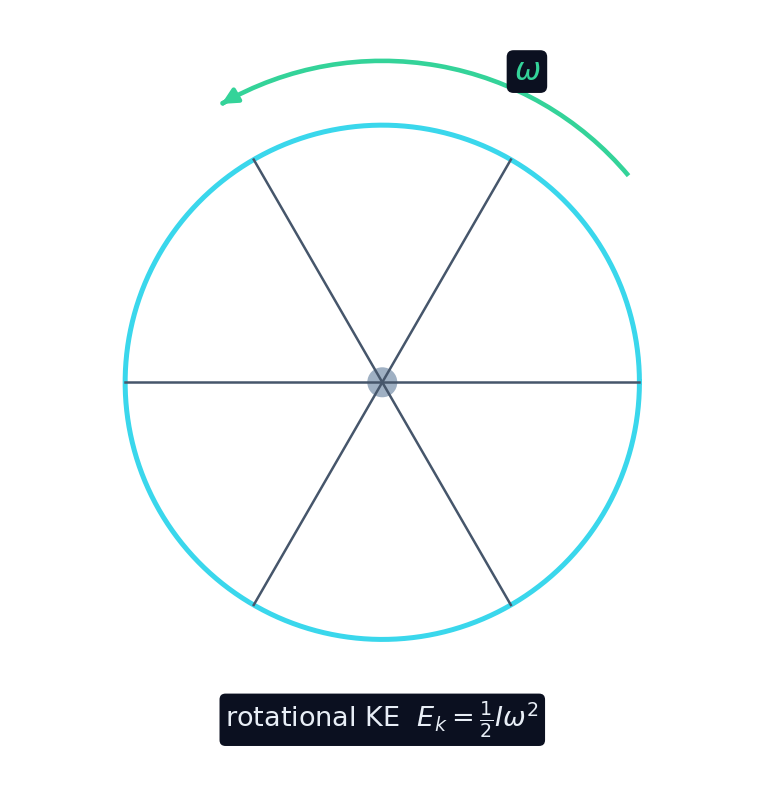
Spin stores energy · Rotação armazena energia
Change how fast the angle sweeps to feel how spin rate feeds the rotational kinetic energy. · Mude a rapidez com que o ângulo é varrido para sentir como a taxa de giro alimenta a energia cinética rotacional.
A wheel with $I = 4\ \text{kg}\cdot\text{m}^2$ spins at $\omega = 3\ \tfrac{\text{rad}}{\text{s}}$. What is its rotational kinetic energy, in joules? · Uma roda com $I = 4\ \text{kg}\cdot\text{m}^2$ gira a $\omega = 3\ \tfrac{\text{rad}}{\text{s}}$. Qual é sua energia cinética rotacional, em joules?
$E_k = \tfrac12 I\omega^2 = \tfrac12 (4)(9) = 18\ \text{J}$.
Which is the formula for rotational kinetic energy? · Qual é a fórmula para energia cinética rotacional?
It is · É $\tfrac12 I\omega^2$ — the rotational twin of $\tfrac12 mv^2$. · É $\tfrac12 I\omega^2$ — o par rotacional de $\tfrac12 mv^2$.
Rotational kinetic energy is measured in ____. · A energia cinética rotacional é medida em ____.
It is an energy, so it is measured in joules. · É uma energia, portanto é medida em joules.
It depends on ω squared
- Because of the $\omega^2$, doubling the spin rate stores four times the energy.
- This is why flywheels are spun as fast as their strength allows.
- Rotational inertia matters too, in direct proportion — double $I$, double the energy.
- Mass placed far from the axis (large $I$) makes a very effective energy store.
Depende de ω ao quadrado
- Devido ao $\omega^2$, dobrar a taxa de rotação armazena quatro vezes a energia.
- É por isso que volantes são girados tão rápido quanto sua resistência permite.
- Inércia rotacional também importa, em proporção direta — dobre $I$, dobre a energia.
- Massa colocada longe do eixo (grande $I$) faz um armazenamento de energia muito eficaz.
If a flywheel doubles its angular speed, its rotational kinetic energy becomes: · Se um volante duplica sua velocidade angular, sua energia cinética rotacional torna-se:
$E_k \propto \omega^2$, so doubling $\omega$ gives four times the energy. · $E_k \propto \omega^2$, então dobrar $\omega$ resulta em quatro vezes a energia.
Select all · todos ways to increase a flywheel's stored rotational kinetic energy. · Selecione todas as formas de aumentar a energia cinética rotacional armazenada em um volante.
Higher $\omega$ or larger $I$ (mass at the rim) raises $\tfrac12 I\omega^2$. Colour has no effect. · Maior $\omega$ ou maior $I$ (massa na borda) aumenta $\tfrac12 I\omega^2$. A cor não tem efeito.
Flywheels as batteries
- Some buses and race cars store braking energy in a spinning flywheel, then reuse it.
- The energy goes in as $\tfrac12 I\omega^2$ and comes back out to drive the wheels.
- No chemicals, no wear — just a very fast, well-balanced disk.
- It is a neat mechanical "battery" built on this one formula.
Volantes como baterias
- Alguns ônibus e carros de corrida armazenam energia de frenagem num volante giratório, depois a reutilizam.
- A energia entra como $\tfrac12 I\omega^2$ e sai de volta para acionar as rodas.
- Sem produtos químicos, sem desgaste — apenas um disco muito rápido e bem balanceado.
- É uma elegante "bateria" mecânica construída sobre esta única fórmula.
A spinning flywheel can be used to store energy and release it later. · Um volante giratório pode ser usado para armazenar energia e liberá-la posteriormente.
The energy $\tfrac12 I\omega^2$ is stored in the spin and can drive a machine afterward. · A energia $\tfrac12 I\omega^2$ é armazenada no giro e pode acionar uma máquina depois.
Use rotational inertia $I$ and angular speed $\omega$ in $\tfrac12 I\omega^2$, never plain mass and linear speed. A rolling object has both kinds of kinetic energy at once (lesson 6.5) — don't forget the spinning part.
Use inércia rotacional $I$ e velocidade angular $\omega$ em $\tfrac12 I\omega^2$, nunca massa simples e velocidade linear. Um objeto rolante tem ambos os tipos de energia cinética ao mesmo tempo (lição 6.5) — não esqueça a parte giratória.
A wheel of rotational inertia $I = 4\ \text{kg}\cdot\text{m}^2$ spins at $\omega = 3\ \tfrac{\text{rad}}{\text{s}}$.
- $E_k = \tfrac12 I\omega^2 = \tfrac12 (4)(3^2) = \tfrac12 (4)(9) = 18\ \text{J}$.
Double the spin to $6\ \tfrac{\text{rad}}{\text{s}}$ and $E_k = \tfrac12(4)(36) = 72\ \text{J}$ — four times as much.
Uma roda de inércia rotacional $I = 4\ \text{kg}\cdot\text{m}^2$ gira a $\omega = 3\ \tfrac{\text{rad}}{\text{s}}$.
- $E_k = \tfrac12 I\omega^2 = \tfrac12 (4)(3^2) = \tfrac12 (4)(9) = 18\ \text{J}$.
Dobrar a rotação para $6\ \tfrac{\text{rad}}{\text{s}}$ e $E_k = \tfrac12(4)(36) = 72\ \text{J}$ — quatro vezes mais.
Rotational kinetic energy is $E_k = \tfrac12 I\omega^2$, the spin twin of $\tfrac12 mv^2$. It grows with the square of angular speed, so doubling $\omega$ stores four times the energy. Flywheels use it as a mechanical energy store.
Energia cinética rotacional é $E_k = \tfrac12 I\omega^2$, o gêmeo de rotação de $\tfrac12 mv^2$. Cresce com o quadrado da velocidade angular, então dobrar $\omega$ armazena quatro vezes a energia. Volantes a usam como armazenamento mecânico de energia.