Conservation of Linear Momentum
Introduzido| English | Significado |
|---|---|
| conservation/ˌkɒnsəˈveɪʃn/ | conservação |
| isolated system/ˈaɪsəleɪtɪd ˈsɪstəm/ | sistema isolado |
A cannon kicks back — and the books balance
- Fire a cannon and it lurches backward as the ball flies forward.
- The forward momentum of the ball is matched by the backward momentum of the cannon.
- Before firing, nothing moved: total momentum was zero. After firing, it is still zero.
- Momentum was not created — it was shared out, and the total was conserved 守恒.
The conservation law
- In an isolated system 孤立系统 (no external net force), total momentum stays constant.
- Total momentum before an interaction equals total momentum after.
- $m_1 u_1 + m_2 u_2 = m_1 v_1 + m_2 v_2$ (using $u$ for before, $v$ for after).
- It follows directly from Newton's third law: the internal forces cancel in pairs.
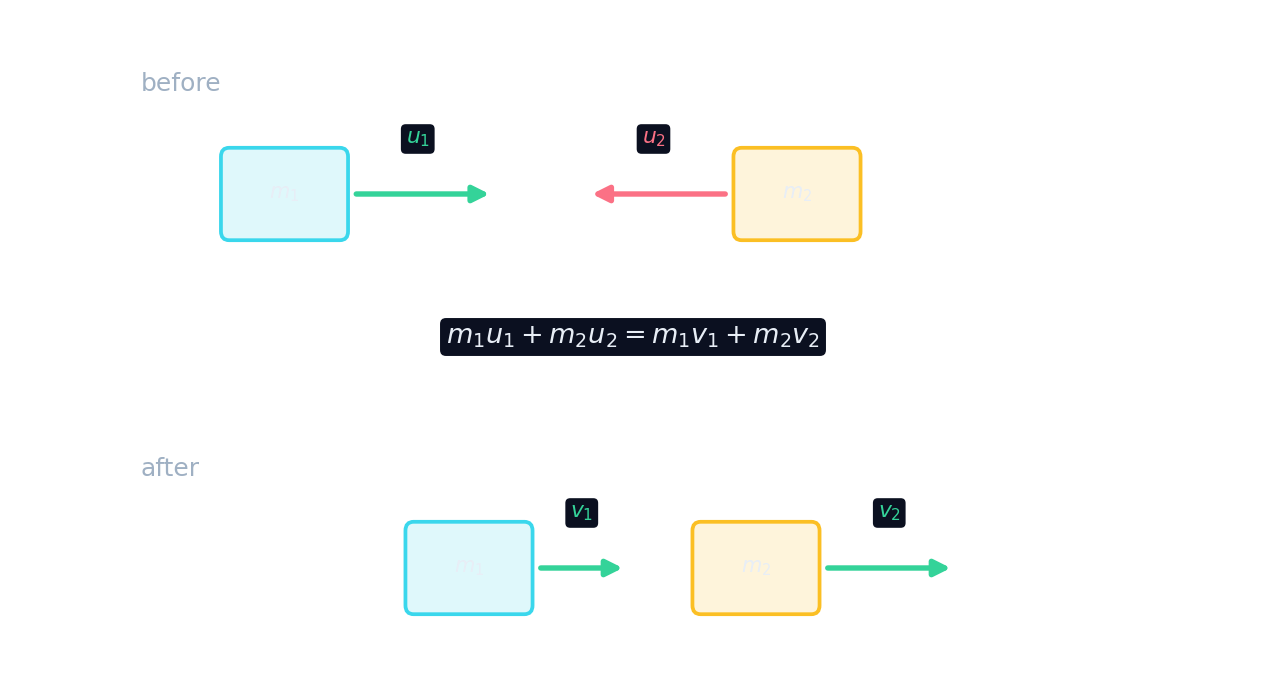
Momentum is conserved
Set the masses and speeds, run the collision, and check the total momentum before equals after.
A $1000\ \text{kg}$ cannon fires a $5\ \text{kg}$ ball at $200\ \tfrac{\text{m}}{\text{s}}$ relative to the ground. (The cannon mass is after firing.) What is the cannon's recoil speed, in $\tfrac{\text{m}}{\text{s}}$? (Total momentum starts at zero.)
Dificuldade 2/5 · Moedas 140 + pequeno bônus na primeira conclusão hoje
$0 = 1000 v + 5(200)$, so $v = -1000/1000 = -1\ \tfrac{\text{m}}{\text{s}}$ — speed $1\ \tfrac{\text{m}}{\text{s}}$ backward.
In an isolated collision, the total momentum after equals the total momentum before.
Dificuldade 1/5 · Moedas 100 + pequeno bônus na primeira conclusão hoje
That is exactly conservation of momentum: $\sum p_{\text{before}} = \sum p_{\text{after}}$.
Why the internal forces cancel
- During a collision, the two objects push on each other equally and oppositely.
- These internal impulses are equal and opposite, so they cancel in the total.
- With no external force, nothing changes the system's total momentum.
- Each object's momentum can change wildly — but their sum does not.
Conservation of momentum follows directly from Newton's ____ law.
Dificuldade 1/5 · Moedas 100 + pequeno bônus na primeira conclusão hoje
The equal-and-opposite internal forces (third law) cancel, leaving the total momentum unchanged.
Solving with conservation
- Write down the total momentum before, set it equal to the total after, and solve.
- Remember to include signs — momentum is a vector.
- Recoil (guns, rockets), explosions, and every collision obey this law.
- It works even when you have no idea about the messy forces during contact.
A $2\ \text{kg}$ trolley at $3\ \tfrac{\text{m}}{\text{s}}$ hits a stationary $1\ \text{kg}$ trolley and they stick. What is their common speed after, in $\tfrac{\text{m}}{\text{s}}$?
Dificuldade 2/5 · Moedas 140 + pequeno bônus na primeira conclusão hoje
Before: $p = 2(3) = 6$. After: $3v = 6$, so $v = 2\ \tfrac{\text{m}}{\text{s}}$.
Select todos situations where total momentum is conserved.
Dificuldade 2/5 · Moedas 140 + pequeno bônus na primeira conclusão hoje
The first three conserve momentum in the relevant direction during the brief event if external impulse is negligible. Strong external friction adds outside impulse, so momentum is not conserved there.
Momentum is only conserved for an isolated system — one with no external net force. Friction, gravity or a wall can add outside impulse and change the total. Choose your system so the big forces are internal, then conservation applies.
Momentum is conserved only when the system is:
Dificuldade 1/5 · Moedas 100 + pequeno bônus na primeira conclusão hoje
With no external net force, the internal forces cancel and total momentum stays constant.
A $2\ \text{kg}$ trolley at $3\ \tfrac{\text{m}}{\text{s}}$ hits a stationary $1\ \text{kg}$ trolley and they stick together.
- Before: $p = 2(3) + 1(0) = 6\ \text{kg}\cdot\tfrac{\text{m}}{\text{s}}$.
- After: combined mass $3\ \text{kg}$ moves at $v$, so $3v = 6 \Rightarrow v = 2\ \tfrac{\text{m}}{\text{s}}$.
Conservation of momentum: in an isolated system, total momentum is unchanged, so $m_1 u_1 + m_2 u_2 = m_1 v_1 + m_2 v_2$. It comes from Newton's third law (internal forces cancel). Keep track of signs, and it solves recoil, explosions and collisions.
Write from the data: find the common speed
- A 4 kg cart at 5 m/s hits a 4 kg cart at rest and they stick.
- Find the common speed.
A 4 kg cart at 5 m/s hits a stationary 4 kg cart and they stick together. The system is isolated. What is their common speed?
With no net external impulse, conserve horizontal momentum: $m_1u_1+m_2u_2=(m_1+m_2)v$. Thus $v=[4(5)+4(0)]/(4+4)=20/8=2.5\ \tfrac{\text{m}}{\text{s}}$, in the incoming cart's direction.
A 4 kg cart at 5 m/s hits a stationary 4 kg cart and they stick together. The system is isolated. What is their common speed?
Dificuldade 1/5 · Moedas 100 + pequeno bônus na primeira conclusão hoje
With no net external impulse, conserve horizontal momentum: $m_1u_1+m_2u_2=(m_1+m_2)v$. Thus $v=[4(5)+4(0)]/(4+4)=20/8=2.5\ \tfrac{\text{m}}{\text{s}}$, in the incoming cart's direction.