Newton's Second Law · Segunda Lei de Newton
| English | Português |
|---|---|
| mass/mæs/ | massa |
The same shove — a feather flies, a fridge barely budges
- Give a feather a gentle push and it shoots off; give a fridge the same push and it hardly moves.
- Same force, wildly different results — the difference is mass 质量.
- Newton's second law ties them together: force, mass and acceleration in one equation.
- It is the engine of mechanics: give me the forces and the mass, and I'll give you the motion.
同样的推力——羽毛飞起,冰箱几乎不动
- 轻轻推一下羽毛,它会飞出去;用同样的力推冰箱,它几乎不动。
- 同样的力,结果天差地别——区别在于质量 质量。
- 第二定律将它们联系在一起:力、质量和加速度在一个方程中。
- 它是力学的引擎:给我力和质量,我就给你运动。
The equation
- The net force equals mass times acceleration: $\vec F_{\text{net}} = m\,\vec a$.
- Rearranged: $\vec a = \dfrac{\vec F_{\text{net}}}{m}$ — acceleration is what the net force produces.
- The acceleration points in the same direction as the net force.
- It is the net force that counts, never one force in isolation.
A equação
- 合力等于质量乘以加速度:$\vec F_{\text{net}} = m\,\vec a$。
- 重新排列:$\vec a = \dfrac{\vec F_{\text{net}}}{m}$ —— 加速度是合力产生的结果。
- 加速度的方向与合力的方向相同。
- 重要的是合力,而不是孤立的一股力。
What net force gives a $2\ \text{kg}$ object an acceleration of $5\ \tfrac{\text{m}}{\text{s}^2}$? Answer in $\text{N}$. · Que força líquida dá a um objeto de $2\ \text{kg}$ uma aceleração de $5\ \tfrac{\text{m}}{\text{s}^2}$? Responda em $\text{N}$.
$F = ma = 2 \times 5 = 10\ \text{N}$.
Two proportions inside one law
- More force, more acceleration: $a \propto F$ (double the force, double the acceleration).
- More mass, less acceleration: $a \propto \dfrac{1}{m}$ (double the mass, halve the acceleration).
- So a light cart leaps ahead while a heavy one crawls under the same push.
- Heavy objects are "sluggish" precisely because $a = F/m$ shrinks as $m$ grows.
一个定律中的两个比例关系
- 力越大,加速度越大:$a \propto F$(力加倍,加速度加倍)。
- 质量越大,加速度越小:$a \propto \dfrac{1}{m}$(质量加倍,加速度减半)。
- 因此,轻车在同样的推力下会猛冲向前,而重车则缓慢爬行。
- 重物之所以“迟钝”,正是因为当$a = F/m$增大时$m$减小。
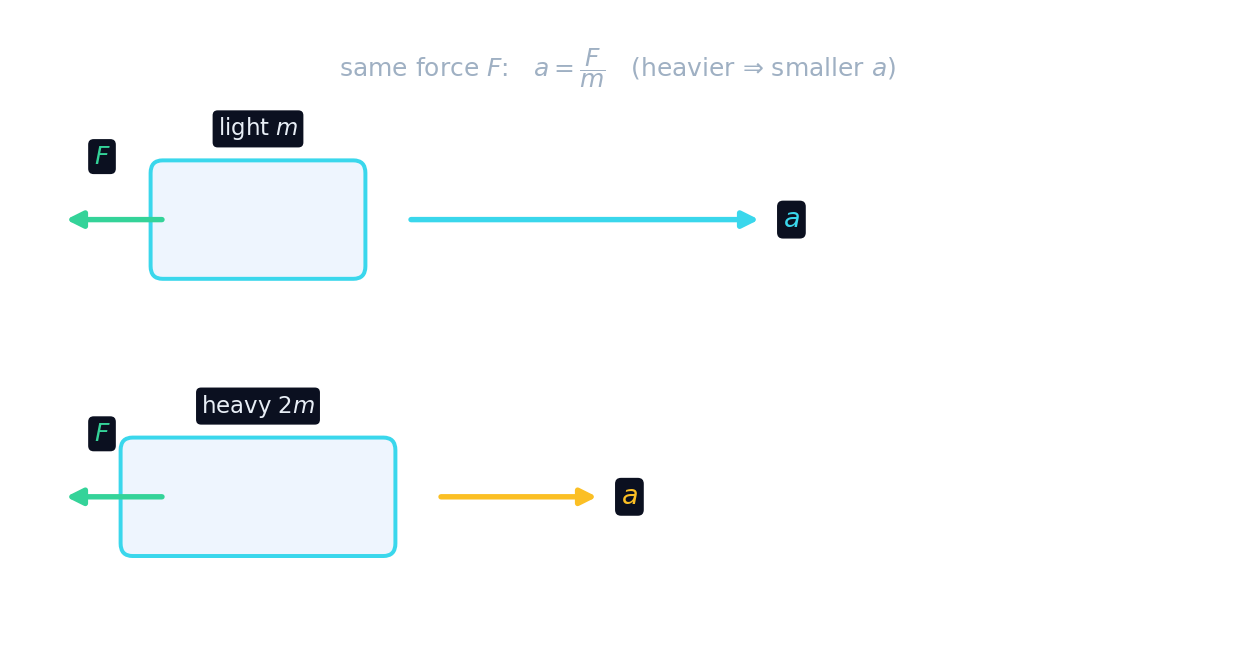 *同样的力$F$给轻车带来大的$a$,给重车带来小的$a$——因为$a = F/m$。
Net force sets the acceleration · A força líquida determina a aceleração
Raise the applied force or the mass and watch how the net force and the acceleration change. · Aumente a força aplicada ou a massa e observe como a força líquida e a aceleração mudam.
A net force of $12\ \text{N}$ acts on a $3\ \text{kg}$ trolley. What is its acceleration, in $\tfrac{\text{m}}{\text{s}^2}$? · Uma força líquida de $12\ \text{N}$ age em um carrinho de $3\ \text{kg}$. Qual é sua aceleração, em $\tfrac{\text{m}}{\text{s}^2}$?
$a = F_{\text{net}}/m = 12/3 = 4\ \tfrac{\text{m}}{\text{s}^2}$.
If you double the net force on an object but keep its mass the same, its acceleration: · Se você dobrar a força líquida sobre um objeto, mas manter sua massa constante, sua aceleração:
Since $a = F/m$ and · e $m$ is fixed, $a \propto F$: doubling the force doubles the acceleration. · Como $a = F/m$ e $m$ são fixos, $a \propto F$: dobrar a força dobra a aceleração.
Doubling the mass while keeping the same net force halves the acceleration. · Dobrar a massa enquanto mantém a mesma força líquida reduz a aceleração pela metade.
$a = F/m$, so $a \propto 1/m$: double the mass, half the acceleration. · $a = F/m$, logo $a \propto 1/m$: dobra a massa, metade da aceleração.
Units and weight
- $1\ \text{N} = 1\ \text{kg} \cdot \tfrac{\text{m}}{\text{s}^2}$ — the newton is defined by this law.
- Weight is just the second law applied to gravity: $W = mg$.
- Mass ($\text{kg}$) measures inertia; weight ($\text{N}$) is a force — do not confuse them.
- On the Moon your mass is unchanged, but your weight is about one-sixth.
单位和重量
- $1\ \text{N} = 1\ \text{kg} \cdot \tfrac{\text{m}}{\text{s}^2}$ —— 牛顿就是根据这个定律定义的。
- 重量只是第二定律应用于重力:$W = mg$。
- 质量($\text{kg}$)衡量惯性;重量($\text{N}$)是一种力——不要混淆它们。
- 在月球上你的质量不变,但重量约为六分之一。
Complete the definition: $1\ \text{N} = 1\ \text{kg} \cdot$ ____ (write the units). · Complete a definição: $1\ \text{N} = 1\ \text{kg} \cdot$ ____ (escreva as unidades).
From $F = ma$, $1\ \text{N} = 1\ \text{kg} \cdot 1\ \tfrac{\text{m}}{\text{s}^2}$. · De $F = ma$, $1\ \text{N} = 1\ \text{kg} \cdot 1\ \tfrac{\text{m}}{\text{s}^2}$.
You travel from Earth to the Moon. Which of these changes? · Você viaja da Terra para a Lua. Qual destas coisas muda?
Mass (inertia) is unchanged; weight $W = mg$ drops because the Moon's $g$ is about one-sixth of Earth's. · A massa (inércia) não muda; o peso $W = mg$ cai porque a gravidade da Lua $g$ é cerca de um sexto da da Terra.
Use the net force in $F = ma$, not a single force. If several forces act, add them as vectors first. And remember mass is not weight: mass is in kilograms, weight is a force in newtons ($W = mg$).
Use a força líquida em $F = ma$, não uma única força. Se várias forças atuarem, some-as como vetores primeiro. E lembre-se: massa não é peso: massa está em quilogramas, peso é uma força em newtons ($W = mg$).
A net force of $12\ \text{N}$ acts on a $3\ \text{kg}$ trolley.
- $a = \dfrac{F_{\text{net}}}{m} = \dfrac{12}{3} = 4\ \tfrac{\text{m}}{\text{s}^2}$.
Keep the same force but double the mass to $6\ \text{kg}$, and the acceleration halves to $2\ \tfrac{\text{m}}{\text{s}^2}$.
一个$12\ \text{N}$的合力作用在一个$3\ \text{kg}$的小车上。
- $a = \dfrac{F_{\text{net}}}{m} = \dfrac{12}{3} = 4\ \tfrac{\text{m}}{\text{s}^2}$.
Mantenha a mesma força mas dobre a massa para $6\ \text{kg}$, e a aceleração cai pela metade para $2\ \tfrac{\text{m}}{\text{s}^2}$.
Newton's second law: $\vec F_{\text{net}} = m\vec a$, so $\vec a = \vec F_{\text{net}}/m$ in the direction of the net force. Acceleration grows with force ($a\propto F$) and shrinks with mass ($a\propto 1/m$). $1\ \text{N} = 1\ \text{kg}\cdot\text{m/s}^2$; weight is $W = mg$.
第二定律:$\vec F_{\text{net}} = m\vec a$,所以$\vec a = \vec F_{\text{net}}/m$指向合力的方向。加速度随力($a\propto F$)增大而增大,随质量($a\propto 1/m$)增大而减小。$1\ \text{N} = 1\ \text{kg}\cdot\text{m/s}^2$;重量是$W = mg$。