Demanda
Introduzido| English | Significado |
|---|---|
| income/ˈɪŋkʌm/ | renda |
| law of demand/lɔː ɒv dɪˈmænd/ | lei da demanda |
| demand/dɪˈmænd/ | demanda |
| quantity demanded/ˈkwɒntɪti dɪˈmændɪd/ | quantidade demandada |
| inverse relationship/ɪnˈvɜːs rɪˈleɪʃənʃɪp/ | relação inversa |
| substitution effect/ˌsʌbstɪˈtjuːʃn ɪˈfekt/ | efeito substituição |
| substitute/ˈsʌbstɪtjuːt/ | substituto |
| income effect/ˈɪŋkʌm ɪˈfekt/ | efeito renda |
| movement along/ˈmuːvmənt əˈlɒŋ/ | movimento ao longo da curva |
| shift/ʃɪft/ | deslocamento |
| tastes/teɪsts/ | gostos |
| complement/ˈkɒmplɪmənt/ | complementar |
Why a sale empties the shelves
- Cut a price and a crowd appears; raise it and the crowd melts away.
- That predictable response is the single most important pattern in a market.
- Get it right and you can predict how buyers react to price, income, and fashion.
- It is called the law of demand 需求定律.
The law of demand
- Demand 需求 is the whole relationship between price and how much buyers want at each price — not one number.
- Quantity demanded 需求量 is just one number: the amount bought at one price.
- The law of demand: price up → quantity demanded down; price down → quantity demanded up. An inverse relationship 反向关系.
- The curve slopes down for two reasons: the substitution effect 替代效应 (switch to cheaper substitutes) and the income effect 收入效应 (your money buys less).
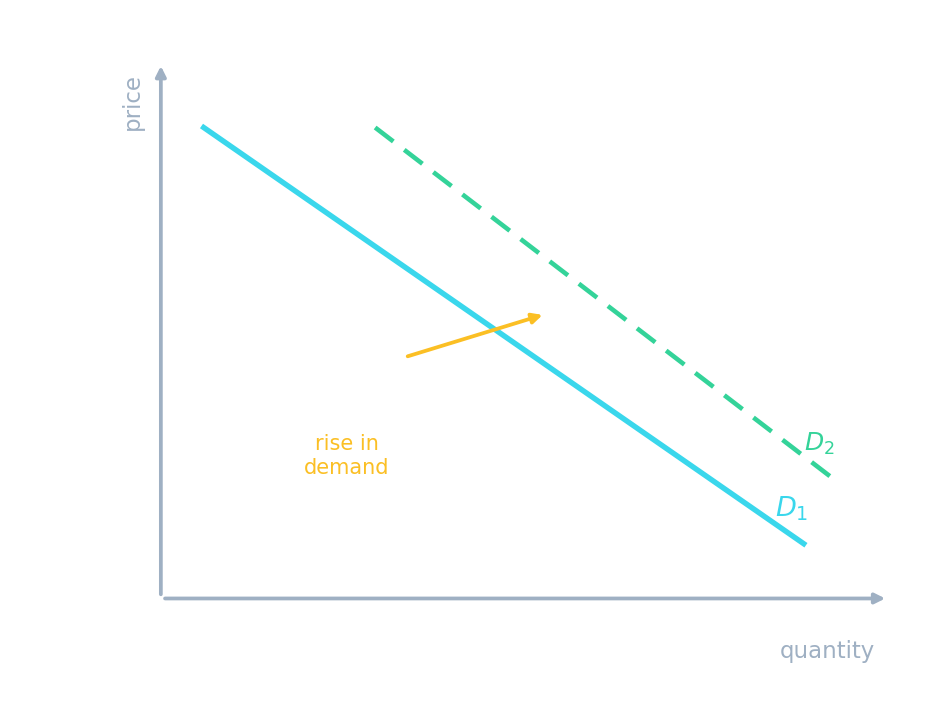
Demanda e Oferta
A demanda curve slopes down — a lower price, more is wanted. A change in income or tastes shifts the whole curve.
The law of demand says that, other things equal, when price rises the quantity demanded:
Dificuldade 1/5 · Moedas 100 + pequeno bônus na primeira conclusão hoje
Price and quantity demanded move in opposite directions — an inverse relationship.
The amount buyers will buy at one particular price is called:
Dificuldade 1/5 · Moedas 100 + pequeno bônus na primeira conclusão hoje
Quantity demanded is one number; demand is the whole price–quantity relationship.
Movement vs shift
- A change in the good's own price → a movement along 沿曲线移动 the curve (a change in quantity demanded).
- A change in anything else → a shift 移动 of the whole curve (a change in demand).
This distinction wins marks. Only the good's own price moves you along the curve. Income, tastes, or other prices shift it. Mixing these up is the classic exam mistake.
A change in the good's own price causes a movement along the demand curve, not a shift.
Dificuldade 1/5 · Moedas 100 + pequeno bônus na primeira conclusão hoje
Own price → movement along; every other factor → shift of the whole curve.
What shifts demand — TIPEN
- Tastes 偏好: a good becomes popular → demand shifts right.
- Income 收入: for a normal good, higher income → demand right.
- Prices of related goods: a cheaper substitute 替代品 shifts this good's demand left; a cheaper complement 互补品 shifts it right.
- Expectations of higher future prices → buy more now (right). Number of buyers rises → right.
Match each change to its effect on the demand for coffee.
Dificuldade 2/5 · Moedas 140 + pequeno bônus na primeira conclusão hoje
Income, substitutes and complements shift the curve; the good's own price only moves you along it.
Two goods used together, like printers and ink, are called ______.
Dificuldade 1/5 · Moedas 100 + pequeno bônus na primeira conclusão hoje
A rise in the price of one lowers demand for the other.
Select todos that shift the demand curve (rather than move along it).
Dificuldade 2/5 · Moedas 140 + pequeno bônus na primeira conclusão hoje
TIPEN factors shift the curve; the good's own price only causes a movement along it.
Worked example: movement or shift?
For the market for coffee, decide whether each causes a movement along the demand curve or a shift, and in which direction: (a) the price of coffee rises from 3 dollars to 4 dollars; (b) the price of tea (a substitute) falls; (c) a study reports coffee improves health.
- (a) The good's own price changes, so there is a movement up along the curve: quantity demanded falls. Demand itself does not change.
- (b) Cheaper tea pulls buyers away, so demand for coffee shifts left. (c) A change in tastes in coffee's favour shifts demand right: more is wanted at every price.
Incomes rise and pizza is a normal good. What happens to the demand curve for pizza?
Dificuldade 1/5 · Moedas 100 + pequeno bônus na primeira conclusão hoje
Buyers want more of a normal good at every price.
A fall in the price of a good shifts its demand curve to the right.
Dificuldade 1/5 · Moedas 100 + pequeno bônus na primeira conclusão hoje
It causes a movement along the curve, an increase in quantity demanded.
Demand is the whole price–quantity relationship; the law of demand makes it slope down (substitution + income effects). The good's own price = a movement along; any other factor (TIPEN) = a shift of the whole curve.
Write from the data: find the movement
- The price of noodles falls from 8 dollars to 6 dollars.
- Quantity demanded rises from 10 bowls to 14 bowls.
The price of noodles falls from 8 dollars to 6 dollars and quantity demanded rises from 10 bowls to 14. Is this a movement or a shift, and by how many bowls does quantity demanded change?
14 minus 10 is 4, and only the good's own price changed.
What happens to demand in this noodle example?
Dificuldade 1/5 · Moedas 100 + pequeno bônus na primeira conclusão hoje
A lower own price raises quantity demanded along the same curve.