The Origin and Influences of Urbanization
Introduzido| English | Significado |
|---|---|
| urbanization/ˌɜːbənaɪˈzeɪʃn/ | Urbanização |
| site/saɪt/ | Sítio |
| situation/ˌsɪtʃuːˈeɪʃn/ | Situação |
| suburbanization/səˌbɜːbənaɪˈzeɪʃn/ | Suburbanização |
| suburb/ˈsʌbɜːb/ | Subúrbio |
| urban sprawl/ˈɜːbən sprɔːl/ | Expansão urbana |
Shenzhen: from fishing villages to 17 million
- In 1979, Shenzhen was a group of fishing villages and market towns beside Hong Kong. China made it a Special Economic Zone in 1980, factories arrived, and today it is a city of about 17 million people. China as a whole went from about 19% urban in 1980 to about 66% in 2023.
- Urbanization 城市化 is the growth in the share of a population living in cities. Geographers explain where cities grow with site and situation, and how they grow with changes in farming, industry and transport.
Site and situation
| Site 地点 | Situation 区位 | |
|---|---|---|
| Meaning | the physical features of the place itself | the place's location relative to other places |
| Examples of features | a deep harbour, a river crossing, a defensible hill, fresh water | near trade routes, resources, other cities or a border |
| Singapore | small island with a sheltered natural harbour | on the Strait of Malacca, the main sea route between the Indian Ocean and the Pacific |
| Shenzhen | flat coastal land by the Pearl River estuary | next to Hong Kong, with its investors, port and markets |
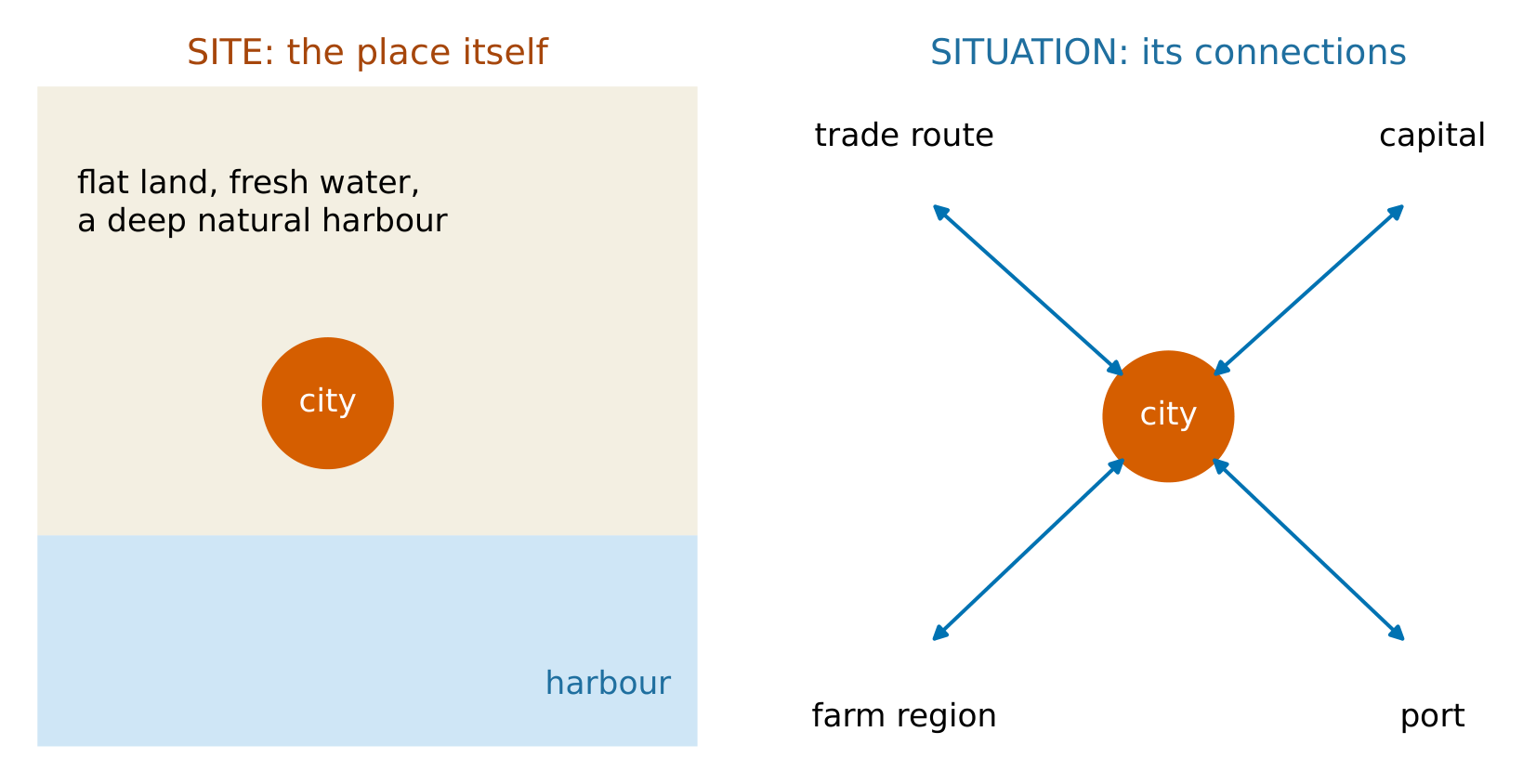
Sítio ou situação?
Sort each description as a site factor or a situation factor.
Match each feature to site or situation.
Dificuldade 2/5 · Moedas 140 + pequeno bônus na primeira conclusão hoje
Site is the place itself; situation is its connections.
Why cities grew: three revolutions
- Agricultural surplus (from about 10,000 years ago): farmers could feed people who did not farm, so the first cities grew in river valleys such as Mesopotamia and the Nile.
- Industrial Revolution (1700s onward): factory jobs pulled people from farms; Britain became majority urban by about 1850. Today: most urban growth is in Asia and Africa, and since about 2007 more than half of humanity has lived in cities.
What made the first cities possible?
Dificuldade 1/5 · Moedas 100 + pequeno bônus na primeira conclusão hoje
Without surplus food, almost everyone had to farm.
Since about 2007, more than half of the world's people have lived in urban areas.
Dificuldade 1/5 · Moedas 100 + pequeno bônus na primeira conclusão hoje
Most urban growth today is in Asia and Africa.
Transport shapes the city
- Cause → effect: streetcars and railways (late 1800s) let workers live further from factories, so cities stretched along the lines → cars and highways (after 1945) let people live almost anywhere → suburbanization 郊区化, the growth of suburbs 郊区 around the central city.
- Unplanned, low-density growth at the edge is called urban sprawl 城市蔓延.
Put these steps in order.
Dificuldade 3/5 · Moedas 200 + pequeno bônus na primeira conclusão hoje
Each transport change let cities spread further.
Worked FRQ answer
(A) Define situation. The location of a place relative to other places, such as trade routes, resources or other cities.
(B) Explain how Singapore's situation contributed to its growth. It lies on the Strait of Malacca, one of the world's busiest shipping routes, so ships stop there to trade and refuel, which made it a major port and financial centre.
(C) Explain ONE way transport technology changed the shape of cities after 1945. Cars and new highways let people commute long distances, so many middle-class families moved to low-density suburbs, spreading the city far beyond its old edge.
- Why it scores: (B) uses situation correctly (connections, not physical features); (C) links a technology to a spatial change.
Site is about the place; situation is about its connections. "A deep harbour" is site; "close to major shipping routes" is situation.
Urbanization is the rising share of people in cities. Site (physical features) and situation (connections to other places) explain where cities grow. Farm surpluses created the first cities; industry made countries urban; transport (rail, then cars) led to suburbanization and urban sprawl.
FRQ practice. (A) Describe ONE site factor and ONE situation factor for a city you know. (B) Explain which factor matters more for the city today.
Site is physical; situation is connection.