Medicine's Unsettled Questions
Introduzido| English | Significado |
|---|---|
| brain death | The permanent end of all brain activity, accepted as a definition of death from 1968. |
| IVF/ˌaɪ viː ˈef/ | In vitro fertilization: joining egg and sperm outside the body, then placing the embryo in the womb. |
| euthanasia | Deliberately ending the life of a very ill person at their request, to end suffering. |
| bioethics | The study of moral questions raised by medicine and biology. |
A heart transplant in Cape Town, 1967
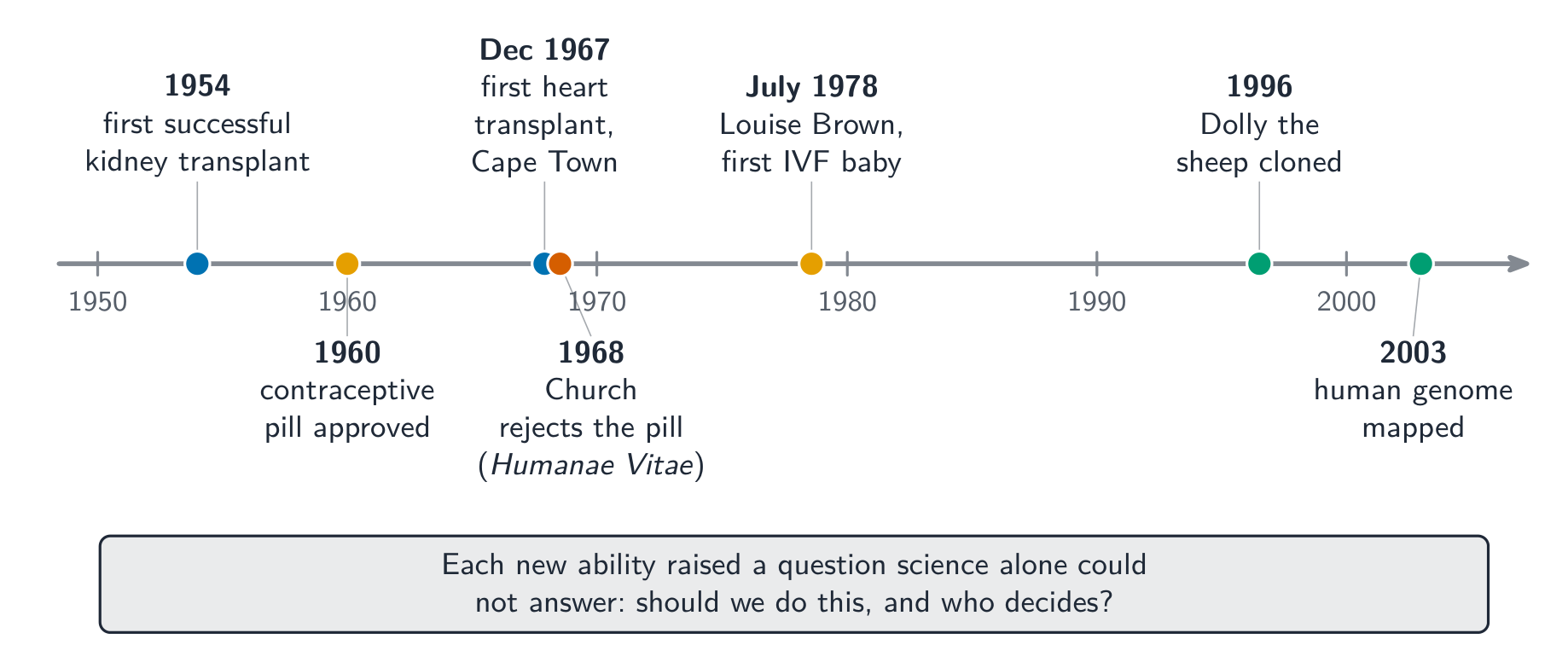
- On 3 December 1967, the surgeon Christiaan Barnard transplanted a heart into Louis Washkansky in Cape Town. He lived 18 days. Doctors now had to decide when a donor was truly dead — and in 1968 a Harvard committee proposed brain death 脑死亡 as a new definition.
- Twentieth-century medicine extended life but raised questions that science alone could not answer.
Why did heart transplants raise the question of brain death?
Dificuldade 1/5 · Moedas 100 + pequeno bônus na primeira conclusão hoje
The Harvard committee, 1968.
Life extended
- Penicillin, discovered by Alexander Fleming in 1928 and mass-produced in the 1940s, made many infections curable. Vaccines nearly wiped out polio in Europe.
- Life expectancy in Western Europe rose from about 50 years in 1900 to over 75 by 2000.
Life expectancy in Western Europe rose from about 50 in 1900 to about 75 in 2000. By how many years did it rise?
Dificuldade 2/5 · Moedas 140 + pequeno bônus na primeira conclusão hoje
75 − 50.
New questions
- The contraceptive pill (from 1960) gave women control over having children; the Catholic Church opposed it in 1968.
- In 1978, Louise Brown in England became the first baby born through IVF 体外受精 (in vitro fertilization).
The advance, the question, or why it stays open?
Sort each element of medicine's cultural influence.
Worked example: why the debate stays open
- The advance: life-support machines can keep a body alive after the brain has failed.
- The question: should doctors ever help a patient to die? The Netherlands legalized euthanasia 安乐死 in 2002, under strict conditions.
- Why it stays open: religious believers, doctors and campaigners disagree, and countries such as Germany reject it, partly because of the Nazis' murder of disabled people. Science can describe the options but not decide the moral question.
Why does the debate on euthanasia remain unsettled?
Dificuldade 1/5 · Moedas 100 + pequeno bônus na primeira conclusão hoje
Science cannot decide "should".
Genetics
- In 1953, Watson and Crick, using Rosalind Franklin's images, identified DNA's double-helix structure. In 1996 Dolly the sheep became the first cloned mammal, in Scotland.
- Cloning and genetic testing raised fears of "designer babies".
Match each advance to its date.
Dificuldade 2/5 · Moedas 140 + pequeno bônus na primeira conclusão hoje
Key dates.
Who decides?
- The study of these moral questions is called bioethics 生物伦理学. After the Nazi doctors' trial at Nuremberg (1946–47), consent became a central principle of medical research.
- European countries came to different laws on abortion, euthanasia and embryo research.
The Nazi doctors' trial helped make consent central to medical research.
Dificuldade 1/5 · Moedas 100 + pequeno bônus na primeira conclusão hoje
Nuremberg, 1946–47.
Medical advances did not settle moral questions. They created new ones. Show the disagreement between groups rather than presenting one answer as the result of science.
Medical science settled the moral questions it raised.
Dificuldade 1/5 · Moedas 100 + pequeno bônus na primeira conclusão hoje
It created new ones.
Penicillin, vaccines and new technology extended European lives. But transplants, contraception, IVF, life support and cloning raised moral questions about life and death. Religious, political and medical groups disagreed, and European countries passed different laws.
Explain why one twentieth-century medical advance raised moral questions that remain unsettled.
Causation.