Migration and Its Reception
Introduzido| English | Significado |
|---|---|
| guest worker | A foreign worker invited to work in a country for a time, such as Turks in West Germany after 1961. |
| multiculturalism/ˌmʌltɪˈkʌltʃərəlɪzəm/ | Recognition and support of different cultural traditions within a society. |
| refugee/ˈrefjuːdʒiː/ | A person forced to leave their country because of war or persecution. |
The Empire Windrush docks, 1948
- On 22 June 1948, the ship Empire Windrush arrived at Tilbury near London carrying about 800 passengers from the Caribbean, many of them former servicemen. As citizens of the British Empire, they had the right to live and work in Britain. They came to fill jobs in transport, hospitals and factories — and many met prejudice in housing and work.
- After 1945, millions of migrants came to Western Europe, and their reception changed with the economy and politics.
Why could the Windrush passengers settle in Britain?
Dificuldade 1/5 · Moedas 100 + pequeno bônus na primeira conclusão hoje
Empire citizenship.
Growth pulled workers in
- During the postwar boom, Western Europe needed workers. Britain and France drew people from their former colonies — the Caribbean, South Asia, Algeria.
- West Germany recruited guest workers 外籍劳工 from Italy, Spain, Greece, Yugoslavia and, from 1961, Turkey. By 1973, about 2.6 million foreign workers lived there.
About how many million foreign workers lived in West Germany by 1973?
Dificuldade 2/5 · Moedas 140 + pequeno bônus na primeira conclusão hoje
Guest workers.
The downturn changed the welcome
- After the 1973 oil shock, unemployment rose, and West Germany stopped recruiting.
- But many guest workers stayed and brought their families. Temporary workers became permanent residents.
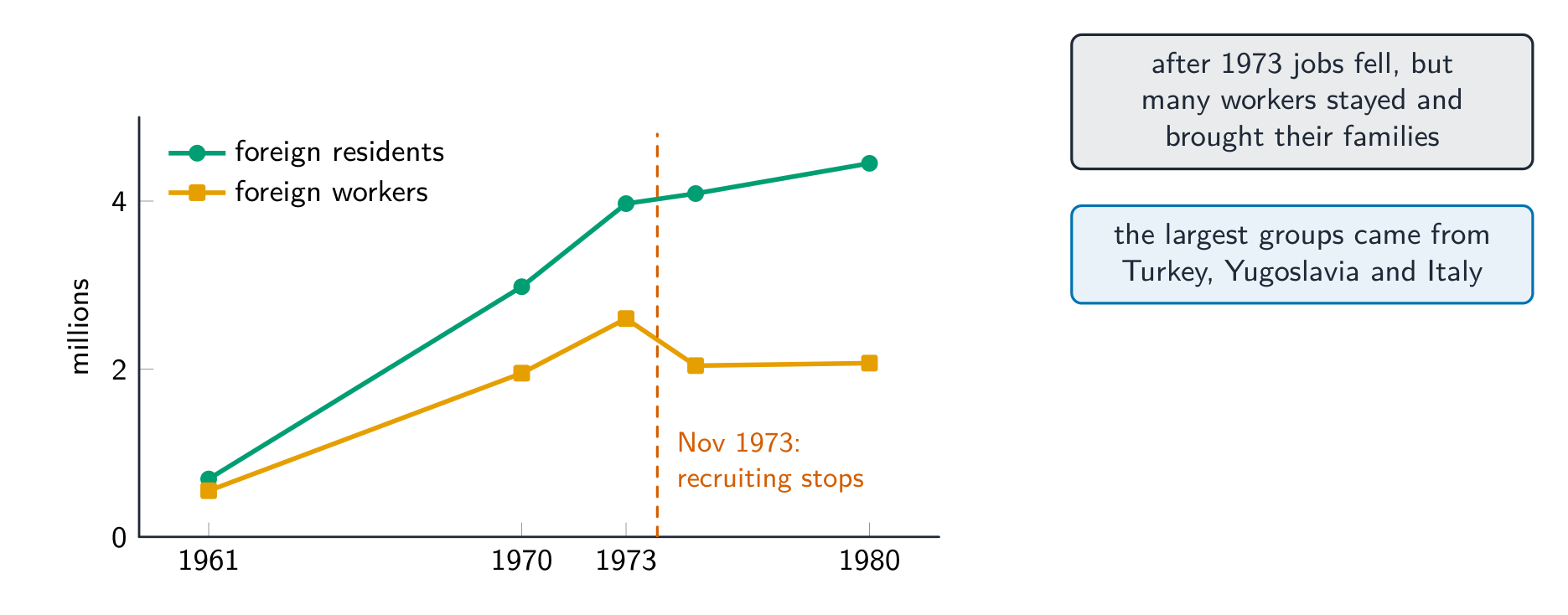
A cause, an effect, or the change in reception?
Sort each element of postwar migration.
What changed after the 1973 oil shock?
Dificuldade 1/5 · Moedas 100 + pequeno bônus na primeira conclusão hoje
Temporary became permanent.
Worked example: reception and response
- Hostility: anti-immigrant parties grew, such as France's National Front (founded 1972), which won about 15% in the 1995 presidential election.
- Laws: Britain restricted immigration from the Commonwealth from 1962.
- Integration: second-generation migrants became citizens, and debates about multiculturalism 多元文化主义 — whether different cultures should keep their own ways — grew.
Match each example to its response.
Dificuldade 2/5 · Moedas 140 + pequeno bônus na primeira conclusão hoje
Reception varied.
Religion in the debate
- Many migrants from Turkey, North Africa and South Asia were Muslims, and Islam became Europe's second-largest religion.
- France banned conspicuous religious symbols, including headscarves, in state schools in 2004.
Two kinds of movement
- Labour migrants came for work; refugees 难民 fled war and persecution, such as from the Yugoslav wars in the 1990s and from Syria after 2011.
- In 2015, about 1.3 million people applied for asylum in the EU.
Refugees and labour migrants moved for different reasons.
Dificuldade 1/5 · Moedas 100 + pequeno bônus na primeira conclusão hoje
Work versus persecution.
Migrants were not only "guests". Many became permanent residents and citizens and shaped European societies. Show both the hostility and the long-term settlement.
All guest workers left Europe when recruitment stopped.
Dificuldade 1/5 · Moedas 100 + pequeno bônus na primeira conclusão hoje
Many settled with their families.
Postwar growth pulled migrants from former colonies and southern Europe into Western Europe. After 1973, recruitment stopped but families settled. Their reception mixed hostility, restriction and integration, debates over religion and multiculturalism grew, and refugees added a second kind of movement.
Explain how and why the reception of migrants in Western Europe changed after 1945.
Change over time.