The European Union
Introduzido| English | Significado |
|---|---|
| sovereignty/ˈsɒvərɪnti/ | Supreme authority over a territory and its people. |
| European Union/ˌjʊərəˈpɪən ˈjuːnɪən/ | The political and economic union that grew from postwar European cooperation. |
| European Economic Community | The common market created by the Treaty of Rome in 1957, which became part of the European Union. |
| euro | The single currency shared by many EU countries, in use as notes and coins since 1 January 2002. |
"Materially impossible", 9 May 1950
- On 9 May 1950, French Foreign Minister Robert Schuman proposed that France and West Germany put their coal and steel industries under a single shared authority. Coal and steel were what armies needed. Pooling them, he said, would make war between the two countries "not merely unthinkable, but materially impossible". Five years after the war, old enemies began to share sovereignty.
- European integration began as a way to end national rivalries and grew into the European Union.
Why did Schuman propose pooling coal and steel?
Dificuldade 1/5 · Moedas 100 + pequeno bônus na primeira conclusão hoje
Materially impossible.
Rivalries set aside
- The European Coal and Steel Community (1951) joined France, West Germany, Italy, Belgium, the Netherlands and Luxembourg.
- The Treaty of Rome (1957) created the European Economic Community 欧洲经济共同体, a common market without tariffs between its members.
Sovereignty and membership
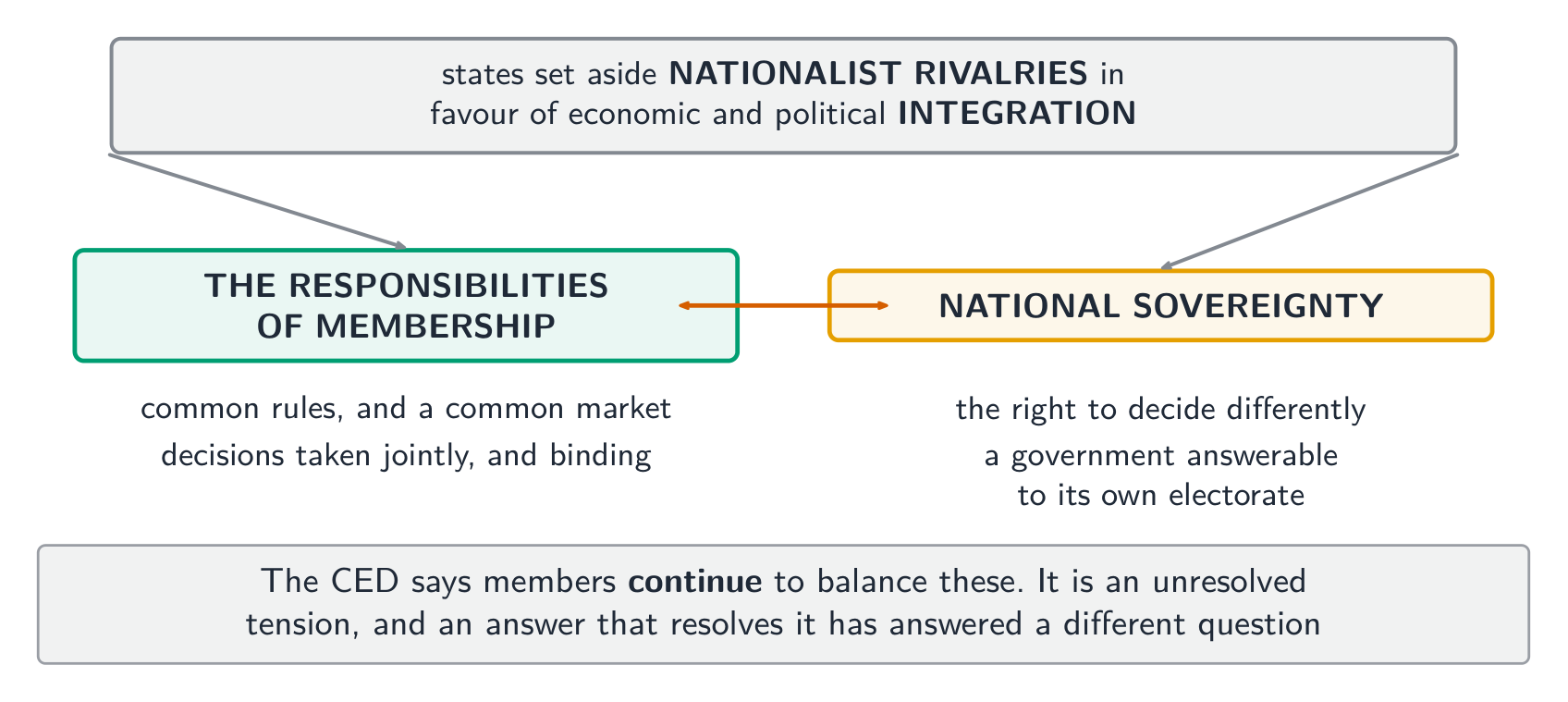
- Each member gave up some sovereignty 主权 — the right to make all its own decisions — in return for the benefits of a larger market and shared rules.
- Britain joined in 1973, after France's de Gaulle had twice blocked it.
Integration, the standing tension, or the comparison with Vienna?
Sort each element of the European Union.
Members of the EEC gave up some sovereignty in return for a larger market.
Dificuldade 1/5 · Moedas 100 + pequeno bônus na primeira conclusão hoje
Shared rules.
Worked example: from market to union
- Maastricht (1992): created the European Union 欧盟, with EU citizenship and plans for a single currency.
- The euro 欧元: coins and notes came into use on 1 January 2002 in 12 countries.
- Enlargement: in 2004, ten countries joined, eight of them former communist states — Poland, Hungary, the Czech Republic and others.
Put these steps in order.
Dificuldade 3/5 · Moedas 200 + pequeno bônus na primeira conclusão hoje
1951, 1957, 1992, 2002.
How many countries joined the EU in 2004?
Dificuldade 2/5 · Moedas 140 + pequeno bônus na primeira conclusão hoje
Eight were former communist states.
Identity
- Many people came to see themselves as both national and European; students studied abroad through the Erasmus programme from 1987.
- Others felt the EU threatened national identity and democracy.
Resistance
- In 2005, French and Dutch voters rejected a proposed EU constitution.
- In 2016, 52% of British voters chose to leave the EU; the United Kingdom left in 2020.
What percentage of British voters chose to leave the EU in 2016?
Dificuldade 2/5 · Moedas 140 + pequeno bônus na primeira conclusão hoje
The UK left in 2020.
The tension between integration and sovereignty has not been resolved. Do not describe the EU as a single state or as a simple trade agreement; it is something in between.
The tension between integration and national sovereignty has been fully resolved.
Dificuldade 1/5 · Moedas 100 + pequeno bônus na primeira conclusão hoje
It remains open.
Beginning with the Schuman Plan and the Coal and Steel Community, Western Europe pooled sovereignty to end rivalry. The EEC became the European Union, introduced the euro and expanded east in 2004. Integration created a European identity alongside national ones, but resistance, such as Brexit, showed the balance was unresolved.
Explain how and why European integration developed after 1950.
Change over time.