An Iron Curtain, and a Global Stage
Introduzido| English | Significado |
|---|---|
| iron curtain/ˈaɪən ˈkɜːtn/ | Churchill's phrase (1946) for the line dividing communist Eastern Europe from the West. |
| deterrence/dɪˈtɜːrəns/ | Preventing an attack by making clear that the attacker would suffer terrible damage in return. |
| containment/kənˈteɪnmənt/ | The Cold War policy of stopping the spread of Soviet communism beyond where it already ruled. |
A plane every three minutes, 1948
- In June 1948, the Soviet Union blocked all roads, railways and canals into West Berlin, a city of 2 million people deep inside the Soviet zone of Germany. The Americans and British answered with an airlift. At its peak, a plane landed every few minutes; in eleven months, they flew in about 2.3 million tonnes of food and coal. In May 1949, the Soviets lifted the blockade.
- After 1945, wartime cooperation turned into a Cold War between the United States and the Soviet Union — fought by every means except direct war.
About how many million tonnes of supplies did the Berlin Airlift deliver?
Dificuldade 2/5 · Moedas 140 + pequeno bônus na primeira conclusão hoje
In eleven months.
Cooperation, then division
- At Yalta and Potsdam (1945), the Allies agreed to divide Germany into four zones and to hold free elections in Eastern Europe. Stalin installed communist governments instead.
- In March 1946, Churchill said an iron curtain 铁幕 had descended across Europe.
Four kinds of Cold War activity
- Economic: the Marshall Plan (1948). Military: NATO (1949) and the Warsaw Pact (1955).
- Proxy wars: the superpowers backed opposing sides, as in Korea (1950–53). Propaganda and space: the Soviets launched Sputnik, the first satellite, in 1957.
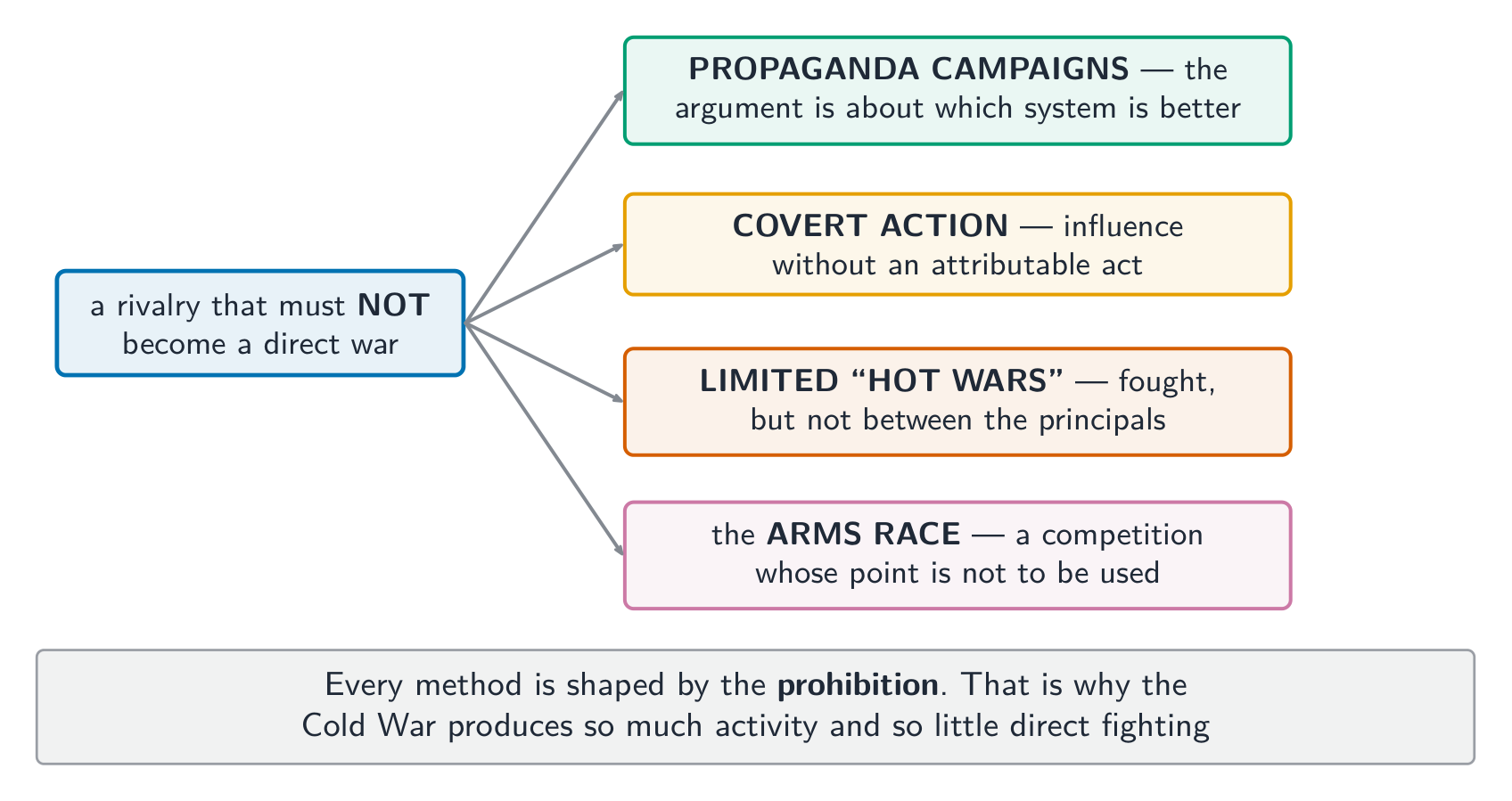
A cause, a method, or an effect?
Sort each element of the Cold War.
Match each example to its kind of Cold War activity.
Dificuldade 2/5 · Moedas 140 + pequeno bônus na primeira conclusão hoje
Four kinds.
Put these events in order.
Dificuldade 3/5 · Moedas 200 + pequeno bônus na primeira conclusão hoje
1946, 1948, 1955, 1962.
Worked example: the arms race
- Bombs: the US used the atomic bomb in 1945; the Soviets tested their own in 1949. By the 1960s, both had thousands of nuclear weapons.
- Danger: in the Cuban Missile Crisis (October 1962), Soviet missiles in Cuba brought the world close to nuclear war for 13 days.
- The logic: deterrence 威慑 — each side knew an attack would destroy both, so neither attacked directly.
What is deterrence?
Dificuldade 1/5 · Moedas 100 + pequeno bônus na primeira conclusão hoje
Mutual destruction.
Why the tensions ran deep
- The two sides had opposite systems: capitalism and elections against communism and one-party rule. Each believed the other wanted to spread its system worldwide.
- The US policy of containment 遏制政策 (the Truman Doctrine, 1947) aimed to stop communism spreading.
Containment aimed to stop communism from spreading.
Dificuldade 1/5 · Moedas 100 + pequeno bônus na primeira conclusão hoje
The Truman Doctrine, 1947.
A global stage
- The Cold War spread to Asia, Africa and Latin America, where the superpowers competed for influence among new states.
- Many states, such as India, chose non-alignment.
The Cold War was not "cold" everywhere. There was no direct war between the superpowers, but proxy wars in Korea, Vietnam and Afghanistan killed millions.
The Cold War caused no fighting anywhere.
Dificuldade 1/5 · Moedas 100 + pequeno bônus na primeira conclusão hoje
Proxy wars killed millions.
Wartime cooperation broke down as Stalin imposed communism in Eastern Europe and the US adopted containment. The Cold War was fought through aid, alliances, proxy wars, propaganda and an arms race of deterrence — never by direct war between the superpowers, but at great cost elsewhere.
Explain why wartime cooperation between the US and the Soviet Union turned into the Cold War.
Causation.