Identity Under Totalitarian Rule
Introduzido| English | Significado |
|---|---|
| antisemitism | Hostility to, prejudice against or hatred of Jews. |
| genocide/ˈdʒenəsaɪd/ | The intentional destruction, in whole or in part, of a national, ethnic, racial or religious group. |
| collaboration/kəˌlæbəˈreɪʃn/ | Working with an occupying enemy power, especially with Nazi Germany during the Second World War. |
| totalitarian/təʊˌtælɪˈteərɪən/ | Describes a system seeking comprehensive political control over public and private life and suppressing independent opposition. |
The Nuremberg Laws, 1935
- In September 1935, Nazi Germany passed the Nuremberg Laws. They stripped Jews of German citizenship and banned marriage between Jews and other Germans. A person was defined as Jewish not by their own beliefs but by the religion of their grandparents — so people who had converted to Christianity, or never practised any religion, became "Jews" by law.
- Under Nazi rule, identity defined by ancestry decided who would live and who would die.
How did the Nuremberg Laws define who was Jewish?
Dificuldade 1/5 · Moedas 100 + pequeno bônus na primeira conclusão hoje
Ancestry, not belief.
Racism and antisemitism
- Nazi ideology held that Germans were a superior "Aryan" race and that Jews were a racial enemy. Antisemitism 反犹主义 — hatred of Jews — became state policy.
- After the Kristallnacht attacks of November 1938, about 30 000 Jewish men were sent to concentration camps.
From persecution to genocide
- After the invasion of the Soviet Union in 1941, killing squads shot over a million Jews. At the Wannsee Conference (January 1942), officials planned the "Final Solution": deporting Jews from all over Europe to death camps.
- About 6 million Jews were murdered in this genocide 种族灭绝, about 1.1 million of them at Auschwitz-Birkenau.
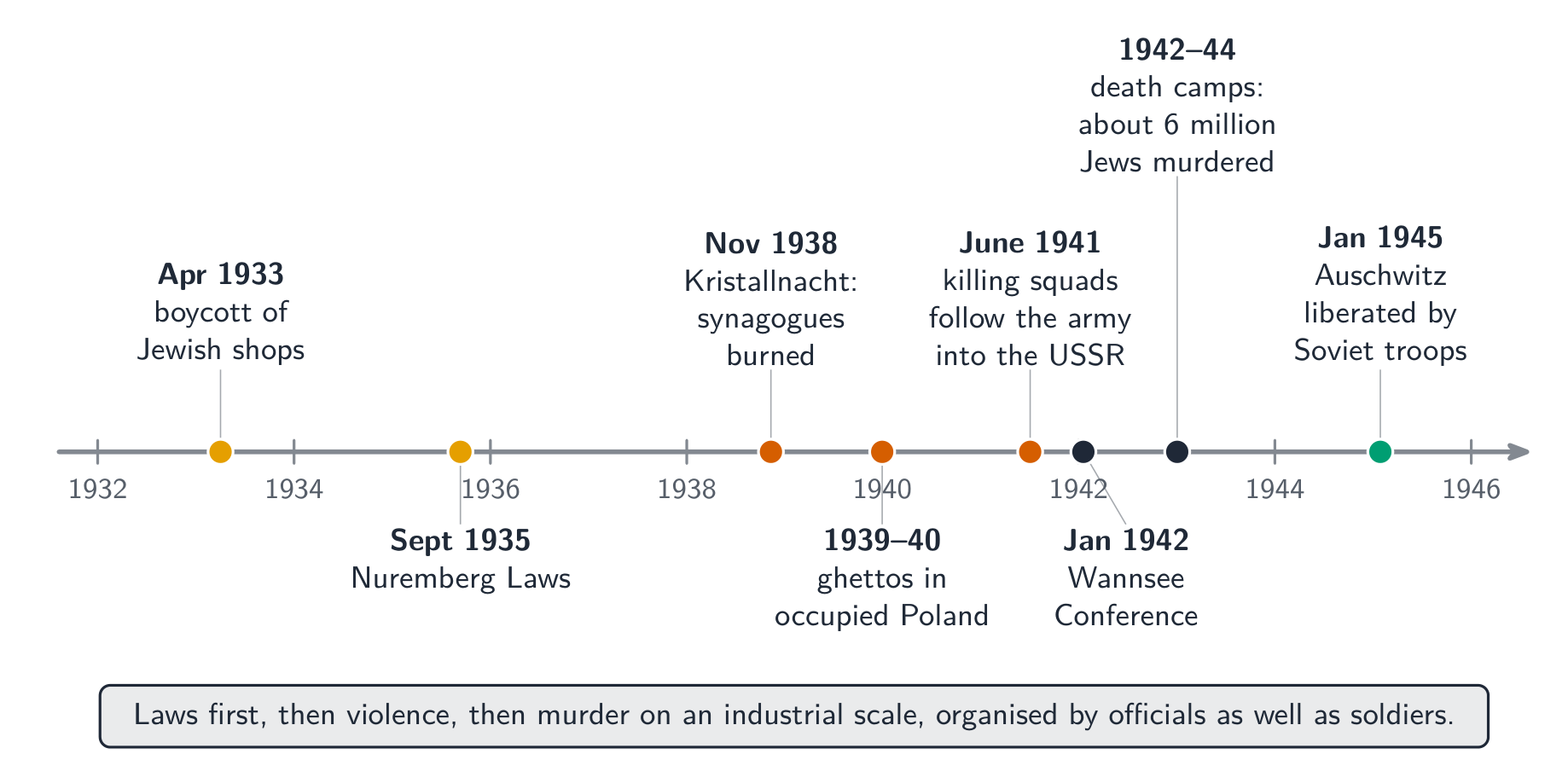
Put these events in order.
Dificuldade 3/5 · Moedas 200 + pequeno bônus na primeira conclusão hoje
1935, 1938, 1941, 1942.
Worked example: who carried it out?
- Nazi Germany: planned the genocide and ran the camps.
- Some Axis allies and collaborationist governments: France's Vichy government helped deport about 76 000 Jews, including about 13 000 arrested in Paris in July 1942; Croatia's Ustaše ran its own camps.
- But not all: Denmark's people helped about 7000 Jews escape to Sweden in 1943, and Bulgaria refused to deport its own Jews. Collaboration 通敌合作 was a choice, and some refused it.
The motive, the actors, or the consequences?
Sort each element of the CED's account.
Match each government or people to its action.
Dificuldade 2/5 · Moedas 140 + pequeno bônus na primeira conclusão hoje
Collaboration was a choice.
Other victims
- Between 200 000 and 500 000 Roma were murdered, along with disabled people, Soviet prisoners of war and political opponents.
- The Nazi state was totalitarian 极权主义: it tried to control every part of life and every person's identity.
Which groups were also murdered by the Nazi regime?
Dificuldade 2/5 · Moedas 140 + pequeno bônus na primeira conclusão hoje
Many victim groups.
Europe's population changed
- Poland lost about 90% of its 3.3 million Jews; centuries-old Jewish communities across eastern Europe disappeared.
- After the war, about 12 million Germans were expelled from eastern Europe, and borders and populations were redrawn.
Poland lost about 90% of its Jewish population in the Holocaust.
Dificuldade 1/5 · Moedas 100 + pequeno bônus na primeira conclusão hoje
Of about 3.3 million.
The Holocaust was not carried out by Germany alone. Some Axis allies and collaborationist governments, such as Vichy France, took part, while others refused. Be precise about which governments and people acted.
Every European government cooperated equally in the Holocaust.
Dificuldade 1/5 · Moedas 100 + pequeno bônus na primeira conclusão hoje
Some collaborated, some refused.
Nazi Germany defined identity by ancestry, turned antisemitism into law and then into genocide, murdering about 6 million Jews and many others. Some allies and collaborators helped; some refused. The war and the Holocaust destroyed Jewish life in eastern Europe and reshaped Europe's population.
Explain how Nazi ideas about identity led to the Holocaust.
Causation.