The Russian Revolution
Introduzido| English | Significado |
|---|---|
| Bolsheviks | Lenin's revolutionary Marxist party, which took power in Russia in November 1917. |
| Provisional Government | The temporary government that ruled Russia from the tsar's abdication in March 1917 until the Bolsheviks seized power. |
| War Communism | The Bolshevik policy of 1918–21 of seizing grain from peasants and nationalizing industry during the civil war. |
| New Economic Policy | Lenin's policy from 1921 allowing peasants and small traders to sell goods privately for profit. |
Bread queues in Petrograd, February 1917
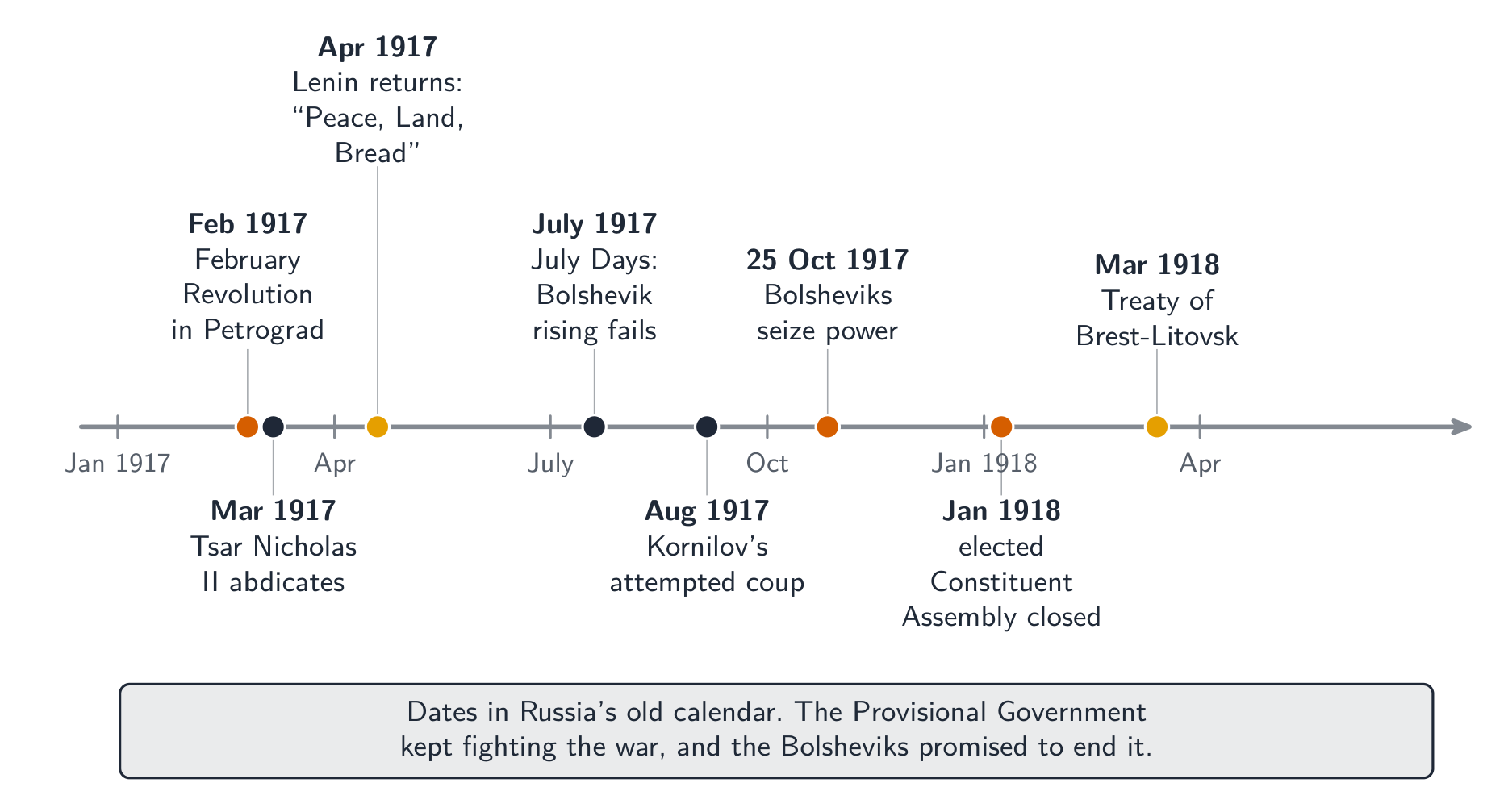
- On 23 February 1917 (8 March in the Western calendar), women in Petrograd queuing for bread went on strike on International Women's Day. Within days, about 200 000 workers had joined them, and soldiers sent to shoot the crowds joined the protest instead. On 2 March, Tsar Nicholas II abdicated. Three hundred years of Romanov rule ended in a week.
- In 1917, Russia had two revolutions, and the second created the world's first communist state.
How did the February Revolution begin?
Dificuldade 1/5 · Moedas 100 + pequeno bônus na primeira conclusão hoje
International Women's Day, 1917.
Causes from two directions
- From below: hunger, war losses — about 2 million Russian soldiers died — and anger at the tsar's government.
- From above: Nicholas took personal command of the army in 1915, so defeats were blamed on him, while the court was discredited by the influence of Rasputin.
Which were causes of the February Revolution?
Dificuldade 2/5 · Moedas 140 + pequeno bônus na primeira conclusão hoje
Brest-Litovsk came later.
The Bolsheviks take power
- The Provisional Government 临时政府 that replaced the tsar kept fighting the war. Lenin promised "Peace, Land, Bread".
- On 25 October 1917, the Bolsheviks 布尔什维克 seized power in Petrograd with few deaths.
Long-term cause, short-term cause, or effect?
Sort each element of the Russian Revolution.
The Provisional Government took Russia out of the war.
Dificuldade 1/5 · Moedas 100 + pequeno bônus na primeira conclusão hoje
It kept fighting.
Worked example: effects at home and abroad
- War: the Treaty of Brest-Litovsk (March 1918) took Russia out of the war but gave up about a third of its population.
- Civil war: Reds fought Whites in 1918–21; perhaps 7–12 million died from fighting, famine and disease. Lenin's War Communism 战时共产主义 seized grain and nationalized industry.
- Abroad: the Communist International (1919) supported communist parties worldwide, and fear of communism spread across Europe.
Put these events in order.
Dificuldade 3/5 · Moedas 200 + pequeno bônus na primeira conclusão hoje
March 1917, October 1917, 1918, 1921.
A state built on a theory
- The Soviet state claimed its right to rule from Marxist theory: the party acted for the working class.
- Opponents could not appeal to elections or courts; disagreement with the party was treated as betrayal.
Retreat and the New Economic Policy
- After the Kronstadt sailors' revolt (1921), Lenin allowed small private trade under the New Economic Policy 新经济政策.
- Lenin died in 1924, and Stalin won the struggle to succeed him.
Match each policy to its description.
Dificuldade 2/5 · Moedas 140 + pequeno bônus na primeira conclusão hoje
Bolshevik policies.
There were two revolutions in 1917. The February Revolution ended the monarchy; the October Revolution brought the Bolsheviks to power. Do not merge them.
The February and October Revolutions were the same event.
Dificuldade 1/5 · Moedas 100 + pequeno bônus na primeira conclusão hoje
Two revolutions.
War, hunger and a discredited tsar caused the February Revolution of 1917. The Provisional Government kept fighting, and the Bolsheviks seized power in October. They left the war, won a brutal civil war and built a state based on Marxist doctrine, which inspired and frightened the world.
Explain why the Bolsheviks were able to seize power in October 1917.
Causation.