A Settlement That Satisfied Few
Introduzido| English | Significado |
|---|---|
| self-determination/self dɪˌtɜːmɪˈneɪʃn/ | The right of a people or nation to choose its own government and state. |
| League of Nations/liːɡ ɒv ˈneɪʃnz/ | The interwar organisation meant to keep peace through collective security. |
| reparations | Payments demanded from a defeated country for damage caused in a war. |
| mandate | A former German colony or Ottoman territory governed by Britain or France on behalf of the League of Nations after 1919. |
Signed in the Hall of Mirrors, 28 June 1919
- On 28 June 1919 — five years to the day after the Sarajevo assassination — two German ministers signed the Treaty of Versailles in the Hall of Mirrors. It was the same room where the German Empire had been proclaimed in 1871. The Germans had not been allowed to negotiate; they called it a Diktat, a dictated peace.
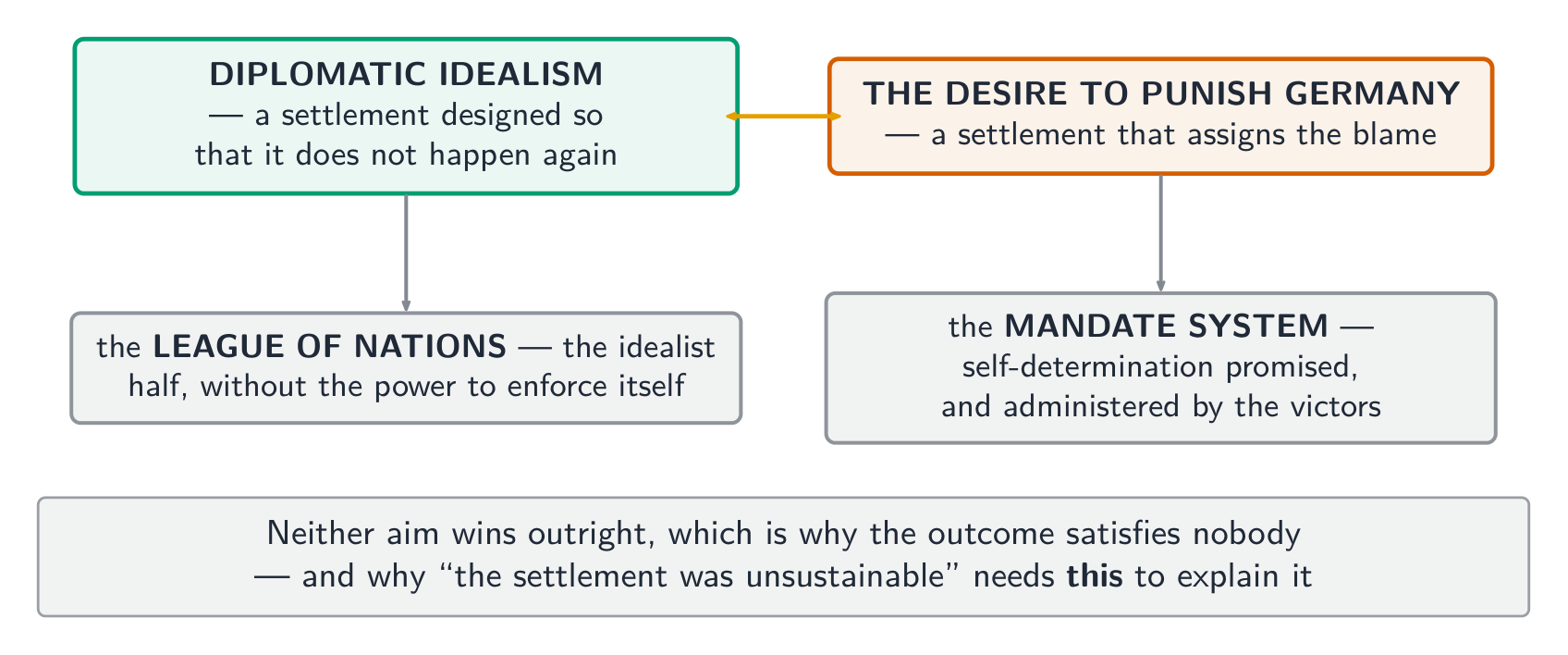
- The Paris Peace Conference tried to punish Germany and build a lasting peace — two aims that could not both be met.
Why was the Hall of Mirrors symbolic?
Dificuldade 1/5 · Moedas 100 + pequeno bônus na primeira conclusão hoje
A deliberate humiliation.
Two goals in conflict
- France's Clemenceau wanted Germany weakened so it could never attack again. US President Wilson wanted a fair peace based on self-determination 民族自决 and a League of Nations 国际联盟.
- Britain's Lloyd George stood between them.
Match each leader to his main aim.
Dificuldade 2/5 · Moedas 140 + pequeno bônus na primeira conclusão hoje
Conflicting goals.
The terms for Germany
- Germany lost about 13% of its territory and all its colonies, its army was limited to 100 000 men, and the Rhineland was demilitarized.
- Article 231, the "war guilt" clause, made Germany accept responsibility, and reparations 赔款 were set in 1921 at 132 billion gold marks.
A goal, an outcome, or a later consequence?
Sort each element of the peace settlement.
To how many men was the German army limited?
Dificuldade 2/5 · Moedas 140 + pequeno bônus na primeira conclusão hoje
A small army.
Worked example: empire redistributed
- New states: Poland, Czechoslovakia and Yugoslavia were created from the old empires in the name of self-determination — but each contained large minorities.
- Mandates: Germany's colonies and the Ottoman Empire's Arab lands became mandates 委任统治地 run by Britain and France under the League. Iraq, Syria and Palestine were among them.
- Result: Arabs who had fought the Ottomans, hoping for independence, found themselves under new European rule.
What was a mandate?
Dificuldade 1/5 · Moedas 100 + pequeno bônus na primeira conclusão hoje
Iraq, Syria, Palestine.
Why it failed to settle Europe
- Germany resented the treaty; Italy and Japan felt they had gained too little. The US Senate refused to join the League.
- The treaty was too harsh to accept but not harsh enough to stop Germany recovering.
The United States joined the League of Nations.
Dificuldade 1/5 · Moedas 100 + pequeno bônus na primeira conclusão hoje
The Senate refused.
Compared with Vienna
- In 1815 France was included and treated mildly, and the settlement lasted nearly a century.
- In 1919 Germany and Soviet Russia were excluded, and peace lasted only twenty years.
Do not say the treaty alone caused the Second World War. It created resentment, but the Depression, the rise of Hitler and the failure to enforce it also mattered.
The Treaty of Versailles alone caused the Second World War.
Dificuldade 1/5 · Moedas 100 + pequeno bônus na primeira conclusão hoje
Other causes mattered.
The Paris settlement tried both to punish Germany and to build a peace of self-determination and a League of Nations. Germany lost land, colonies and armed forces and owed reparations; new states and mandates redistributed empire. Resentment and exclusion left Europe unsettled.
Compare the Paris settlement of 1919 with the Congress of Vienna.
Comparison.