Three New Threads
Introduzido| English | Significado |
|---|---|
| Industrial Revolution/ɪnˈdʌstrɪəl ˌrevəˈluːʃn/ | The historical shift toward mechanised production, factory organisation and new energy sources that transformed work, settlement and economic activity. |
| Zollverein | The customs union of German states, formed in 1834 under Prussian leadership, that removed tariffs between them. |
| urbanization/ˌɜːbənaɪˈzeɪʃn/ | The growth of towns and cities as people move from the countryside. |
The Crystal Palace, 1851
- In 1851 London's Great Exhibition displayed steam engines, power looms and machine tools in a giant hall of iron and glass, the Crystal Palace. About 6 million visitors came in five months. Britain was showing the world that it was the first industrial nation.
- Between 1815 and 1914, industry spread across Europe and changed how people lived and thought.
From Britain to the continent
- The Industrial Revolution 工业革命 began in Britain with coal, steam power and textile machines, then railways: the Liverpool–Manchester line opened in 1830.
- Belgium, northern France and the German states followed; by 1900 Germany's steel output had overtaken Britain's.
Where did the Industrial Revolution begin?
Dificuldade 1/5 · Moedas 100 + pequeno bônus na primeira conclusão hoje
Coal, steam and textiles.
States promoted industry
- Governments built or funded railways — Belgium's network was state-built from 1834 — and set tariffs to protect new industries.
- The Zollverein 德意志关税同盟 (1834), a customs union of German states led by Prussia, created a large free-trade market inside Germany.
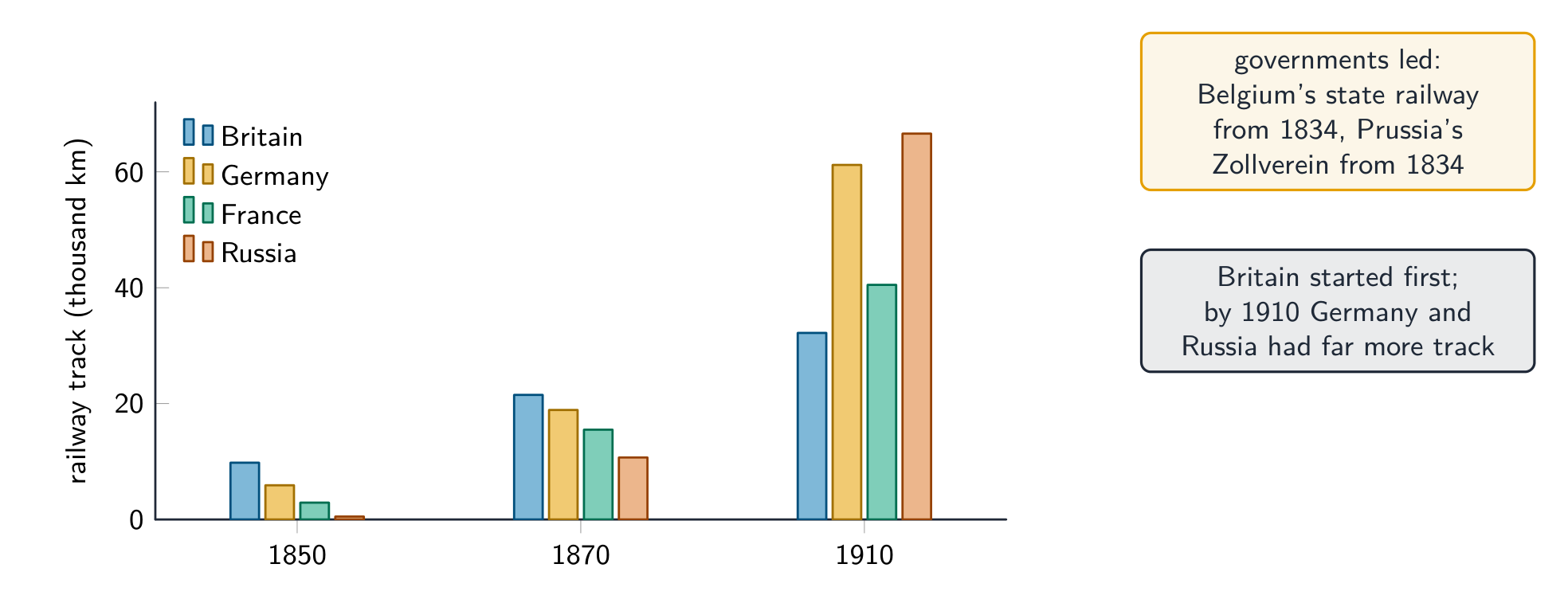
What was the Zollverein?
Dificuldade 1/5 · Moedas 100 + pequeno bônus na primeira conclusão hoje
A free-trade area inside Germany.
How did governments promote industry?
Dificuldade 2/5 · Moedas 140 + pequeno bônus na primeira conclusão hoje
The state played a role.
Worked example: a contextualization paragraph
Prompt: Explain the context for the growth of socialism in nineteenth-century Europe.
- Industry: factories, mines and railways spread from Britain to Belgium, France and Germany, creating a large new working class.
- Cities: rapid urbanization 城市化 — Manchester grew from about 75 000 people in 1801 to over 300 000 by 1851 — brought crowded housing, disease and long hours.
- Ideas: liberals defended free markets, so critics such as Marx and Engels (Communist Manifesto, 1848) argued that workers needed a different system. These conditions explain socialism's appeal.
Which of unit 6's threads?
Sort each statement into its thread.
Manchester grew from about 75 000 people in 1801 to about 300 000 in 1851. By how many times did it grow?
Dificuldade 2/5 · Moedas 140 + pequeno bônus na primeira conclusão hoje
300 000 ÷ 75 000.
Uneven experience
- Eastern and southern Europe remained mostly rural: Russia freed its serfs only in 1861, and much of Spain, Italy and the Balkans industrialized slowly.
- Within industrial countries, the middle class grew richer while many workers lived in poverty.
Russia freed its serfs in 1861 and stayed mostly rural for decades.
Dificuldade 1/5 · Moedas 100 + pequeno bônus na primeira conclusão hoje
Uneven industrialization.
Responses
- Workers formed unions and, in Britain, the Chartist movement (1838–48) demanded votes for all men.
- Governments responded over time with factory laws, public health reforms and, in Germany, social insurance.
Industrialization did not happen everywhere at once. It began in Britain and spread unevenly; much of eastern Europe stayed agricultural until the twentieth century. Name the region and the decade.
All of Europe industrialized at the same time and pace.
Dificuldade 1/5 · Moedas 100 + pequeno bônus na primeira conclusão hoje
It spread unevenly.
Industry spread from Britain to Belgium, France and Germany, often with state help through railways and the Zollverein. It created fast-growing cities and a new working class, while much of eastern and southern Europe stayed rural. Workers, thinkers and governments responded in new ways.
Explain how industrialization spread from Britain to continental Europe in the nineteenth century.
Change over time.